

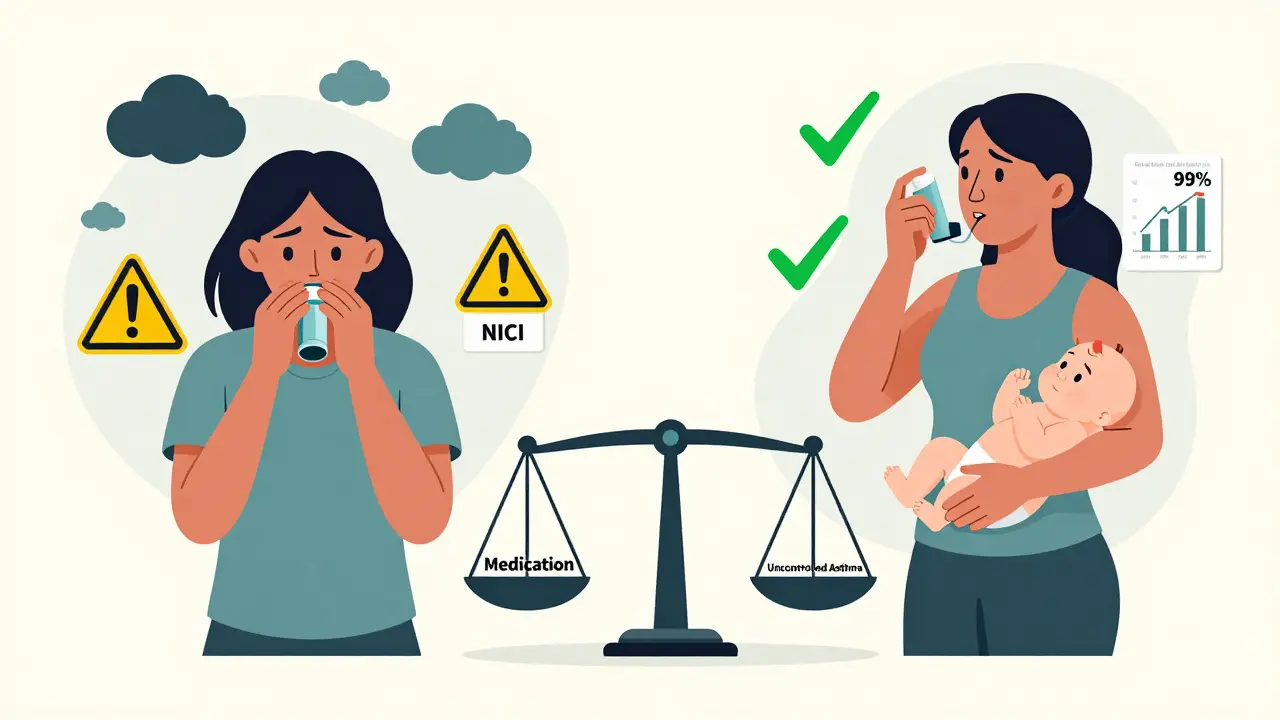
When you’re pregnant or breastfeeding and have asthma, the last thing you want is to choose between breathing well and keeping your baby safe. But that’s exactly the fear many women face. Asthma medication during pregnancy and breastfeeding isn’t about risk-it’s about balance. And the science is clear: not treating your asthma is far more dangerous than using the right medications.
Why Uncontrolled Asthma Is Riskier Than Medication
Many women stop their asthma meds out of fear. But here’s the truth: if your asthma isn’t under control, your baby doesn’t get enough oxygen. That’s not theoretical-it’s measurable. Studies show that uncontrolled asthma during pregnancy increases the chance of preeclampsia, preterm birth, and low birth weight by up to 40%. In fact, babies born to mothers with poorly managed asthma are twice as likely to need NICU care.
One National Jewish Health study followed 327 pregnant women with asthma who stuck to their treatment plan. Nearly 99% delivered at full term with normal birth weights. Compare that to the group who stopped or cut back on meds-only 76% had babies with healthy weights. The difference isn’t subtle. It’s life-changing.
Which Asthma Medications Are Safe?
Not all asthma drugs are created equal. The safest options are inhaled, not pills. Why? Because inhaled medications go straight to your lungs. Less than 30% of the dose even enters your bloodstream. That means almost nothing reaches your baby.
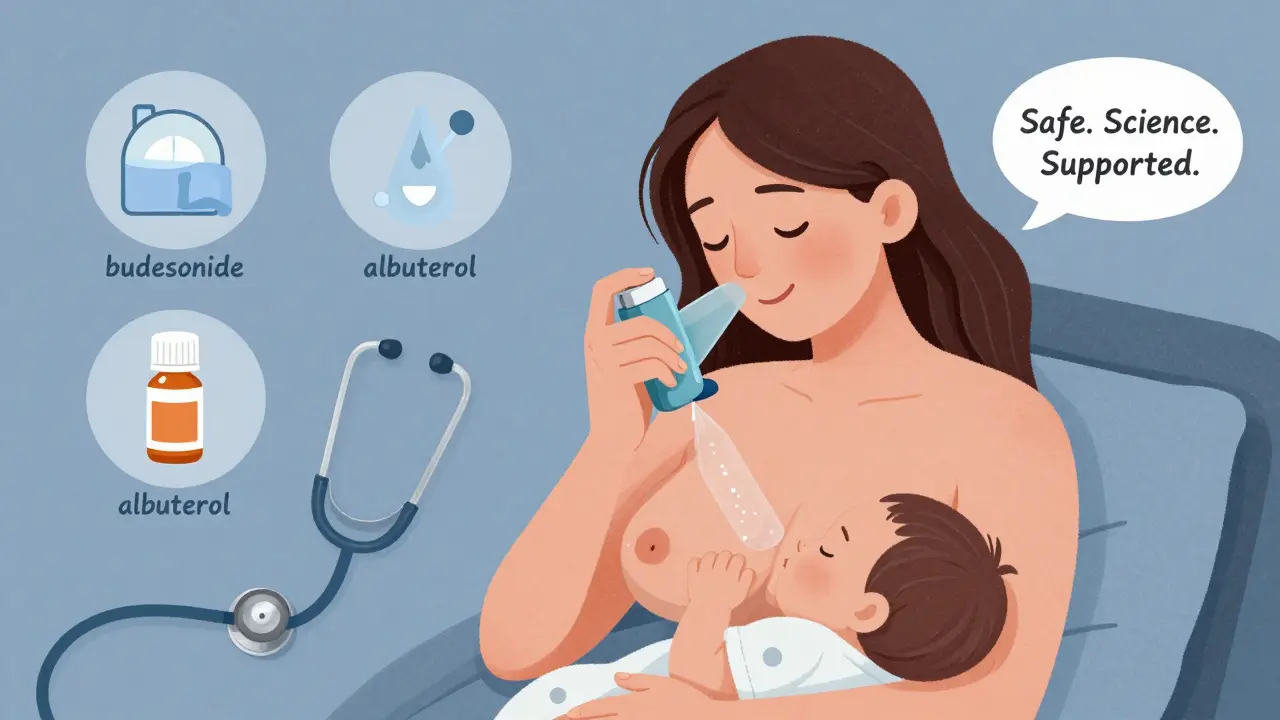
Inhaled corticosteroids (ICS) like budesonide (Pulmicort) are the gold standard. Over 10,000 pregnancy outcomes have been tracked, and no increased risk of birth defects has been found. Budesonide is the most studied and recommended by the American College of Obstetricians and Gynecologists. Other ICS like fluticasone and mometasone are also considered safe, though they have slightly less data.
Short-acting beta agonists (SABAs) like albuterol (Ventolin, ProAir) are your rescue inhalers. They’re safe during pregnancy and breastfeeding. A single puff delivers 90-180 mcg-far below the dose that could cause concern. You can use them whenever you need them, even right before feeding.
Leukotriene modifiers like montelukast (Singulair) are taken as a daily pill. While not first-line, they’re still considered low-risk. Studies show only tiny amounts pass into breast milk-less than what’s given to infants over six months old.
What About Oral Medications?
Oral corticosteroids like prednisone or prednisolone should be avoided if possible. They’re stronger and cross the placenta more easily. But if you have a severe flare-up, they’re still safer than letting your asthma spiral. The rule? Use the lowest dose for the shortest time. For breastfeeding, a single 40mg daily dose for five days won’t affect your baby. Higher doses? Wait 4 hours after taking it before nursing, or pump and discard the milk from that dose.
Theophylline is another oral option, but it’s rarely used now. It needs blood tests to make sure levels stay safe. Most doctors won’t start it during pregnancy unless absolutely necessary.
What About Newer Biologics Like Xolair or Nucala?
This is where things get fuzzy. Drugs like omalizumab (Xolair) and mepolizumab (Nucala) are amazing for severe asthma-but we don’t have enough data on their use during pregnancy or breastfeeding. The FDA lists them as Category B, meaning animal studies showed no harm, but human data is limited. If you’re already on one and get pregnant, don’t stop. Talk to your doctor about continuing. If you’re thinking of starting one while pregnant or breastfeeding? Wait until after delivery if possible.
Is Breastfeeding Safe with Asthma Meds?
Yes. Absolutely. The Breastfeeding Network in the UK puts it simply: "Inhalers do not produce levels of drug in the blood system let alone in milk so are safe to use as normal."
Even medications like prednisolone-when taken orally-transfer less than 1% of the dose into breast milk. The amount your baby gets is tiny, far below the dose that would ever cause side effects. No need to pump and dump. No need to time feeds. Use your inhaler right after feeding if it helps you feel better, but it’s not required.
One mom in Auckland shared her story: she used her inhaler during every feeding for months. Her daughter is now two, healthy, and never had a single reaction. That’s not luck. That’s science.
What You Should Do Before and During Pregnancy
You don’t wait until you’re pregnant to manage asthma. Start early.
- See your asthma specialist before conception if you can. Get your asthma under tight control.
- Build a personalized asthma action plan with your doctor. Include your OB/GYN and pulmonologist.
- Keep track of your peak flow readings. Lung capacity drops 5-10% in late pregnancy-that’s normal. Don’t confuse it with an asthma flare.
- Have check-ups every 4-6 weeks during pregnancy. That’s more often than the usual yearly visit.
- Keep your rescue inhaler with you at all times. Even if you feel fine.
And here’s something no one tells you: shortness of breath in the third trimester? That’s normal. Your uterus pushes up on your diaphragm. It doesn’t mean your asthma is worsening. Only if you’re wheezing, coughing, or using your inhaler more than twice a week should you call your doctor.
What to Avoid
Don’t stop your meds because of fear. Don’t switch to "natural" remedies without talking to your doctor. Don’t assume that because a medication is "old," it’s unsafe. Budesonide has been used by millions of pregnant women since the 1990s. It’s one of the most studied drugs in pregnancy.
And don’t believe the myth that "if it’s a pill, it’s dangerous." The real danger is in the untreated asthma-not the pill. But yes, inhaled is always better than oral.
Real Numbers, Real Outcomes
Here’s what the data says:
- 8% of pregnant women have asthma.
- 20-25% of them stop or reduce their meds due to safety fears.
- Those who stop are 37% more likely to end up in the ER.
- Women who stick to treatment reduce their risk of preterm birth by 30-40%.
- 95% of obstetricians now recommend continuing asthma meds during pregnancy.
The American Lung Association updated its guidelines in October 2024. The message hasn’t changed: "Taking asthma medication is safer than having uncontrolled asthma."
What’s Coming Next
The NIH launched the Pregnancy Asthma Medication Safety Registry in 2024. It’s tracking 5,000 pregnancies through 2027. That means better data on newer drugs will be available soon. By 2030, adherence rates among pregnant asthmatics are expected to hit 95%-up from 75% today.
For now, the message is simple: if you have asthma and are pregnant or breastfeeding, keep taking your inhaler. Your baby needs you to breathe. And your medicine helps you do that.
Are asthma inhalers safe during pregnancy?
Yes. Inhaled asthma medications like budesonide and albuterol are considered safe during pregnancy. They work directly in the lungs, with very little entering the bloodstream. Over 10,000 pregnancy outcomes have been studied, with no increased risk of birth defects. Using your inhaler as prescribed reduces the risk of complications like preterm birth and low birth weight.
Can I use my inhaler while breastfeeding?
Absolutely. Asthma inhalers are safe during breastfeeding. The amount of medication that enters your bloodstream-and then your breast milk-is extremely low, often less than 1%. You don’t need to time your doses around feedings or pump and dump. The Breastfeeding Network and American Academy of Family Physicians both confirm that inhalers pose no risk to the infant.
What if I’m on a biologic like Xolair and get pregnant?
Don’t stop it without talking to your doctor. While there’s limited human data on biologics like omalizumab during pregnancy, stopping your treatment could lead to a severe asthma flare, which is more dangerous than the medication. If you’re already on one, continue under medical supervision. If you’re planning pregnancy, discuss alternatives with your specialist before conception.
Is it safe to take oral steroids like prednisone while pregnant?
Oral steroids like prednisone are not first-choice medications during pregnancy, but they’re still safer than uncontrolled asthma. If you need them for a flare-up, use the lowest effective dose for the shortest time. For breastfeeding, a single 40mg daily dose for five days is considered safe. Higher doses may require waiting 4 hours after taking the pill before nursing, or pumping and discarding the milk from that dose.
Why do I feel short of breath in late pregnancy-is it my asthma?
Feeling short of breath in the third trimester is normal for most pregnant women, even those without asthma. Your growing uterus pushes up on your lungs, reducing capacity by 5-10%. This doesn’t mean your asthma is getting worse. If you’re wheezing, coughing, or needing your inhaler more than twice a week, then it’s time to see your doctor. Otherwise, it’s just pregnancy.
Joe Grushkin
February 16, 2026 AT 03:13Let me get this straight - we’re now treating asthma like it’s a yoga retreat? You can’t just ‘breathe through it’ while your fetus is slowly suffocating. The science isn’t even up for debate. If you’re skipping your inhaler because some Reddit guru said ‘natural remedies’ work, you’re not being holistic - you’re being reckless. I’ve seen ER reports. I’ve read the neonatal logs. This isn’t fearmongering. It’s forensic evidence.
Daniel Dover
February 16, 2026 AT 03:22Inhaled corticosteroids are safe. Budesonide is the gold standard. No need to overthink it.
Chiruvella Pardha Krishna
February 17, 2026 AT 21:32There is a metaphysical truth here, beyond the data: the body knows what it needs. When a woman’s lungs contract under the weight of fear, they do not heal - they rebel. Medication is not a crutch, but a bridge. The child does not inherit your anxiety - they inherit your breath. And if your breath is fractured, so too is their beginning. The pills are not the enemy. The silence between inhaler puffs - that is the true poison.
Virginia Kimball
February 19, 2026 AT 05:36Y’all need to stop acting like asthma meds are some scary alien drug. My sister used albuterol and Pulmicort through BOTH pregnancies, and her kids are now 5 and 3 - running around like tiny tornadoes with zero issues. She didn’t pump and dump, didn’t time feedings, didn’t panic. She just kept breathing. And guess what? So did they. Stop overcomplicating this. Your baby doesn’t need a PhD in pharmacology - they just need you to not pass out on the couch.
Sarah Barrett
February 19, 2026 AT 22:16The data presented here is both robust and reassuring. It is imperative that clinical guidelines be communicated with clarity, particularly when public perception is influenced by misinformation. The distinction between inhaled and oral corticosteroids is critical, and the emphasis on early intervention before conception is a prudent recommendation. The anecdotal evidence from the Auckland mother further reinforces the empirical findings.
Erica Banatao Darilag
February 20, 2026 AT 18:45i just had my 2nd baby and used my inhaler like normal and my kid is fine?? like i didnt even think about it? i mean i had asthma since i was 7 and my mom was like ‘dont stop’ so i didnt? and now my daughter is 18 months and she’s climbing everything and i’m like… what was i so scared of??
Charlotte Dacre
February 22, 2026 AT 01:18Oh wow, so if I don’t take my inhaler, my baby becomes a science project? And if I do, I’m a responsible adult? I guess the real risk here is people who think they’re saving their child by ignoring 10,000 data points and listening to a TikTok influencer who says ‘coconut oil fixes everything.’
Esha Pathak
February 23, 2026 AT 08:08When the body breathes, it sings. When the mind fears, it silences that song. The inhaler is not a weapon - it is a lullaby. I have watched my sister take her budesonide after every night feed, her baby sleeping on her chest, both of them rising and falling together - one with lungs, one with trust. No study can capture that. But I see it. And it is enough.