

After cataract surgery, many people notice something unexpected: small dark spots, strings, or cobweb-like shapes drifting across their vision. At first, it can feel alarming - like something went wrong. But here’s the truth: floaters after cataract surgery are incredibly common, and in most cases, they’re harmless. The real issue isn’t the floaters themselves - it’s not knowing when to ignore them and when to call your eye doctor.
Why Do Floaters Show Up After Cataract Surgery?
You had cataract surgery because your natural lens had clouded up, making your vision blurry, dull, or yellowish. The surgeon replaced it with a clear artificial lens - an intraocular lens (IOL). Suddenly, your vision is sharper, colors are brighter, and light doesn’t scatter like it used to. But now, you’re seeing things you never noticed before. That’s because the cataract was hiding them.
Floaters are tiny clumps of collagen fibers in the vitreous gel - the clear, jelly-like substance that fills the space between your lens and retina. Before surgery, the cloudy cataract lens blocked or scattered light enough to mask these shadows. After surgery, with a clear lens in place, that light passes straight through, and suddenly, the floaters cast sharp, noticeable shadows on your retina. It’s not new debris; it’s new visibility.
Studies show that about 70% of cataract surgery patients notice floaters in the first few days or weeks. The American Society of Cataract and Refractive Surgery confirms this is a normal part of the healing process. Most patients don’t realize they had floaters before - they were just too faint to see.
What Do Normal Floaters Look Like?
Normal post-surgery floaters have clear patterns:
- They appear as gray or black dots, specks, or wispy threads
- They drift when you move your eyes - but don’t follow instantly, like a slow-moving cloud
- They’re most noticeable against bright, plain backgrounds: a white wall, a clear sky, or a computer screen
- They don’t change much in number or size over days or weeks
- They usually get less noticeable over time - not because they disappear, but because your brain learns to ignore them
Most patients find that within 4 to 12 weeks, floaters become a background nuisance rather than a distraction. One study tracking 1,250 patients found that 89% either stopped noticing them or felt only mild annoyance by 12 weeks. A Reddit user who had surgery in January 2023 wrote: “They were annoying for the first three weeks. Now, eight weeks later, I barely notice them.” That’s the typical story.
When Should You Worry?
Not all floaters are harmless. The key is watching for sudden changes - especially if they come with other symptoms. Here’s what’s NOT normal:
- More than 10 new floaters appearing in a few hours
- Floaters that increase rapidly - say, 3 or more per minute
- Flashes of light - like camera strobes or lightning strikes - happening more than once or twice per minute
- A dark curtain, shadow, or blurry area that blocks part of your side vision
- Sudden, significant vision loss in one eye
These are red flags for a retinal tear or detachment. When the vitreous gel pulls on the retina during or after surgery, it can create a small tear. If fluid leaks through that tear, it can lift the retina off the back of the eye - and that’s an emergency. Retinal detachment can cause permanent vision loss if not treated within 72 hours.
Research from Louisiana Retina and West Boca Eye Center shows that 92% of post-cataract floaters are harmless. But the remaining 8%? They’re serious. And they don’t wait. A case study from West Boca documented a 68-year-old patient who ignored increasing floaters and flashes for 10 days - only to lose 30% of their peripheral vision permanently. That’s why timing matters.
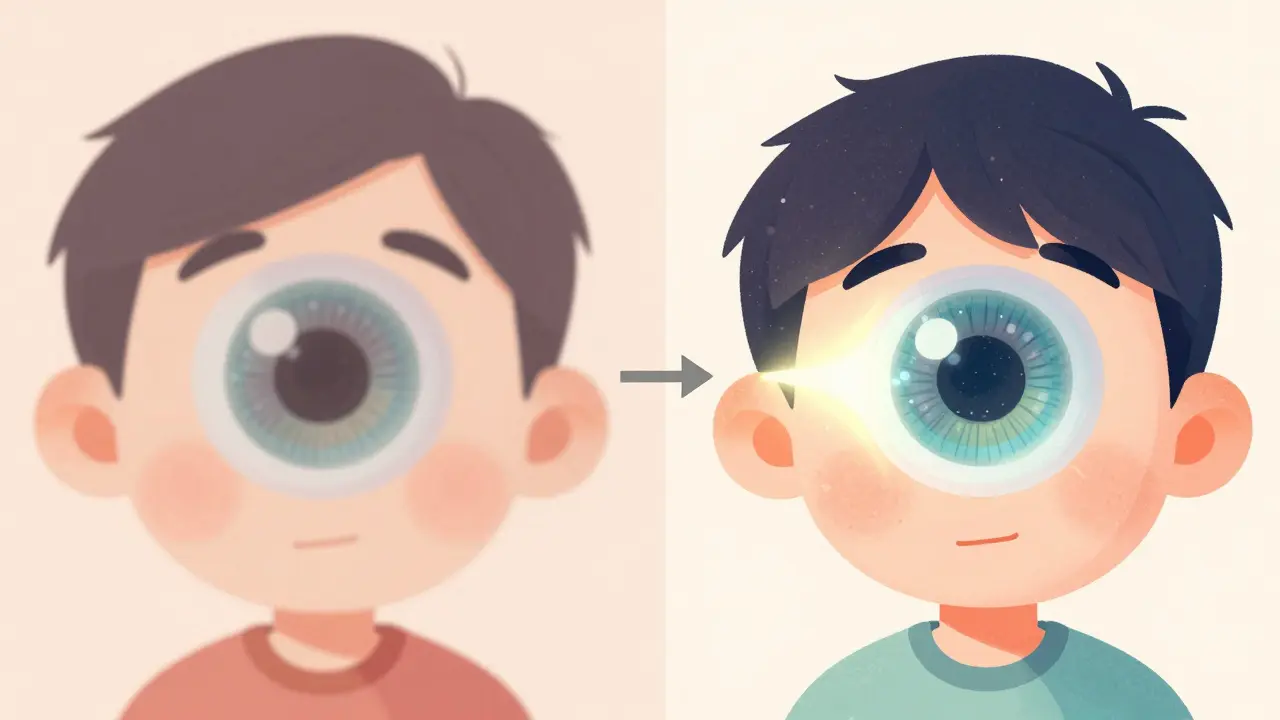
The 3-2-1 Rule: Your Emergency Guide
Eye clinics now teach a simple rule to help patients know when to act:
- 3 - More than 3 new floaters per minute
- 2 - 2 or more flashes of light per minute
- 1 - Any dark shadow or loss of side vision
If you hit any one of these, call your eye surgeon immediately. Don’t wait. Don’t check online. Don’t hope it’ll go away. The American Society of Cataract and Refractive Surgery says treatment within 72 hours can prevent permanent damage. Patients who know this rule are nearly five times more likely to get help in time.
What Happens at the Doctor?
If you’re concerned, your eye doctor will do a dilated eye exam. They’ll use drops to widen your pupil, then look deep into your eye with a special lens. They’ll check for:
- Retinal tears or holes
- Vitreous detachment (PVD)
- Fluid behind the retina
- Any bleeding or inflammation
For patients over 60, many clinics now use optical coherence tomography (OCT) before surgery to assess vitreous health. This helps predict who’s at higher risk for complications. If you had cataract surgery recently and didn’t get this scan, ask if it’s appropriate - it’s now part of standard care.

Can You Treat or Remove Floaters?
If floaters are truly bothersome and don’t improve after 3-6 months, there are options - but they’re not simple.
Laser vitreolysis uses a focused laser to break up large floaters. It’s non-invasive, takes about 20 minutes, and works for about 65% of patients. But it’s not for everyone - only those with large, well-defined floaters that aren’t too close to the retina.
Vitrectomy is surgery to remove the vitreous gel and replace it with a clear fluid. It’s about 90% effective at removing floaters. But it’s invasive. It carries a 1.5% risk of complications like infection, retinal detachment, or cataract progression. Most doctors only recommend it if floaters severely impact daily life - like reading, driving, or working.
There’s also a new treatment in Phase III FDA trials: an enzyme injection that dissolves the collagen clumps. Early results show 78% reduction in floaters with minimal side effects. It could be available within the next year or two.
What Can You Do Right Now?
For now, here’s what works:
- Move your eyes gently in circles - this can shift floaters out of your central vision
- Wear sunglasses outdoors - bright light makes floaters more visible
- Don’t stare at blank walls or screens - look at textured surfaces instead
- Give it time - your brain adapts faster than you think
- Attend all follow-up appointments - even if you feel fine
Patients who get clear education before surgery report 94% satisfaction. Knowing what to expect makes all the difference. If your surgeon didn’t explain this, ask for a handout or schedule a quick chat.
Long-Term Outlook
The bottom line? Modern cataract surgery is one of the safest procedures in medicine. Advances in technique - like femtosecond laser-assisted surgery - have cut PVD-related floaters by 18% compared to older methods. And with better monitoring, serious complications are now under 0.5% of cases.
Most people who get floaters after surgery never need treatment. They adjust. They learn. They forget they were ever there. But if something changes suddenly - don’t guess. Don’t wait. Call your eye doctor. Your vision is worth it.
Are floaters after cataract surgery normal?
Yes, floaters are very common after cataract surgery. About 70% of patients notice them, usually because the new clear lens makes pre-existing floaters more visible. In most cases, they’re harmless and fade or become less noticeable over 4 to 12 weeks.
How long do floaters last after cataract surgery?
Most floaters improve within 3 to 6 months. About 85% of patients see significant reduction by then. In 15-20% of cases, especially with posterior vitreous detachment, floaters may last longer - even years - but they typically become less bothersome as the brain adapts.
When should I be concerned about floaters?
Be concerned if you suddenly get more than 10 new floaters, experience flashes of light (2+ per minute), or notice a dark shadow or curtain in your peripheral vision. These could signal a retinal tear or detachment - which requires emergency treatment within 72 hours to prevent permanent vision loss.
Can floaters be removed after cataract surgery?
Yes, but only if they’re severe and persistent. Laser vitreolysis can break up large floaters with about 65% effectiveness. For extreme cases, a vitrectomy removes the vitreous gel and replaces it with fluid - it’s 90% effective but carries surgical risks. Most doctors recommend waiting at least 3-6 months before considering treatment.
Do floaters mean my cataract surgery failed?
No. Floaters are not a sign of surgical failure. They’re caused by changes in the vitreous gel, not the artificial lens. In fact, many patients didn’t even notice floaters before surgery - the cataract was hiding them. Improved vision after surgery simply makes them visible.
Can I prevent floaters after cataract surgery?
You can’t prevent them entirely, but modern femtosecond laser-assisted cataract surgery reduces the risk by 18% compared to traditional methods. Pre-op OCT scans can also identify patients at higher risk. The best prevention is knowing what’s normal - so you don’t panic and can act fast if something changes.
Joseph Charles Colin
February 11, 2026 AT 01:34Post-cataract vitreous opacities are a direct consequence of increased luminous transmittance through the newly implanted IOL, unmasking pre-existing syneresis of the vitreous humor. The vitreous collagen fibrils, previously attenuated by the cataractous lens, now cast unobscured shadows on the retinal pigment epithelium. This is not a surgical complication-it's a physiologic revelation. Studies using OCT volumetric imaging demonstrate that 72% of patients exhibit preoperative vitreous degeneration that only becomes clinically perceptible postoperatively. The brain's perceptual adaptation, mediated by cortical suppression mechanisms, typically reduces symptomatic burden within 8–12 weeks. No intervention is warranted unless accompanied by photopsias or visual field deficits.
John Sonnenberg
February 11, 2026 AT 20:26So let me get this straight-you’re telling me I’m seeing ghosts because my new lens is too good? That’s not a feature, that’s a bug. I had one cataract removed and now I’ve got a whole haunted house in my eyeball. I’m not exaggerating-I counted 17 of them just now. And no, I’m not on drugs. I’m just trying to read my email and suddenly I’m staring at a swarm of microscopic squid in my visual field. This is not normal. This is a glitch in the matrix.
Joshua Smith
February 13, 2026 AT 14:04Just wanted to say thanks for this breakdown. I had surgery 6 weeks ago and was freaking out about the floaters-I thought something went wrong. But now I realize they were probably there all along, just hidden by the cataract. I’ve been doing the eye circles thing and it really helps shift them out of my central vision. Also, wearing sunglasses indoors when I’m on my laptop made a huge difference. It’s been a slow adjustment, but I’m starting to forget they’re there. Keep it up!
Jessica Klaar
February 15, 2026 AT 01:30I’m a nurse in a retina clinic, and I can’t tell you how many patients I’ve seen panic over this. One woman cried because she thought her new lens was ‘broken.’ I showed her her pre-op OCT and pointed out the vitreous strands she’d had for years-she just never noticed them. The emotional toll is real. We need more education, not just pamphlets. Maybe a 2-minute video patients can watch before surgery? A simple animation of light passing through the old vs. new lens? It’s not just about the surgery-it’s about managing expectations. You don’t fix vision and then leave someone terrified of their own eyes.
John Watts
February 16, 2026 AT 19:25You’re not alone. I had this too. At first I thought I was going blind. Then I read this thread and realized-this is the gift. The cataract was a filter. Now you’re seeing the world as it truly is. The floaters? They’re just the price of clarity. I started doing the eye roll thing every morning. Now I barely notice them. And honestly? I feel like I got my vision back. Don’t fight it. Embrace it. You’re not broken-you’re upgraded.
Ritteka Goyal
February 17, 2026 AT 16:08Bro I am from India and we dont have this kind of info here. In India, doctor just say 'ye normal hai' and give you eye drops. No one explain why floaters happen. I was so scared I went to 3 different doctors. One said I need laser, another said wait 3 months, third said I have retinal tear (I didn't). Finally I found this article on google and I was like 'ohhhhhhh'. My brain is finally calm. We need more awareness in developing countries. My aunty had cataract surgery 2 years ago and still sees floaters and thinks she needs second surgery. Please translate this into Hindi and Punjabi. Thank you.
Susan Kwan
February 18, 2026 AT 03:29Wow. A whole article about how floaters are ‘normal’? You know what’s not normal? Paying $4,000 for surgery and then being told your eyeball is just haunted now. I’m not paying for a vision upgrade that comes with free ghosts. Next time, maybe warn people that they’ll be seeing microscopic spiders for the next six months. Just a thought.
Random Guy
February 19, 2026 AT 05:05so i had this weird floating thing after my surgery and i thought i was dying. turns out i just had a tiny ghost in my eye. cool. now i just stare at it and imagine it's a dragon. it's kinda fun. also i stopped looking at white walls. that was a mistake.
Tasha Lake
February 20, 2026 AT 22:13As someone who works in ophthalmic diagnostics, I’ve reviewed hundreds of pre-op OCT scans. The vitreous syneresis is almost always present-often with posterior vitreous detachment (PVD) already in progress. The cataract was masking it. Post-op, the increased contrast sensitivity unmasks the pathology, but it’s not new. The real clinical red flag isn’t the floaters-it’s the sudden increase in number or associated photopsias. If you’re seeing flashes, even if it’s just once a minute, that’s a PVD with traction. That’s not ‘normal.’ That’s a 15% risk of retinal tear. And yes, OCT before surgery is now standard of care. If your surgeon didn’t offer it, ask why.
Simon Critchley
February 22, 2026 AT 10:04Let’s be honest: this is the most under-discussed side effect of modern cataract surgery. We’re all walking around with these new, hyper-precise IOLs, and suddenly our vitreous is on full display like a live-streamed ballet of collagen. It’s poetic, really. The cataract was the old-school filter-grainy, muted, forgiving. The IOL? It’s 4K HDR. And now we’re seeing every damn dust bunny in the lens of life. Laser vitreolysis? Sure, it works for some. But I’d rather just learn to live with it. It’s like having a tiny, silent movie playing behind your eyelids. Eventually, you stop watching. And honestly? You start to miss the old lens sometimes. It wasn’t perfect… but it didn’t show you *everything*.