
MRONJ Symptom Checker
This tool helps identify potential warning signs of medication-related osteonecrosis of the jaw (MRONJ). MRONJ is a serious condition where jawbone tissue dies and doesn't heal. It's most common in patients taking certain bone medications. If you're taking any of the medications listed in the article, this tool can help you determine if you should seek immediate dental care.
Check your symptoms
Risk factors
Imagine this: you’ve been taking a pill every week to protect your bones from breaking, and suddenly, your gums start hurting. Not just a little soreness-real, persistent pain. Then you notice a piece of bone sticking out where your tooth used to be. Your dentist says it’s an infection, but antibiotics don’t help. Weeks go by. The pain gets worse. You’re not alone. This is osteonecrosis of the jaw-and it’s silently happening to thousands of people on common bone medications.
What Exactly Is Osteonecrosis of the Jaw?
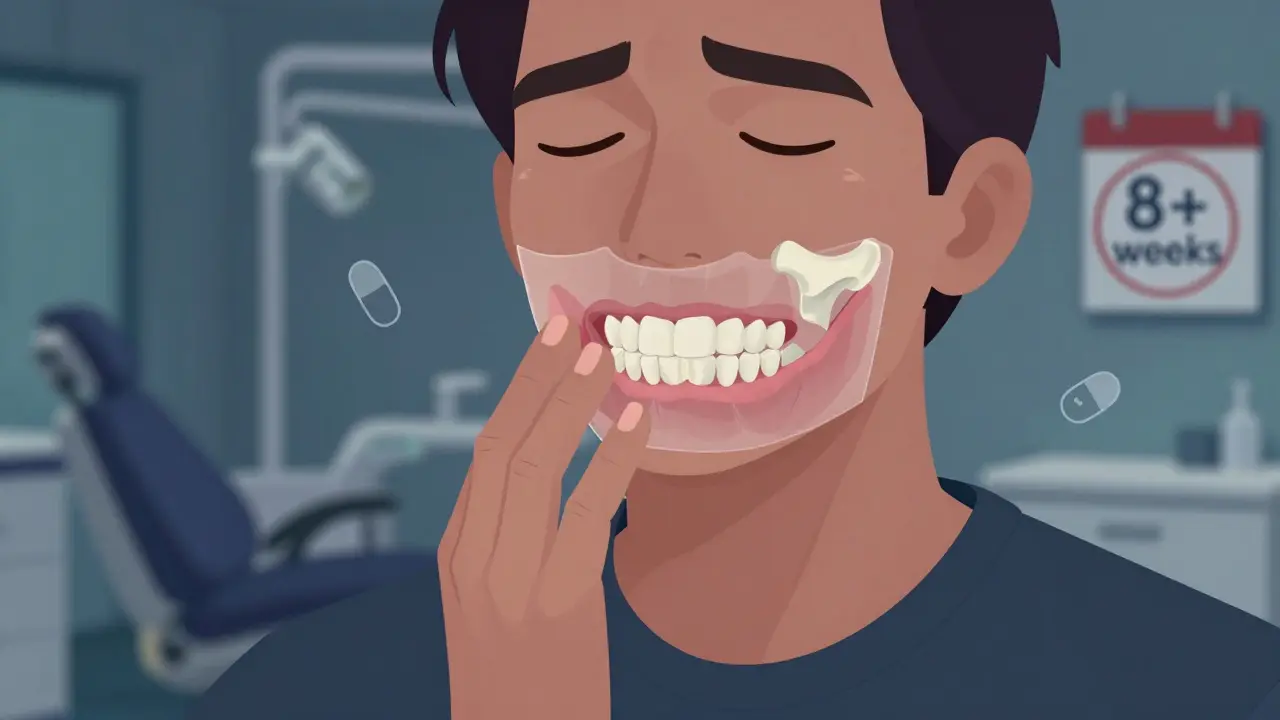
Osteonecrosis of the jaw (ONJ), especially when caused by medication, is called medication-related osteonecrosis of the jaw (MRONJ) a condition where the jawbone loses its blood supply and begins to die, leaving exposed bone in the mouth that doesn’t heal for more than eight weeks. It doesn’t happen overnight. It creeps up after dental work, or sometimes without any trigger at all. The bone doesn’t just break-it stops healing. And once it’s exposed, infection follows.
This isn’t a myth or a rare rumor. The American Dental Association (ADA) reports that while only 0.001% to 0.01% of people taking oral bisphosphonates for osteoporosis develop MRONJ, the risk jumps to 1%-10% for cancer patients on intravenous versions. That’s a 1,000-fold difference. The numbers matter because most people don’t realize their bone drug could be quietly damaging their jaw.
Which Medications Cause This?
Not all bone medications carry the same risk. The biggest culprits are drugs that stop bone breakdown. These include:
- Bisphosphonates like alendronate (Fosamax), risedronate (Actonel), ibandronate (Boniva), and zoledronic acid (Reclast)
- Denosumab (Prolia, Xgeva)
- Romosozumab (Evenity)
The route of delivery makes all the difference. Oral pills for osteoporosis? Low risk. Monthly IV infusions for cancer that’s spread to bone? High risk. Zoledronic acid at 4mg monthly doses, used in breast or prostate cancer, carries the highest documented risk. That’s why cancer patients need to be screened before treatment even starts.
What Are the Warning Signs?
MRONJ doesn’t scream for attention. It whispers. And if you miss the whisper, it becomes a scream. Here’s what to watch for:
- Pain or swelling in the jaw-reported in 87% of cases. Often mistaken for a toothache or sinus infection.
- Gums that don’t heal after extraction, crown work, or even a deep cleaning. If your mouth is still sore 4 weeks later, it’s not normal.
- Loose teeth without gum disease. If teeth that were stable suddenly feel wobbly, it’s a red flag.
- Exposed bone-you can see or feel it. It might look like a sharp edge or a white spot in the gum.
- Pus or bad taste from the gum. Antibiotics might temporarily help, but it always comes back.
- Numbness or heaviness in the jaw or lips. This suggests nerve involvement.
These aren’t random symptoms. They’re the body’s way of saying: “I can’t repair this.” The drugs stop bone from turning over. No new bone forms. No old bone gets cleaned up. Microfractures pile up. The jaw becomes brittle. And when trauma hits-a tooth pulled, a denture rubs-it cracks. And it never heals.
Why Do Dental Procedures Trigger It?
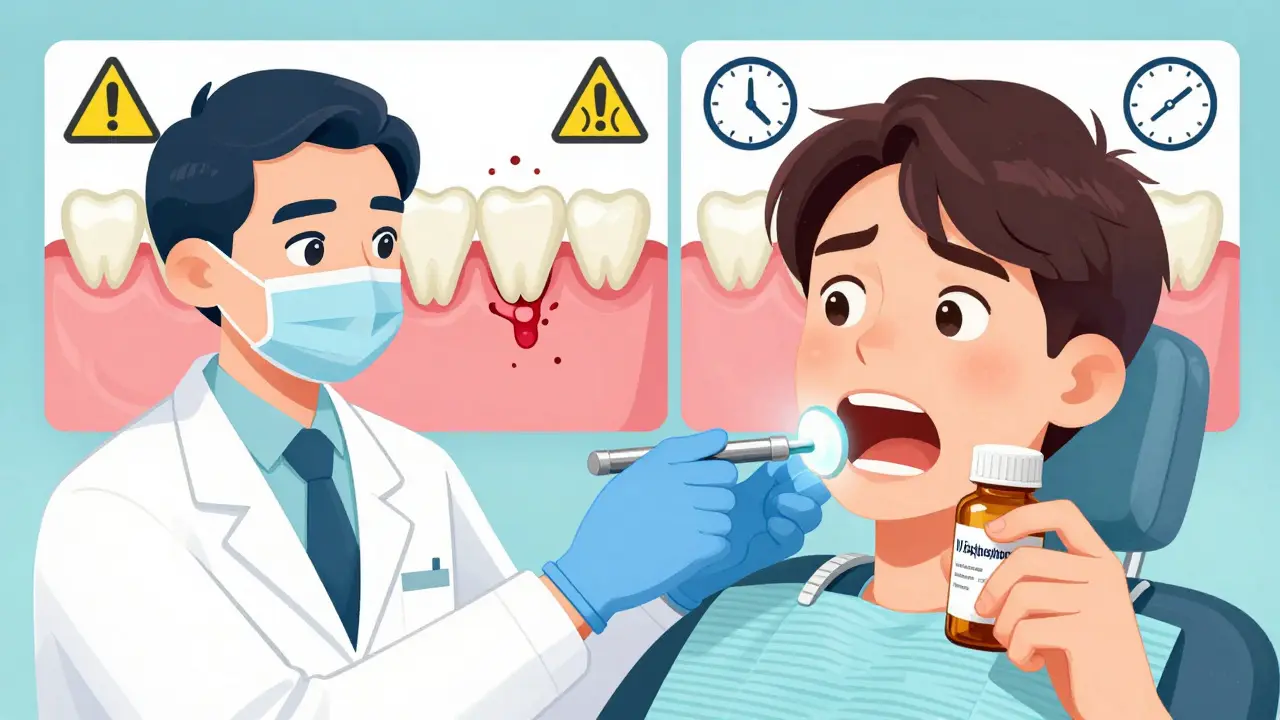
You might think: “I just had a filling. How could that cause this?” The truth is, most cases happen after invasive dental work. Tooth extraction is the biggest trigger. Studies show 3.2% of people on bisphosphonates develop MRONJ after an extraction-compared to just 0.05% in people not taking these drugs. That’s a 64-fold increase.
But here’s the good news: routine cleanings, fillings, and root canals without surgery? No significant risk. The danger isn’t dental care-it’s invasive dental care without preparation.
Who’s at Highest Risk?
It’s not just about the drug. It’s about the whole picture:
- Cancer patients on IV bisphosphonates or denosumab-highest risk group. Up to 10% develop MRONJ.
- People on these drugs for over 3-4 years-risk climbs after this point.
- Those with poor oral hygiene-plaque and infection add fuel to the fire.
- Diabetics or smokers-both impair healing.
- People who had dental work done after starting the drug-instead of before.
One study found that 73% of patients who developed MRONJ said their dentist never asked if they were on bone medication. That’s not negligence-it’s ignorance. And it’s preventable.
How to Prevent It
You can’t stop your medication without talking to your doctor. But you can protect your jaw.
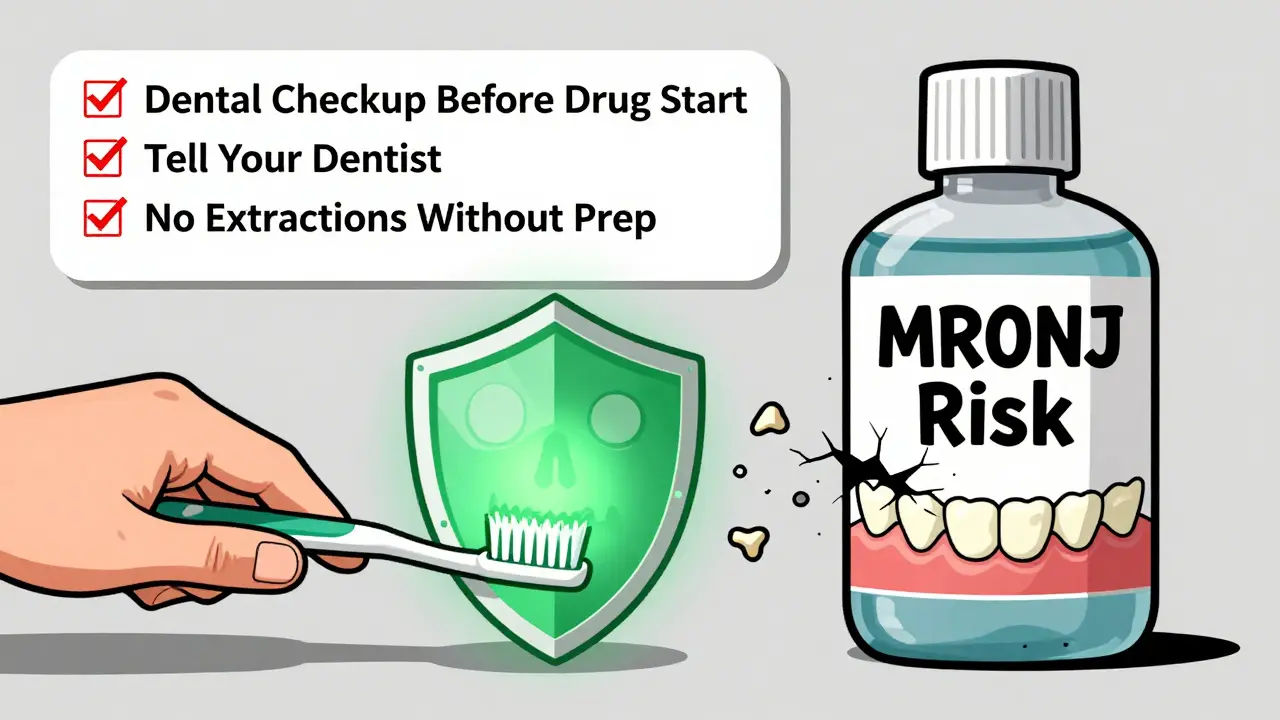
- Get a dental checkup before you start. If you’re about to begin IV bisphosphonates or denosumab for cancer, see a dentist 4-6 weeks before your first infusion. Get all necessary extractions, root canals, or crowns done before the drug hits your system.
- For osteoporosis patients, a dental visit 2-4 weeks before starting oral bisphosphonates is enough. No need to panic, but don’t skip it.
- Keep your mouth clean. Brush twice daily. Use a chlorhexidine rinse (0.12%) twice a day. A 2021 trial showed this cuts MRONJ risk by 37%.
- Tell every dentist you see. Even if you’re on oral meds. Even if it’s been years. Write it on your chart. Say it out loud.
- Avoid extractions if possible. If you’re already on the drug, postpone non-urgent extractions. If you must, your doctor might pause the drug for 2-3 months-but only under medical supervision.
Patients who got full dental clearance before starting bisphosphonates? 92% never developed MRONJ-even after 5+ years of treatment.
What If You Already Have It?
There’s no magic cure. But early detection saves your jaw.
Stage 1: Exposed bone with no infection. Treatment? Mouth rinses, antibiotics, regular monitoring. You might not even need surgery.
Stage 2: Exposed bone with infection and pus. You’ll need antibiotics, maybe minor surgery to remove dead bone.
Stage 3: Severe infection, fractures, or fistulas. Surgery is likely. And recovery is long.
Here’s the hopeful part: new research from UCSF shows that teriparatide (Forteo) , a bone-building drug, helped 78% of early-stage MRONJ patients heal-compared to just 32% with standard care. It’s not approved for this yet, but trials are ongoing. The future is looking brighter.
What You Should Do Now
If you’re on one of these medications:
- Check your gums. Are they healing? Is there bone showing?
- Call your dentist. Say: “I’m on [drug name]. Can we check for jawbone health?”
- Ask your doctor: “Has my dental risk been evaluated?”
- Don’t wait for pain. By then, it’s too late.
And if you’re a caregiver, family member, or friend of someone on these drugs? Ask the same questions. This isn’t about scaring people. It’s about giving them control. Because you can’t fix MRONJ once it’s advanced-but you can stop it before it starts.
Can you get osteonecrosis of the jaw from taking Fosamax for osteoporosis?
Yes, but the risk is extremely low-about 1 in 10,000 to 1 in 100,000 people per year of use. Most cases happen in people who’ve been on the drug for over 3 years and had dental work afterward. The benefits of preventing fractures far outweigh this tiny risk for most people.
Is MRONJ the same as jaw infection?
No. A regular jaw infection is caused by bacteria and usually responds to antibiotics. MRONJ is bone death due to lack of healing. Antibiotics may temporarily reduce symptoms, but the exposed bone won’t heal unless the underlying cause is addressed. It’s a structural problem, not just an infection.
Do I need to stop my osteoporosis medication if I need a tooth pulled?
For oral bisphosphonates, stopping isn’t usually needed. For IV bisphosphonates or denosumab, your doctor might pause the drug for 2-3 months before and after extraction. Never stop on your own. Talk to both your dentist and your prescribing doctor. The risk of a fracture from stopping osteoporosis meds is often higher than the risk of MRONJ.
Can MRONJ happen without any dental work?
Yes. About 15%-20% of cases occur spontaneously-no extraction, no trauma. This is more common in cancer patients on high-dose IV drugs. It can start with minor gum irritation, a poorly fitting denture, or even biting your cheek. The bone just fails to repair itself.
How long does it take for MRONJ to develop after starting the medication?
It usually takes 2-4 years of continuous use before risk increases significantly. Most cases appear after dental procedures done during or after that time. The longer you’re on the drug, the higher the risk-especially past the 3-year mark.
John McDonald
February 9, 2026 AT 21:18Man, I had no idea this was even a thing. My grandma’s on Fosamax and she’s been complaining about a weird sore spot on her gum for months. I thought it was just old age or dentures rubbing. Now I’m gonna get her to the dentist ASAP. This post saved her jaw, honestly.
Chelsea Cook
February 10, 2026 AT 14:22So let me get this straight - you’re telling me my dentist didn’t ask if I was on Prolia before yanking that wisdom tooth? 😂
Yeah, that’s not negligence. That’s a fucking crime. I’m sending this to every family member who’s on ‘bone drugs’ and telling them to print it out and tape it to their dentist’s forehead.
Andy Cortez
February 11, 2026 AT 13:28omg this is so bs. i bet this whole thing is just big pharma scare tactics to sell more mouthwash. like wtf. why would a drug that helps your bones ALSO kill your jaw? sounds like a plot twist from a bad medical drama.
also i think the ADA just made up those numbers. 1%? lol. i’ve seen more people get cavities than MRONJ. this is just fearmongering. 🤷♂️
Joshua Smith
February 12, 2026 AT 09:31Thanks for laying this out so clearly. I’m on Actonel for osteoporosis and just had a cleaning last month. I didn’t mention the medication because I assumed it wasn’t relevant. Now I’m going to call my dentist tomorrow and ask if they track drug history. Better safe than sorry.
Jessica Klaar
February 14, 2026 AT 06:17As someone whose mom passed away from complications after a tooth extraction while on IV Zometa - this hits different.
She was told ‘it’s fine, just keep brushing’ - no one warned us about the bone death risk. We didn’t even know the word MRONJ until after she lost half her jaw.
If this post saves one person from going through that - it’s worth every word.
PAUL MCQUEEN
February 14, 2026 AT 09:40Why are we even talking about this? Just don’t take the drugs. Problem solved. Why does everyone need to be scared into going to the dentist? I’ve been on Fosamax for 6 years and my teeth are fine. Stop overreacting.
glenn mendoza
February 15, 2026 AT 10:52It is imperative to underscore that the prevention of medication-related osteonecrosis of the jaw is not merely a clinical recommendation - it is a fundamental standard of care. Proactive dental evaluation prior to initiation of antiresorptive therapy is not optional; it is ethically and medically obligatory. The data are unequivocal. We must institutionalize this protocol across all oncology and rheumatology practices.
Patrick Jarillon
February 17, 2026 AT 01:23Let me guess - this is all part of the vaccine-bone-drug-5G-jaw-death conspiracy, right?
They put fluoride in the water to weaken your jaw so they can implant microchips later. You think your dentist is helping? Nah. They’re just the front line for the pharmaceutical cartel. I’ve been using coconut oil and sage leaves for 14 years - no problems. Also, the moon is made of cheese.
Randy Harkins
February 17, 2026 AT 09:28Just had my annual dental checkup and told my hygienist I’m on Boniva. She said, ‘Oh wow, we’ve been training staff on this - we’re supposed to ask!’ 🙌
Also got a free chlorhexidine rinse. I’m so glad we’re getting better at this. Small wins, people. Keep talking. Keep asking. You’re not paranoid - you’re prepared. 💪🦷