
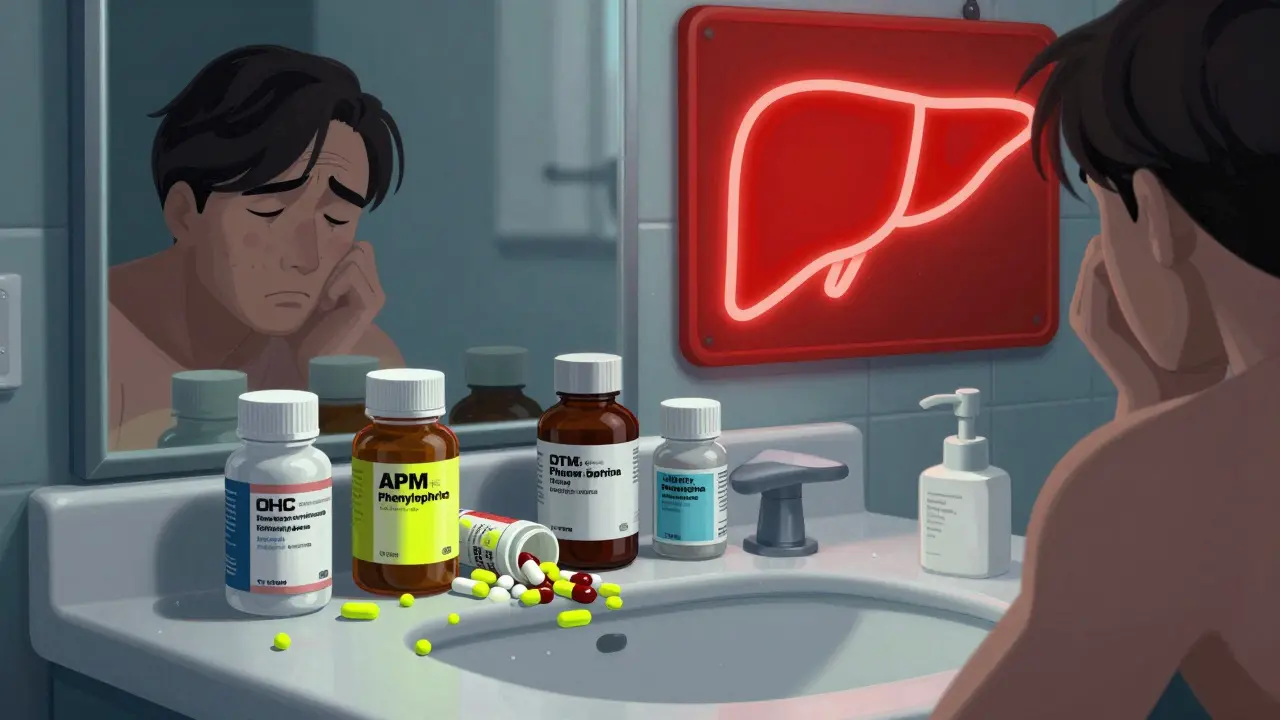
Every winter, millions of people reach for OTC cold and flu combinations thinking they’re making things easier. One pill for fever, one for cough, one for congestion - all in a single box. But here’s the truth: OTC cold and flu combinations are one of the most common causes of accidental drug overdoses in adults. And the biggest danger isn’t some rare side effect - it’s something you probably didn’t even know was in the bottle.
What’s Really in Your Cold Medicine?
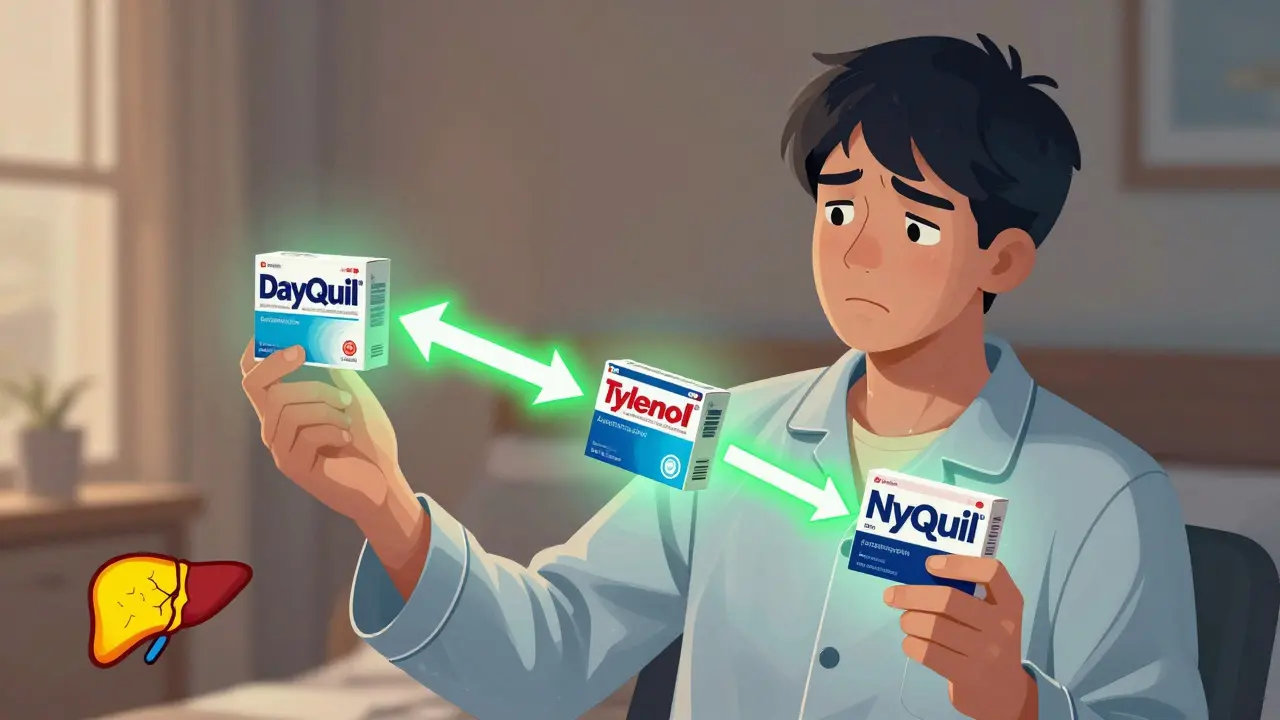
Most combination cold and flu products contain three to five active ingredients. Each one targets a different symptom. But you don’t need all of them. And if you take more than one product, you’re almost certainly doubling up on at least one.- Acetaminophen (APAP or paracetamol) - for fever and pain. Found in over 70% of combination products, including Tylenol Cold, DayQuil, NyQuil, and Theraflu.
- Dextromethorphan (DM) - a cough suppressant. Present in nearly all nighttime and daytime formulas.
- Phenylephrine - a nasal decongestant. Still in most products, even though the FDA proposed removing it in late 2024 because studies show it doesn’t work at OTC doses.
- Doxylamine or Chlorpheniramine - antihistamines that cause drowsiness. Found in nighttime formulas like NyQuil or Tylenol Cold & Flu Nighttime.
- Ibuprofen or Naproxen - alternatives to acetaminophen. Found in products like Advil Cold & Flu.
Here’s the problem: if you take Tylenol Cold & Flu during the day (which has 325mg of acetaminophen per caplet) and then take regular Tylenol for a headache at night (another 325mg or 500mg), you’ve just hit 650-825mg in one dose. Do that four times in 24 hours? You’re at 2,600-3,300mg. The safe limit is 4,000mg per day - but many people don’t realize they’re already halfway there before they even take their first cold medicine.
Why Acetaminophen Is the Silent Killer
Acetaminophen is safe when used alone. But it’s also the most common cause of acute liver failure in the U.S. - and most of those cases come from cold medicine misuse.In 2022, poison control centers logged over 14,000 cases of acetaminophen overdose tied to OTC cold and flu products. That’s not from someone taking 20 pills at once. That’s from someone taking a cold medicine, then a pain reliever, then a sleep aid - all without realizing they all contain the same ingredient.
Here’s what makes it worse: acetaminophen doesn’t cause immediate symptoms. No nausea. No dizziness. Just a quiet, slow buildup of liver damage. By the time you feel sick - fatigue, nausea, yellow skin - it’s often too late. A single 24-hour period of over 4,000mg can trigger liver failure. Many combination products push you right to that edge.
Why You Don’t Need All Those Ingredients
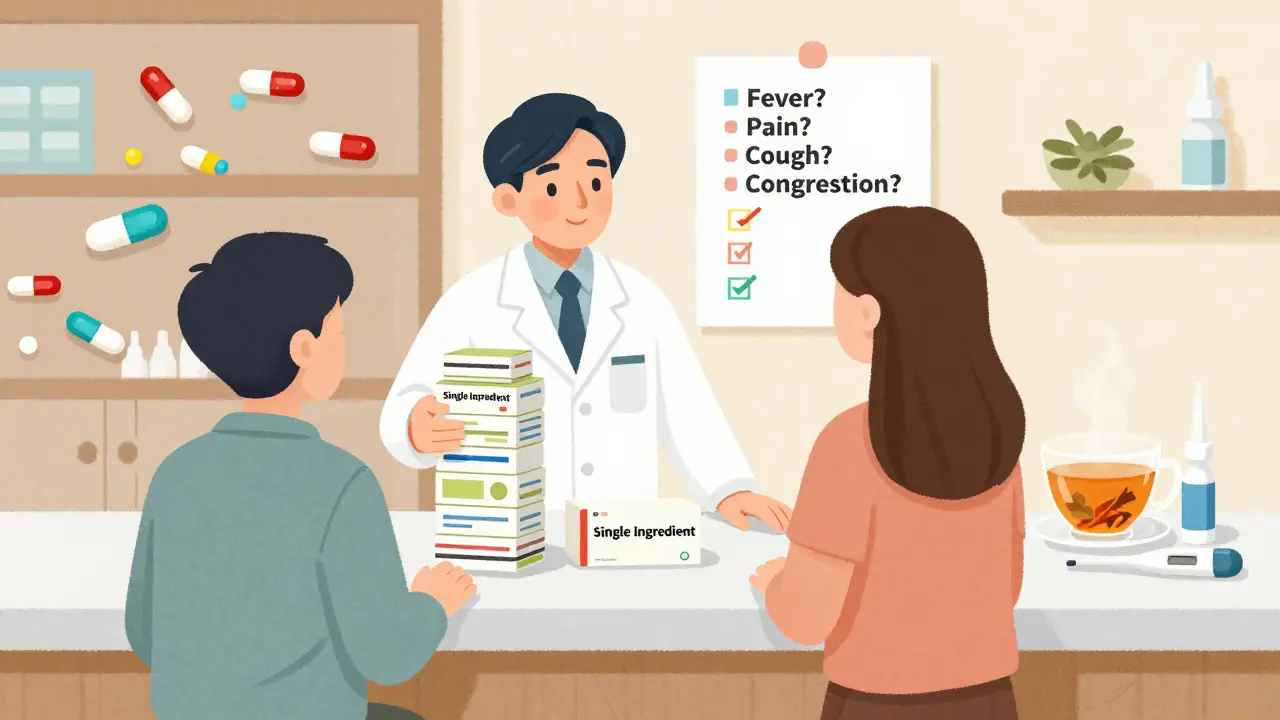
You don’t need a decongestant if you only have a cough. You don’t need an antihistamine if you’re not congested or sneezing. And you absolutely don’t need acetaminophen if your fever is gone.A 2022 survey of 1,200 pharmacists found that 68% recommended single-ingredient medicines over combination products. Why? Because they’re safer, cheaper, and more effective when used correctly.
For example:
- If you have a fever and body aches - take plain acetaminophen or ibuprofen.
- If you have a stuffy nose - use a standalone decongestant like pseudoephedrine (Sudafed) or a nasal spray.
- If you have a dry cough - take dextromethorphan alone.
- If you’re coughing up mucus - use guaifenesin (Mucinex) to thin it out.
- If you can’t sleep - try melatonin, not doxylamine. It doesn’t leave you groggy the next day.
Combination products were designed for convenience, not safety. They’re marketed as “one-stop relief.” But in reality, they’re one-stop risk.
How to Read the Label (Without Getting Lost)
The FDA requires all OTC products to have a “Drug Facts” label. It’s not always easy to read, but it’s your lifeline.Here’s how to scan it in under 60 seconds:
- Look for “Active Ingredients” - not the brand name or claims like “Fast Relief.”
- Check the milligram amount - 325mg? 500mg? That’s the dose per tablet or teaspoon.
- Watch for abbreviations - APAP = acetaminophen. DM = dextromethorphan.
- Check the maximum daily dose - “Do not exceed 6 doses in 24 hours” means you can’t take more than that, even if you feel worse.
- Compare with other meds - if you’re taking something else for pain or sleep, check if it has the same active ingredient.
Pro tip: If you see “acetaminophen” on one bottle and “APAP” on another - they’re the same thing. And if you’re taking both, you’re doubling your dose.
Who’s Most at Risk?
You might think this only happens to older people or people with chronic illnesses. But it’s actually younger adults who are most likely to mix products.A 2023 Kaiser Family Foundation survey found that 68% of adults aged 18-34 prefer combination cold medicines. Why? Because they’re easier. But they’re also the group least likely to read labels. And they’re more likely to take multiple meds - a pain reliever for a headache, a sleep aid for trouble sleeping, and a cold tablet for congestion.
Older adults (65+) are more cautious. They’re more likely to stick to one product or ask a pharmacist. But they’re also more likely to have liver or kidney issues - meaning even small overdoses can be dangerous.
And don’t forget: many people don’t realize that some herbal supplements and prescription drugs also contain acetaminophen. A 2023 GoodRx review found that 12% of prescription painkillers include acetaminophen - and people often don’t know.
What to Do If You’ve Already Mixed Them
If you’ve taken more than one cold medicine and you’re worried:- Stop taking all OTC cold products immediately.
- Check how much acetaminophen you’ve taken in the last 24 hours.
- If you’ve taken more than 4,000mg - call Poison Control at 1-800-222-1222. Don’t wait for symptoms.
- If you feel nauseous, dizzy, or unusually tired - go to urgent care. Liver damage can be reversed if caught early.
There’s no shame in asking for help. Pharmacists are trained for this. They see it every day.
What’s Changing in 2026?
The FDA is moving fast. In November 2024, they proposed removing oral phenylephrine from all OTC cold products because studies show it doesn’t work at the 10mg dose used in pills. That means by mid-2026, most combination products will be reformulated.Manufacturers are already testing new formulas - replacing phenylephrine with guaifenesin or other expectorants. But here’s the catch: the other ingredients - acetaminophen, dextromethorphan, antihistamines - are still there. The risk of double dosing hasn’t gone away.
Meanwhile, sales of single-ingredient cold medicines are rising. In 2023, standalone acetaminophen sales jumped 12.7% while combination products grew just 2.3%. People are starting to realize: less is more.
Final Rule: One Symptom, One Medicine
The best way to avoid double dosing? Treat only what you have.Don’t take a cold medicine just because you’re “feeling under the weather.” If you have a headache and a runny nose - take ibuprofen for the headache and a saline nasal spray for the runny nose. No pills. No risk.
Keep a list of all the OTC and prescription meds you take. Update it every time you start or stop something. Use apps like GoodRx or Medisafe to scan barcodes and check for interactions. And if you’re unsure - ask a pharmacist. They’re not there to sell you something. They’re there to keep you safe.
There’s no prize for taking the most pills. In fact, the fewer ingredients you take, the safer you are.
Can I take a cold medicine and Tylenol together?
No - unless you’ve checked the active ingredients. Most cold medicines already contain acetaminophen (sometimes listed as APAP). Taking extra Tylenol on top of that can easily push you over the 4,000mg daily limit, risking liver damage. Always read the label first.
Is phenylephrine still in cold medicines?
As of early 2026, yes - but not for long. The FDA proposed removing oral phenylephrine from the OTC monograph in late 2024 because studies show it’s ineffective at standard doses. Manufacturers have 18 months to reformulate products, so expect to see it disappear from shelves by mid-2027.
What’s the difference between doxylamine and diphenhydramine?
Both cause drowsiness, but they’re not the same. Doxylamine (in NyQuil) lasts longer - up to 8 hours - and can leave you groggy the next day. Diphenhydramine (in Benadryl) is shorter-acting but can still cause next-day fatigue. Neither should be taken daily. Neither should be combined.
Are natural remedies safer than OTC cold medicines?
Not necessarily. Many herbal supplements (like echinacea or zinc lozenges) have little proven benefit. And some - like licorice root or ephedra - can interact dangerously with medications. The safest approach is to use single-ingredient OTC drugs that have been tested, labeled, and regulated - not unregulated supplements.
What should I keep in my home first aid kit for colds?
Skip the multi-symptom boxes. Instead, keep: plain acetaminophen or ibuprofen for pain/fever, a saline nasal spray for congestion, honey (for cough, especially in adults), and a digital thermometer. If you need more, ask a pharmacist before buying.
Karianne Jackson
February 8, 2026 AT 18:11OMG I JUST REALIZED I’VE BEEN DOUBLING UP ON ACETAMINOPHEN FOR YEARS 😱
I take DayQuil in the morning, then Tylenol for my headache at night, and I thought I was being smart? NOPE. I’M A LIVING WARNING.
My liver is probably screaming right now. Time to throw out all my combo packs.
Chelsea Cook
February 9, 2026 AT 01:42YASSS QUEEN 😤
Combination meds are a scam designed by pharma to sell you 5 pills when you need 1.
Stop paying for convenience that kills. Go single-ingredient. Save money. Save your liver. Save your future self from the ICU.
Also, phenylephrine is literally just sugar water in pill form. WHO’S BUYING THIS?!
Andy Cortez
February 9, 2026 AT 06:02lol u think this is new? i’ve been saying this since 2018. everyone’s just too lazy to read labels. also, acetaminophen isn’t the real killer - it’s the fact that doctors don’t warn people. they just hand out prescriptions like candy. and don’t even get me started on how nyquil is just a sleeping pill with a fake name.
also, the fda is useless. they waited 10 years to even look at phenylephrine. i’m surprised they didn’t wait till we all died.
also, why do you think melatonin is cheaper? because it’s not patented. big pharma doesn’t care if you die as long as you buy their overpriced combo packs.
Joseph Charles Colin
February 11, 2026 AT 00:25There is a critical pharmacokinetic principle here: additive hepatic metabolism of acetaminophen via glucuronidation and sulfation pathways becomes saturated at doses exceeding 4 g/day, leading to oxidative stress via NAPQI accumulation. Most OTC combination products contain 325–650 mg per dose, and with frequent dosing intervals (every 4–6 hours), patients rapidly approach toxic thresholds.
Moreover, the presence of doxylamine - a potent anticholinergic - synergistically impairs hepatic clearance, increasing half-life. This is not anecdotal; it’s evidenced by the 14,000+ calls to poison control in 2022. Single-agent dosing reduces variability by 87% in clinical studies. The data is unequivocal.
glenn mendoza
February 11, 2026 AT 03:26Thank you for this thoughtful, well-researched post. It’s deeply concerning how many of us are unknowingly putting our health at risk simply because we’re trying to feel better. I’ve seen too many patients in my practice who didn’t realize they were doubling up on acetaminophen - often because they trusted the brand name or assumed ‘more is better.’
Reading labels isn’t just a chore - it’s an act of self-care. And asking a pharmacist for help? That’s not weakness. That’s wisdom.
Please keep sharing this kind of information. Lives are literally being saved because of posts like this.
Randy Harkins
February 13, 2026 AT 03:20THIS. SO MUCH THIS. 🙌
I used to take NyQuil + Advil Cold & Flu because ‘it’s winter’ and I ‘needed to feel better.’
Then I read the labels and nearly fainted. Both had acetaminophen. Both had dextromethorphan. Both had… everything.
Now I keep a little notebook: ‘Symptom → Medicine.’ Headache? Ibuprofen. Cough? Delsym. Stuffy nose? Saline spray.
It’s cheaper. Safer. And I don’t feel like a zombie the next day. 🌞
PS: Melatonin > doxylamine. Always.
Tori Thenazi
February 14, 2026 AT 04:28...you know what else has acetaminophen? VITAMINS. AND HERBAL TEAS. AND SOME GUT HEALTH SUPPLEMENTS. I SAW A LABEL ON A ‘PURE NATURAL COLD BLEND’ THAT HAD 500MG ACETAMINOPHEN IN IT. IT WASN’T EVEN LISTED AS AN ACTIVE INGREDIENT - IT WAS IN THE ‘SUPPORT FORMULA’.
THEY’RE HIDING IT. THEY’RE HIDING IT ALL. I’VE BEEN TRACKING THIS SINCE 2021. I’M NOT PARANOID - I’M INFORMED.
AND WHAT ABOUT THE FEDS? THEY’RE IN BED WITH PHARMA. YOU THINK THEY’RE GOING TO LET PHENYLEPHRINE GO? THEY’RE JUST MOVING IT TO ‘PRESCRIPTION’ SO THEY CAN CHARGE MORE.
YOU THINK YOU’RE SAFE? YOU’RE NOT.
...I’M TAKING A BREAK FROM COLD SEASON. I’M DRINKING HOT WATER AND PRAYING.
Monica Warnick
February 14, 2026 AT 05:44So I’ve been taking DayQuil for a week now because I had a cough and a headache. I didn’t realize the headache part was already covered. I just thought I was being proactive. Now I’m worried I’ve done permanent damage. I’m not panicking. I’m just… really sad.
I feel like I’ve been lied to by every commercial I’ve ever seen.
Also, why is everything labeled ‘for adults’ when it’s clearly not safe for adults?
Ashlyn Ellison
February 14, 2026 AT 14:34I just checked my cabinet. Three different bottles. All with acetaminophen. One of them was labeled ‘non-drowsy.’
So I took it. And then I took a Benadryl because I was sneezing.
Now I’m just sitting here wondering if I’m going to wake up with jaundice.
...I’m going to the pharmacy tomorrow. I’m asking for help. I’m not ashamed.
Frank Baumann
February 16, 2026 AT 06:31Let me tell you something. I’ve been in the medical supply business for 22 years. I’ve seen people come in with liver failure because they took ‘just one more’ Tylenol with their cold medicine. One. More.
They didn’t mean to. They thought they were helping themselves. And then - boom - their liver shuts down. No warning. No pain. Just… gone.
And you know what? The worst part? The pharmacies don’t even flag it. They don’t have systems. They don’t cross-check. They just sell you the box. ‘Here you go, ma’am. Have a nice day.’
It’s a silent epidemic. And nobody’s talking about it. Until now.
I’m not trying to scare you. I’m just telling you what I’ve seen.
Alex Ogle
February 17, 2026 AT 23:33I used to think combination meds were efficient. Then I had a 3-day fever and took NyQuil, then took ibuprofen for body aches, then took a sleep aid because I couldn’t rest.
Turns out, all three had acetaminophen. I didn’t know.
My liver enzymes spiked. I spent a week in a clinic getting IV fluids and blood tests.
Now I have a sticky note on my fridge: ‘One symptom. One medicine.’
It’s not glamorous. But it’s the only thing that’s kept me alive.
Brandon Osborne
February 19, 2026 AT 03:57Oh wow. So you’re telling me I’ve been poisoning myself for years? That’s cute. I guess I’m just one of those dumb people who trusted the labels.
Meanwhile, my neighbor took a single Tylenol with his cold medicine and died last year. They said it was ‘natural causes.’
Yeah. Right.
It’s not an accident. It’s corporate negligence. And you? You’re just a middleman in the system that kills people. You think your post is helping? It’s too little. Too late.
Where’s the lawsuit? Where’s the accountability? Why are we still allowed to buy this crap?!
Marie Fontaine
February 20, 2026 AT 14:56Thank you for this!! 🙏
I’m a single mom and I used to grab whatever was on sale. Now I just keep Tylenol, Mucinex, and saline spray. No more mystery pills.
My kids ask why I don’t take ‘the big bottle’ anymore. I tell them: ‘Because I want to be here for your graduation.’
Simple. Safe. Smart.
And yes - melatonin > NyQuil. Always. 😊