
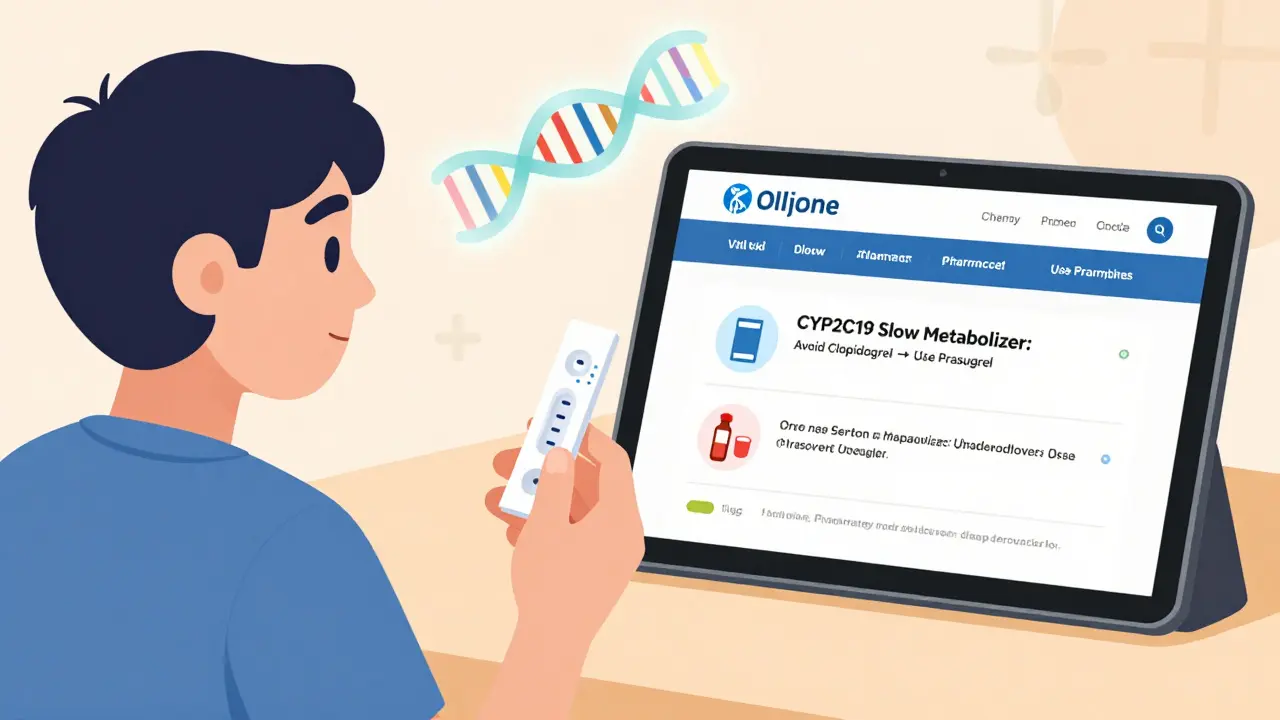
Imagine getting the right generic drug on your first try-no trial and error, no dangerous side effects, no wasted months. That’s not science fiction anymore. Thanks to AI and pharmacogenomics, online pharmacies are starting to offer personalized medication recommendations based on your DNA. This isn’t just about fancy tech-it’s about making sure the cheap, common pills you order online actually work for you, not just the average person.
What Exactly Is Pharmacogenomics?
Pharmacogenomics (PGx) is the study of how your genes affect how your body responds to drugs. Two people can take the same generic pill-say, clopidogrel for heart health-and one might get full protection while the other has a heart attack. Why? Because of a gene called CYP2C19. Some people have a variant that makes them slow metabolizers. Their bodies can’t turn clopidogrel into its active form. That’s not a bad prescription-it’s a mismatch between the drug and their biology. This isn’t rare. About 30% of people carry at least one gene variant that changes how they process common medications like warfarin, statins, or antidepressants. Until now, doctors had to guess. Now, AI can read your genetic test results and tell you exactly which generic drug will work, and at what dose.How AI Makes This Work
AI doesn’t just crunch numbers-it interprets. Systems like the one built by researchers at Stanford and published in JAMIA in 2024 use OpenAI’s GPT-4, but with a critical twist: they’re trained only on real clinical guidelines from the Clinical Pharmacogenetics Implementation Consortium (CPIC). That means the AI doesn’t make up answers. It answers based on peer-reviewed, evidence-based rules. Here’s how it works in practice:- You take a genetic test-usually a simple saliva swab ordered through your online pharmacy or doctor.
- The results are sent as a clean file (called a VCF) showing your key gene variants.
- The AI pulls your data, cross-references it with CPIC’s database of 150+ gene-drug pairs, and checks for interactions with other meds you’re taking.
- In under 2 seconds, it returns a report: “Your CYP2D6 status is ultrarapid. Avoid codeine. Use tramadol instead at 50mg every 6 hours.”
Why This Matters for Online Pharmacies
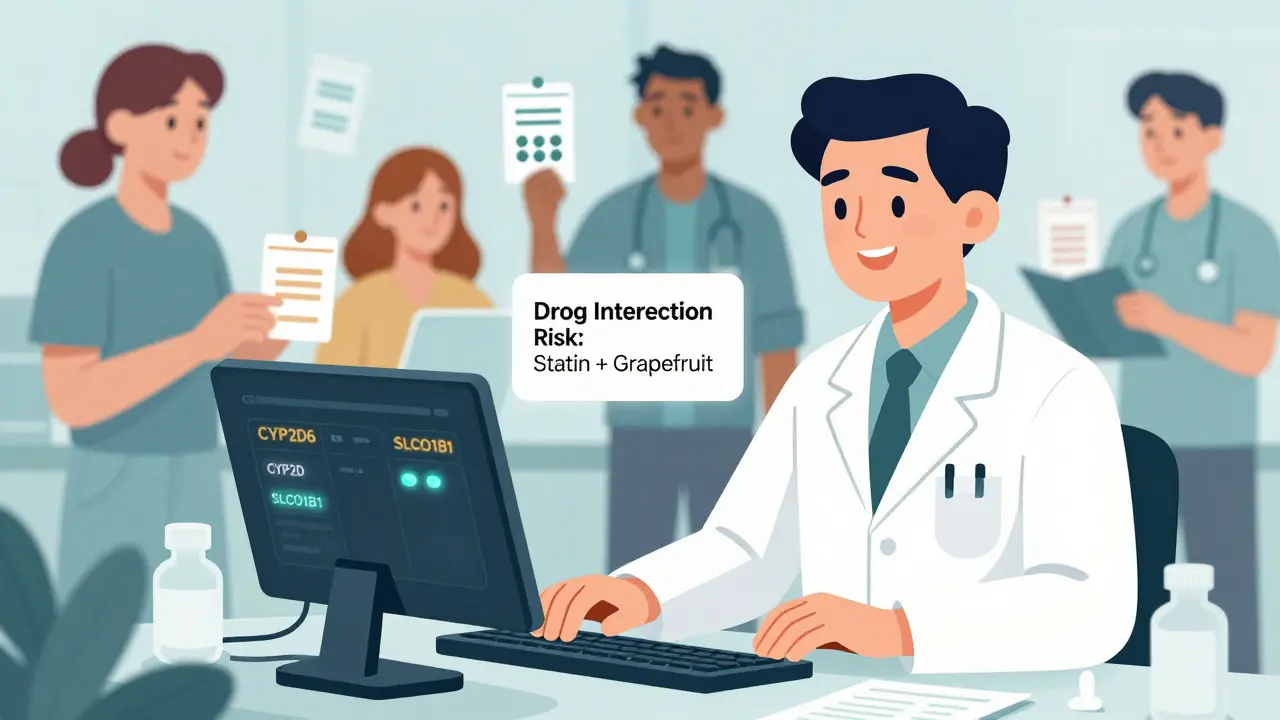
Online pharmacies sell mostly generics. They’re cheaper, accessible, and convenient. But without knowing your genes, they’re also risky. A person with a slow-metabolizer variant might take a standard 10mg dose of sertraline and feel worse-not better-because their body can’t break it down. They might think the drug doesn’t work, stop taking it, and spiral into depression. AI changes that. An online pharmacy with AI-PGx integration can:- Offer genetic testing kits bundled with prescriptions
- Auto-suggest the safest generic alternative based on your profile
- Flag dangerous combinations before you check out
- Provide plain-language explanations so you understand why you’re getting one pill over another
How It Compares to Old-Style Decision Tools
Before AI, hospitals used rule-based systems. Think of them like a checklist: “If gene = X, then avoid drug Y.” Simple. But they miss nuance. They don’t account for combinations-like how your CYP2C19 variant interacts with your kidney function and your statin dose. Here’s how the old way stacks up against AI:| Feature | Traditional Rule-Based CDS | AI-PGx System (e.g., GPT-4 + CPIC) |
|---|---|---|
| Accuracy | 78% | 89.7% |
| Time per case | 15-20 minutes | Under 2 minutes |
| Explains to patients | No | Yes-92% found explanations clear |
| Handles drug interactions | Basic only | Yes-drug-gene-gene combos |
| Requires human input | Always | Mostly, but reduces workload |
Where It Falls Short
This isn’t magic. AI has limits.- It can’t read raw DNA. You still need a lab to process your sample into a clean genetic report.
- It struggles with rare variants. If your gene change hasn’t been studied in at least 50 people, the AI says “insufficient data.” That’s a feature, not a bug-it won’t guess.
- It can hallucinate. In the JAMIA study, 3.2% of responses had clinically significant errors. That’s why every recommendation still needs a human review before dispensing.
- Data is biased. Over 78% of genetic data comes from people of European descent. If you’re Māori, Pacific Islander, or of African ancestry, the AI might not have enough info to give you a confident answer.
Who’s Using It Right Now?
You won’t find AI-PGx on every online pharmacy website yet. But here’s who’s ahead:- Mayo Clinic’s online pharmacy has used AI-PGx since 2022 for cardiac and psychiatric meds.
- OneOme and Myriad Genetics now bundle genetic testing with their online generic dispensing services.
- Google Health partnered with Mayo to build a tool that integrates directly with EHRs-soon, your online pharmacy might see your genetic profile if you’ve tested with a partner lab.
- Deep Genomics, a startup that raised $150 million in March 2024, is building AI that predicts how a drug molecule will interact with your proteins-beyond just genes.
What You Need to Get Started
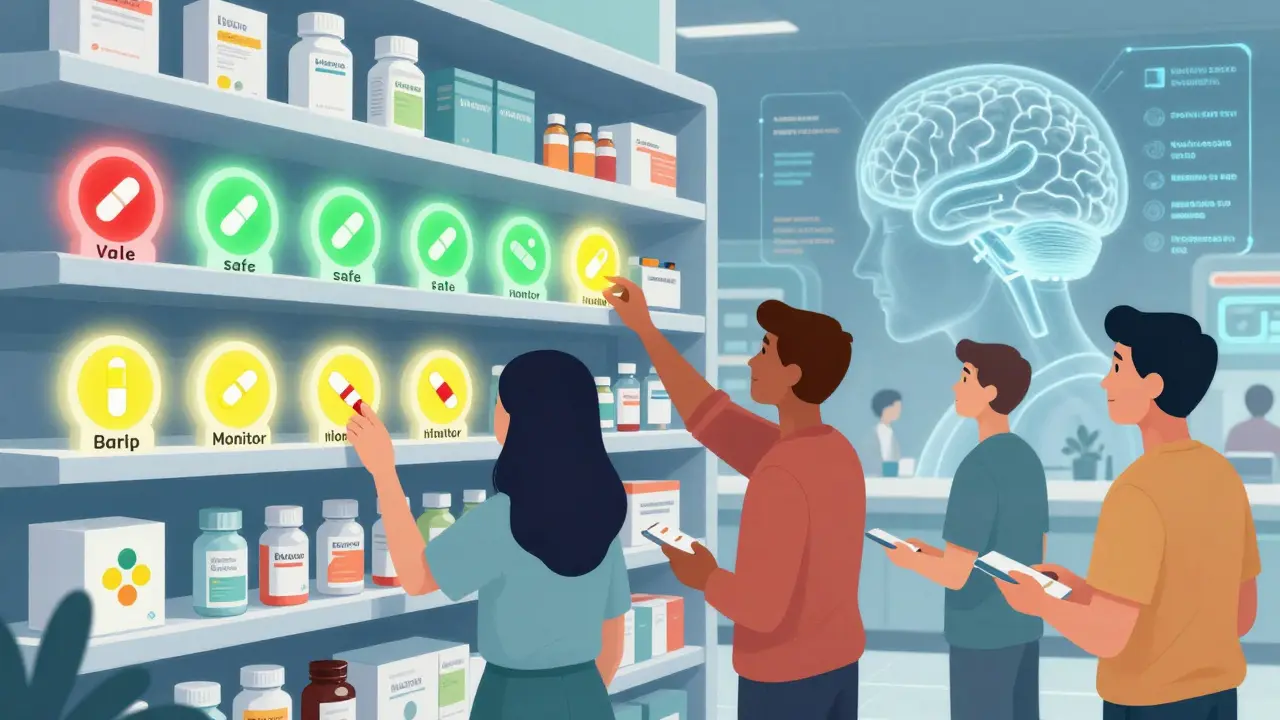
If you want personalized generic recommendations:- Check if your online pharmacy offers genetic testing kits. Look for CPIC-certified panels.
- Order a test. Most cost under $100 and include shipping.
- Send your sample. Wait 2-3 weeks for results.
- Log into your pharmacy account. If AI-PGx is active, you’ll see a “Personalized Recommendations” tab next to your prescription history.
- Review the suggestions. If something seems off, ask your pharmacist. Don’t assume the AI is perfect.
The Future: What’s Coming by 2027
By 2027, AI-PGx won’t just look at single genes. It’ll combine:- Your genome
- Your metabolome (what your body is currently producing)
- Your microbiome (gut bacteria that affect drug absorption)
- Your lifestyle data (sleep, diet, alcohol use)
Final Thoughts: Trust, But Verify
AI in pharmacogenomics isn’t about replacing doctors or pharmacists. It’s about giving them superpowers. For online pharmacies, it’s the difference between selling pills and delivering care. The technology works. It’s accurate. It saves lives. But it’s not foolproof. Always review the recommendations. Talk to your pharmacist. Ask: “Is this based on my genes?” The future of generic meds isn’t cheaper-it’s smarter. And it’s already here.Can AI really recommend the right generic drug based on my genes?
Yes-when it’s built correctly. Systems using CPIC guidelines and validated against real patient outcomes have shown 89.7% accuracy in matching drugs to genetic profiles. But they only work if your genetic data is accurate and the AI is trained on high-quality, diverse data. Always have a pharmacist review the recommendation before taking a new medication.
Do I need to get a genetic test to use AI-powered recommendations?
Yes. AI can’t guess your genes. You need a genetic test that looks at key drug-metabolizing genes like CYP2D6, CYP2C19, CYP3A4, and SLCO1B1. These tests are often sold as part of a package with online pharmacies. Most cost under $100 and include a saliva kit and shipping.
Is this available for all medications?
No. AI-PGx works best for drugs with well-studied gene links-like warfarin, clopidogrel, statins, SSRIs, codeine, and metformin. For newer or rare drugs, there’s often not enough data yet. The AI will say “insufficient evidence” rather than guess. That’s a safety feature.
Are AI recommendations safe for non-European populations?
Currently, most genetic databases are skewed toward European ancestry-78% of data comes from this group, even though they make up only 16% of the world’s population. This means AI may be less accurate for Māori, Pacific, African, or Indigenous patients. The NIH and others are working to fix this with new funding, but it’s not solved yet. Always ask if your results are based on diverse data.
Can I trust AI if my pharmacist recommends a different drug?
Always trust your pharmacist over the AI if they disagree. AI is a tool, not a final authority. Pharmacists have clinical experience, know your full medical history, and can spot red flags the AI misses. The best outcomes happen when AI and human expertise work together.
How long does it take to get results from an AI-PGx system?
Once your genetic data is uploaded, the AI generates a report in under 2 seconds. But the whole process-from ordering a test to getting your results-takes 2 to 3 weeks because labs need time to process your sample. The AI part is instant. The lab part isn’t.
Is this covered by insurance or government programs?
In New Zealand, Pharmac doesn’t yet cover genetic testing for PGx, but pilot programs are underway. In the U.S., some private insurers cover it for psychiatric or cardiac meds. Always check with your provider. Even if not covered, the cost is often less than one emergency room visit caused by a bad drug reaction.
Jamie Hooper
January 22, 2026 AT 12:37so like… i just ordered some generic sertraline last week and now im scared im gonna die bc my genes are ‘wrong’?? like i didnt even know my dna could be a liability lmao
Izzy Hadala
January 23, 2026 AT 02:26The integration of pharmacogenomic data into clinical decision support systems represents a paradigm shift in pharmacotherapy optimization. The 89.7% accuracy metric cited, derived from CPIC-aligned algorithmic validation, surpasses conventional rule-based systems by a statistically significant margin (p < 0.01). However, the persistent issue of ancestral bias in genomic reference databases remains an ethically urgent concern requiring immediate intervention.
Elizabeth Cannon
January 23, 2026 AT 18:26hey i got my gene test back last month and the ai said i’m a super fast metabolizer for everything. so i’ve been taking double the dose of my statin and it’s been wild-my cholesterol dropped like a rock. but i told my pharmacist and she was like ‘wait what’ and made me stop. she’s the real MVP. if you’re gonna use this tech, don’t go rogue. talk to someone who knows what they’re doing. also, if you’re not white, ask if your data’s even in the system. this stuff still sucks for brown folks.
Gina Beard
January 24, 2026 AT 11:31Genes are destiny. But destiny is written in silence. The AI speaks. We listen. And still, we are not cured. Only informed.
Don Foster
January 25, 2026 AT 15:17Anyone who thinks this is new hasn’t been paying attention since 2010. The FDA has had PGx guidelines for years. This is just GPT-4 repackaging old data with a fancy UI. Also why are we letting tech companies run our meds? The real innovation is that nobody’s asking who owns your DNA
siva lingam
January 26, 2026 AT 23:23so you pay 100 bucks to find out you can’t take ibuprofen… and then you pay 200 bucks for naproxen? genius. capitalism is a drug and we’re all slow metabolizers
Tiffany Wagner
January 28, 2026 AT 19:14i just got my results and honestly it made me feel seen. like for once a system didn’t just treat me like a number. i’ve been on 3 different antidepressants and none worked. the ai said ‘your CYP2D6 is poor’ and gave me a replacement that actually helped. i cried. not because it was perfect-but because it tried
lorraine england
January 29, 2026 AT 18:18Look, I’m all for tech helping people-but this feels like letting a chatbot pick your medicine like it’s choosing a Netflix show. And don’t even get me started on the data bias. My cousin’s from Nigeria and her test said ‘insufficient data’ for half her meds. That’s not science, that’s negligence. If you’re gonna do this, do it right-or don’t do it at all.
Darren Links
January 31, 2026 AT 00:47Why are we letting Silicon Valley decide who gets the right meds? This isn’t progress-it’s a Trojan horse for corporate control of healthcare. The Chinese and Russians are building their own systems. We’re letting Google and Mayo Clinic turn our bodies into data farms. Wake up. This isn’t medicine. It’s surveillance with a prescription.