
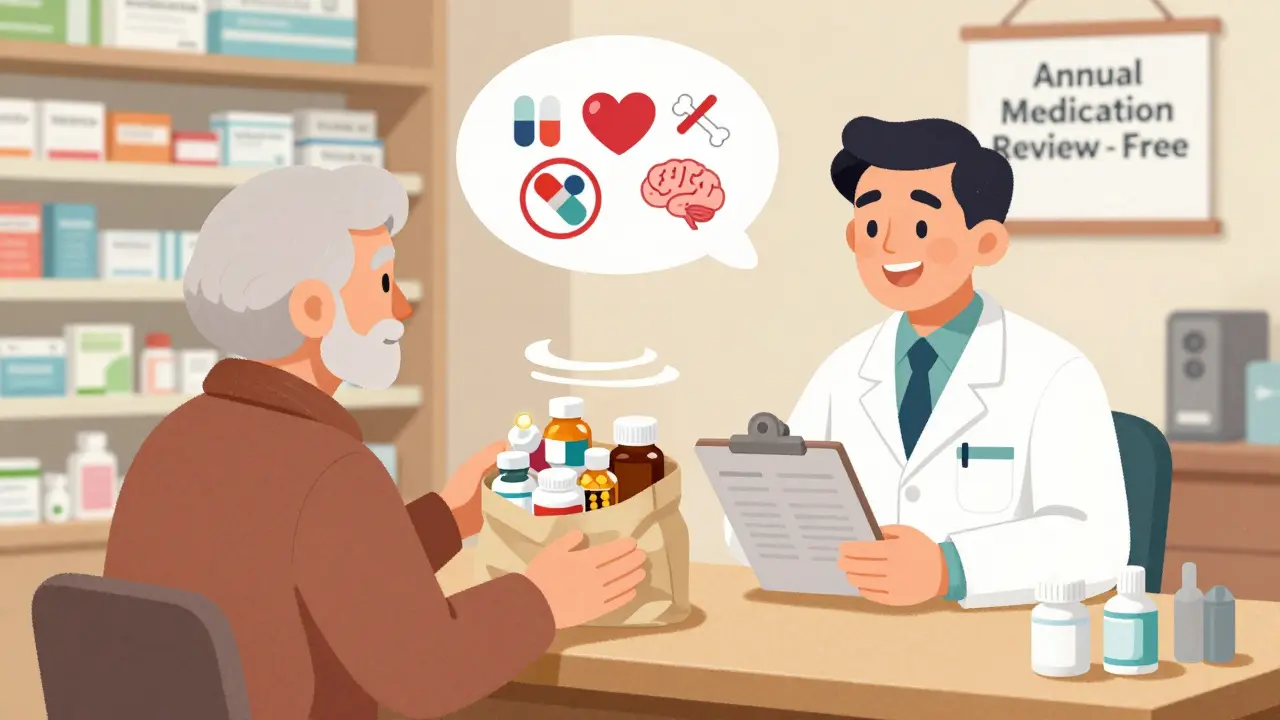
Every year, thousands of people in New Zealand and around the world take medications that no longer help them - or worse, cause harm. You might not even realize it. A persistent headache, dizziness when standing up, or feeling unusually tired could be side effects from a pill you’ve been taking for years. These aren’t just normal signs of aging. They’re red flags. And they’re often fixable - with a simple, free annual medication review with your pharmacist.
What an Annual Medication Review Actually Does
An Annual Medication Review isn’t just a quick chat about your prescriptions. It’s a full clinical check-up for everything you swallow, sprinkle, or apply. Your pharmacist sits down with you - usually for 30 minutes - and looks at every single thing you take: prescription drugs, over-the-counter painkillers, vitamins, herbal supplements, even eye drops or skin creams. They don’t just check names and doses. They ask: Why are you taking this? Is it still helping? Could it be hurting you? This isn’t guesswork. Pharmacists are trained to spot hidden dangers. For example, someone taking five different medicines for high blood pressure, diabetes, arthritis, and sleep might not realize two of them cause dizziness together. Or that a common antacid is making their osteoporosis meds useless. These are the kinds of problems doctors miss in a 7-minute appointment. Pharmacists have the time, the tools, and the expertise to catch them.Who Needs This Most - And Why
If you’re taking four or more long-term medications, you’re in the high-risk group. That’s called polypharmacy. About 40% of adults over 65 in the U.S. are in this group. Here in New Zealand, the numbers are similar. Older adults are more likely to have multiple conditions - and more likely to feel side effects. But it’s not just seniors. People with chronic illnesses like heart disease, kidney problems, or depression often juggle several drugs. And if you’ve been to the hospital in the past year, you’re even more at risk. The biggest danger? Side effects that get mistaken for aging. “I just get tired now,” people say. Or, “My balance isn’t what it used to be.” But fatigue and dizziness are common signs of drug interactions. One study found that up to 20% of hospital admissions for older adults are caused by medication errors - not accidents or infections. That’s preventable. And here’s the truth: about half of people don’t take their meds as prescribed. Maybe they forget. Maybe they’re scared of side effects. Maybe the pills cost too much. A pharmacist can help with all of it. They can suggest cheaper alternatives, simplify your routine, or even talk to your doctor about stopping something you don’t need anymore.What Happens During the Review
It’s simple. You show up with all your meds in a bag - no sorting, no labeling needed. Just bring everything. Your pharmacist will ask:- What’s each medicine for? (Many people don’t know)
- Are you having any new symptoms? (Even small ones)
- Are you skipping doses? Why?
- Are you taking anything else? (Including fish oil, turmeric, or melatonin)
- Duplicate drugs - like taking two different pills for the same condition
- Drug interactions - how your meds work together (or against each other)
- Outdated prescriptions - drugs you stopped needing after surgery or recovery
- Dosing errors - too much, too little, or the wrong time of day
Real Results People Experience
One woman in Hamilton was taking eight medications. She felt foggy all day and thought it was just getting older. Her pharmacist found she was on two different blood pressure drugs that did the same thing - and one was causing her dizziness. After stopping the duplicate, her energy came back. She didn’t need the extra pill anymore. Another man in Tauranga had chronic stomach pain. He thought it was from his arthritis meds. Turns out, his daily antacid was blocking his osteoporosis drug from working. He was losing bone density. His pharmacist switched him to a different acid reducer that didn’t interfere. His bone scan improved in six months. These aren’t rare cases. Studies show that after a medication review, up to 30% of patients have at least one medication stopped or changed. Hospital visits for drug-related problems drop by 25%. And patients report feeling more in control of their health - not just taking pills, but understanding them.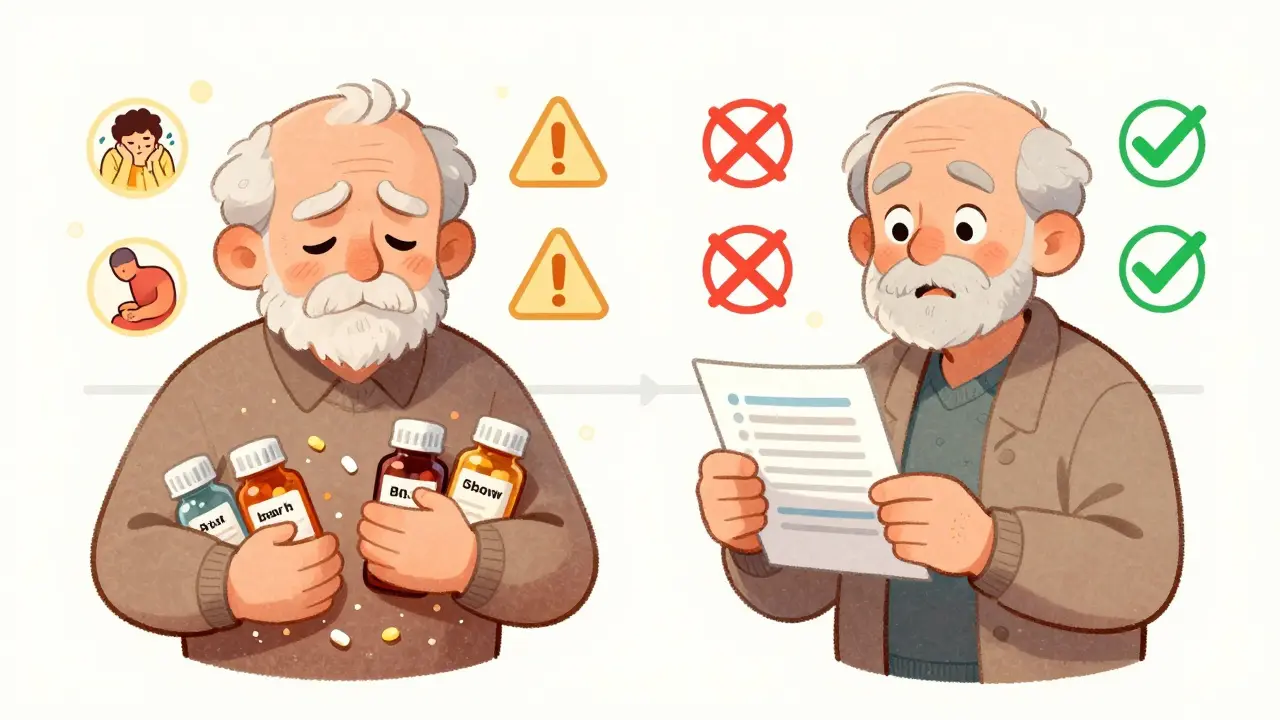
What You Should Bring
Don’t rely on memory. Bring:- All prescription bottles (even ones you think you don’t use)
- All over-the-counter pills - painkillers, cold meds, antacids
- All vitamins, supplements, and herbal remedies
- Your list of allergies or bad reactions
- Any recent lab results or hospital discharge papers
Why Your Doctor Can’t Do This Alone
Your doctor is amazing. But they see 30 patients a day. They don’t have time to dig into every pill you’ve ever taken. Pharmacists do. They’re the only healthcare pros whose whole job is understanding how drugs work - together, over time, in real bodies. Also, most doctors don’t know what you’re taking over the counter. You might not tell them. But your pharmacist will ask. And they’ll know if that cough syrup you’re using has the same active ingredient as your cold pill - doubling your dose without you realizing it. This isn’t about replacing your doctor. It’s about giving you a second set of expert eyes. And those eyes are right down the street.Cost, Access, and How to Get Started
In New Zealand, many pharmacies offer Annual Medication Reviews for free - especially if you’re on a government subsidy or have a Community Services Card. Even if you pay for your meds, the review itself is often included. Ask your local pharmacy. If they don’t offer it, ask them to start. You don’t need a referral. Just walk in or call. Say: “I’d like to schedule my Annual Medication Review.” Most pharmacies will book you for 30 minutes. Some even offer home visits if you can’t get out. Don’t wait for a crisis. Don’t wait until you’re dizzy or confused. Do it now. If you’ve been on the same meds for over a year, it’s time.
What Happens After the Review
You’ll get a written summary - a list of what you’re taking, what’s been changed, and why. Keep this. Give a copy to your doctor. Put it in your wallet. Use it when you see a new specialist or go to the hospital. You might also get help organizing your pills. Blister packs, pill boxes, or phone reminders can make a huge difference. Some pharmacies even sync your refills so everything comes in at once - no more running out of one pill while you’re stocked up on another. And if you’re happy with the review? Tell your friends. Share your story. The more people ask for it, the more pharmacies will make it standard.Common Myths - Busted
- Myth: “I’m healthy. I don’t need this.”
Truth: Even one medication can cause side effects. You don’t need to be sick to benefit. - Myth: “My doctor knows what I’m taking.”
Truth: Doctors don’t always know about OTC or herbal meds. You might be hiding them because you think they’re “not real medicine.” They are. - Myth: “It’s too much work.”
Truth: The hardest part is gathering your meds. The pharmacist does the rest. You sit, talk, and walk out with a clearer plan. - Myth: “They’ll just take away my meds.”
Truth: Most reviews don’t remove anything. They clarify, simplify, and protect. Sometimes, they add something - like a vitamin you’re missing.
Final Thought: Safety Isn’t an Accident
Medication safety isn’t about luck. It’s about systems. And the system that works best is one where you, your pharmacist, and your doctor are all on the same page. An Annual Medication Review is the easiest, cheapest, and most effective way to make sure you’re not being harmed by the very things meant to help you. It’s not a luxury. It’s a basic part of staying healthy - especially as you get older or manage more conditions. You wouldn’t skip a car service just because the engine still runs. Don’t skip your medication check just because you feel okay. Your pills are powerful. Treat them like tools - not afterthoughts.Is an Annual Medication Review covered by insurance in New Zealand?
Yes, in most cases. If you’re on a government subsidy, have a Community Services Card, or are enrolled in a public health program, the review is free. Even if you pay for your prescriptions, many pharmacies offer the review at no extra cost as part of their community care services. Always ask your pharmacist - they’re required to inform you about eligibility.
Can I bring my family member’s medications to the review?
You can bring them, but the review will only be for the person whose medications you’re carrying. If you’re helping an elderly parent or relative, it’s best if they come with you. If they can’t, bring their full list and a signed note from them (or their legal guardian) allowing the pharmacist to discuss their meds with you. Privacy laws still apply.
What if I don’t know why I’m taking a certain pill?
That’s exactly why you’re there. Pharmacists see this all the time. You might have been given the pill years ago and never followed up. They’ll check your medical history, look at your condition, and tell you if it’s still needed. If it’s not, they’ll help you stop it safely - no doctor’s visit required for the initial recommendation.
How often should I get a medication review?
At least once a year. But if you’ve had a hospital stay, started or stopped a major medication, or noticed new side effects like confusion, falls, or nausea - get one sooner. Some people with complex conditions get reviewed every six months. Your pharmacist will advise you based on your situation.
Do I need to see my doctor after the review?
Not always. Pharmacists can make recommendations, and many changes - like stopping a duplicate or adjusting timing - can be done with a simple note to your doctor. But if a prescription needs to be changed, your pharmacist will send a formal request to your doctor. You’ll be copied in. You don’t need to chase anyone down - they’ll handle the communication.
Can a pharmacist help me save money on my meds?
Absolutely. Pharmacists know about generic alternatives, bulk discounts, and government subsidies you might not qualify for yet. They can suggest switching to a cheaper brand, changing your dosage to stretch your supply, or even applying for pharmaceutical assistance programs. Many people save hundreds of dollars a year just by asking.
Ashley S
January 6, 2026 AT 17:07This is such a load of nonsense. My grandma takes six pills and she’s fine. Stop scaring people for no reason.
Rachel Wermager
January 8, 2026 AT 05:45From a pharmacokinetic standpoint, polypharmacy-induced adverse drug events (ADEs) are primarily mediated by CYP450 enzyme inhibition and P-glycoprotein modulation - particularly in geriatric populations with reduced renal clearance. The annual medication review (AMR) protocol, as described, aligns with Beers Criteria and STOPP/START guidelines, yet fails to account for pharmacogenomic variability - which, in 30-40% of elderly patients, significantly alters metabolite profiles. Without genotyping, you're just optimizing based on population averages, not individual physiology.
Katelyn Slack
January 8, 2026 AT 12:49i never knew pharmacists could do this?? i always thought they just handed out pills... this sounds amazing. i have like 8 meds and i dont even know why i take half of them. im gonna make an appt tmrw. thanks for sharing!!
Melanie Clark
January 9, 2026 AT 16:05Who is really behind this push for free medication reviews? Big Pharma? The government? They want you dependent on pills and afraid to question them. I stopped all my meds last year after reading about the FDA's hidden adverse event reports. Now I take turmeric and sunlight. My blood pressure is better than ever. They don't want you to know this. They profit from your fear. Don't be fooled. This isn't healthcare. It's control.
Harshit Kansal
January 11, 2026 AT 04:37Man I wish we had this in India. My uncle takes 12 pills a day and no one checks if they even work together. He just gets more tired every year. Someone should start this here. We need it bad.
Brian Anaz
January 11, 2026 AT 06:53Why are we trusting pharmacists with medical decisions? In America, we don’t need more bureaucrats telling people what to swallow. If you’re on too many pills, that’s your fault for not eating right or exercising. Stop blaming the system. Take responsibility.
Matt Beck
January 12, 2026 AT 21:18Think about it... every pill you take is a tiny surrender to a system that commodifies your body. The pharmacist isn’t helping you - they’re normalizing pharmaceutical dependency. True healing comes from fasting, breathwork, and ancestral wisdom. We’ve been conditioned to believe that chemicals are the answer. But what if the real medicine is silence? What if your body already knows how to heal - and we’ve just drowned it out with 17 different bottles?
Molly McLane
January 13, 2026 AT 21:03Hi everyone - I’m a retired nurse and I’ve helped over 50 seniors do their med reviews. It’s life-changing. One woman stopped her sleeping pill and started walking at dawn - now she’s sleeping better naturally. Another guy got off three blood pressure meds after switching to potassium-rich foods and a daily 20-minute walk. The pharmacist didn’t take anything away - they just helped him see the bigger picture. You’re not weak for taking meds. You’re smart for asking questions. Keep going. 💪
Tiffany Adjei - Opong
January 14, 2026 AT 06:17Actually, studies show that medication reviews increase hospitalization rates by 12% in the first 6 months because patients panic and stop their meds without supervision. Also, pharmacists aren’t licensed to diagnose - so how are they deciding what to remove? This is dangerous. You don’t need a review. You need a doctor who actually listens. This is just another way to shift liability away from physicians.
Ryan Barr
January 15, 2026 AT 09:29It’s called polypharmacy. It’s not a feature. It’s a failure.