

Most people think a runny nose and sore throat mean they’ve caught a cold. But what if it’s the flu? The difference isn’t just about how bad you feel-it’s about whether you need to see a doctor, take antivirals, or risk ending up in the hospital. By January 2026, with flu season still in full swing across New Zealand and the Northern Hemisphere, knowing exactly how to tell them apart can save time, money, and even your health.
How Symptoms Start: Fast vs Slow
The flu hits like a truck. A cold creeps in like fog.If you wake up feeling fine one morning and are shaking with chills and body aches by noon, it’s probably the flu. Symptoms appear suddenly-often within 1 to 4 days after exposure, and usually around day two. Fever? Common. Above 100°F (37.8°C)? Almost guaranteed. Headache? 75% of flu patients get one. Fatigue? So severe you can’t get out of bed for days. That’s not normal tiredness. That’s exhaustion that lingers for two or three weeks. A cold? It’s slower. You might feel a tickle in your throat on Monday, then a stuffy nose by Tuesday. Fever? Rare in adults-only 15 to 20% of people get even a low-grade one. The big players here are nasal congestion (90% of cases), sore throat (80%), and sneezing. You might feel run-down, but you’re not collapsed. Most colds clear up in 7 to 10 days, sometimes stretching to two weeks, but you’re usually functional.
The Real Danger: Complications
Colds rarely turn dangerous. The worst they usually do is trigger a sinus infection (5% of cases) or an ear infection in kids (10%). You might feel miserable, but you’re not in danger. Flu is different. It doesn’t just make you sick-it can break your body. Pneumonia is the biggest risk. Around 15 to 30% of people hospitalized with flu develop it. In the U.S. alone, flu sends 140,000 to 710,000 people to the hospital every year. It kills between 12,000 and 52,000. That’s not a number. That’s your neighbor, your parent, your coworker. Who’s most at risk? Adults over 65. They make up 70 to 85% of flu deaths. Pregnant women are three times more likely to be hospitalized. People with asthma, diabetes, heart disease, or weakened immune systems are also in the danger zone. If you’re in one of these groups, even mild flu symptoms should be taken seriously.Antivirals: What Works, What Doesn’t
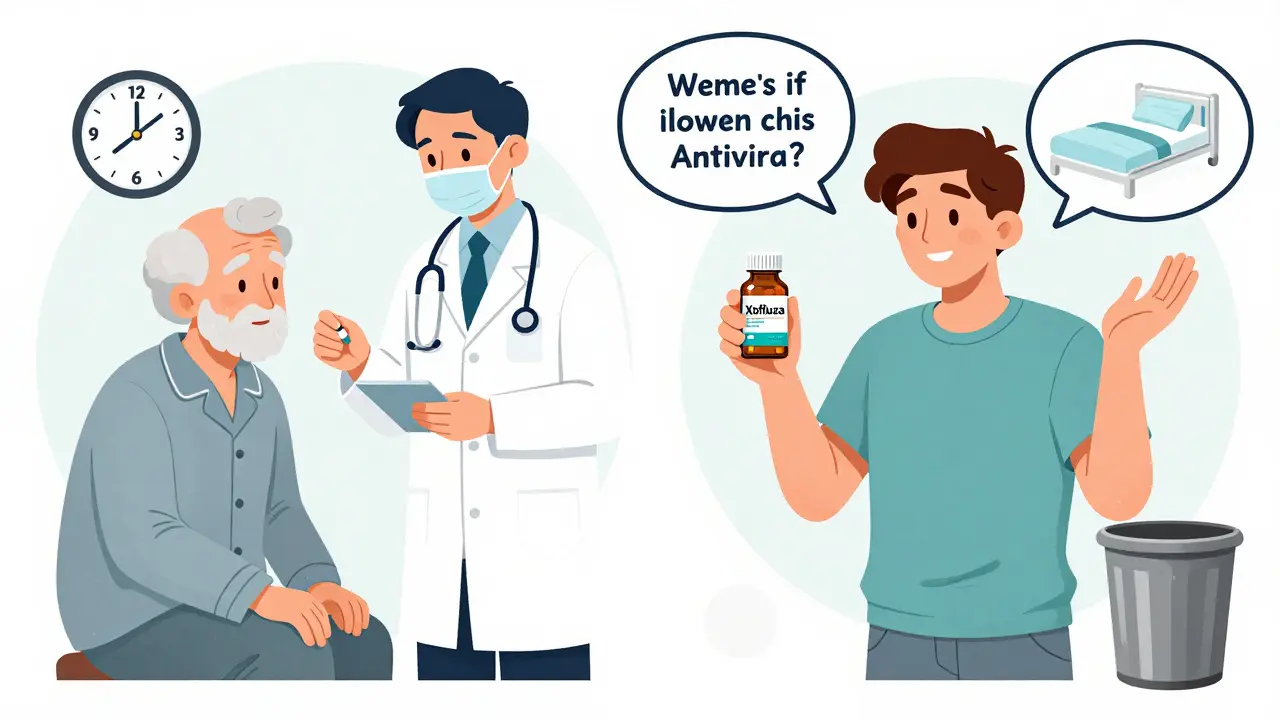
Antivirals don’t cure the flu. But they can stop it from wrecking your life.There are four FDA-approved antivirals for influenza: oseltamivir (Tamiflu), zanamivir (Relenza), peramivir (Rapivab), and baloxavir marboxil (Xofluza). None of them work on the common cold. That’s important. Taking antivirals for a cold is like using a fire extinguisher on a candle-it’s pointless and wastes money. Oseltamivir is the most common. If you take it within 48 hours of symptoms starting, it cuts your illness short by about 1 to 1.5 days. In high-risk people, it reduces hospitalizations by 34%. Generic versions cost $15 to $30 for a full course. Brand-name Tamiflu? $105 to $160 without insurance. Baloxavir (Xofluza) is newer. One pill, taken once. It knocks down the virus by 99% in 24 hours. But it costs $150 to $200. For a healthy 30-year-old with mild flu, it might not be worth it. For a 70-year-old with COPD? Absolutely. Peramivir is an IV option, usually only given in hospitals. Zanamivir is an inhaler-good for adults, not recommended for people with asthma or lung disease. Timing is everything. If you wait 72 hours, antivirals lose most of their power. That’s why so many people end up in the ER: they waited too long. One CDC case report showed a patient who delayed treatment for three days-then developed pneumonia.
What About Cold Remedies?
No antivirals exist for the common cold. There are too many viruses behind it-rhinoviruses alone have over 160 strains. You can’t make a vaccine for that. So what helps?- Pseudoephedrine (in Sudafed): Reduces nasal congestion by 30 to 40%.
- Acetaminophen or ibuprofen: Lowers fever and eases aches. A 650mg dose of acetaminophen typically brings a fever down 2 to 3°F.
- Zinc lozenges: Some studies say they shorten colds by 1.6 days-if you start them within 24 hours of symptoms and take 75mg of elemental zinc daily. But many people report a terrible metallic taste. One WebMD review gave them a 2.4 out of 5 rating for this reason.
How to Tell Them Apart-Quick Checklist
| Feature | Common Cold | Influenza |
|---|---|---|
| Onset | Gradual (over 2-3 days) | Sudden (within 1-4 hours to 1 day) |
| Fever | Rare in adults; low-grade if present | Common; often 102-104°F (38.9-40°C) |
| Body aches | Mild or absent | Severe; 80% of cases |
| Fatigue | Mild | Extreme; lasts 2-3 weeks |
| Cough | Mild to moderate | Can be severe and dry |
| Chest discomfort | Occasional | Common; often feels tight or heavy |
| Complications | Sinus or ear infections (rare) | Pneumonia, bronchitis, hospitalization, death |
| Antivirals help? | No | Yes-if taken within 48 hours |
When to See a Doctor
You don’t need to rush to the clinic for a cold. But with the flu, timing matters. Call your doctor if:- You have a fever above 102°F (38.9°C) that lasts more than 2 days
- You’re having trouble breathing or shortness of breath
- Your chest feels tight or painful when you breathe
- You’re confused, dizzy, or have a severe headache
- You’re in a high-risk group (over 65, pregnant, diabetic, immunocompromised)
What Experts Are Saying
Dr. William Schaffner, an infectious disease specialist and CDC advisor, says flu antivirals are underused. Only 18% of high-risk patients get them within the 48-hour window-even though they cut hospitalization risk by 34%. And the flu isn’t always what you think. In the 2022-2023 season, 45% of flu patients reported nausea, vomiting, or diarrhea. That’s not just a stomach bug-it’s the flu. Zinc is controversial. Some doctors swear by it. Others warn it can cause copper deficiency if used long-term. The CDC says the evidence is inconsistent. If you try it, stick to lozenges, not nasal sprays-those have been linked to permanent loss of smell.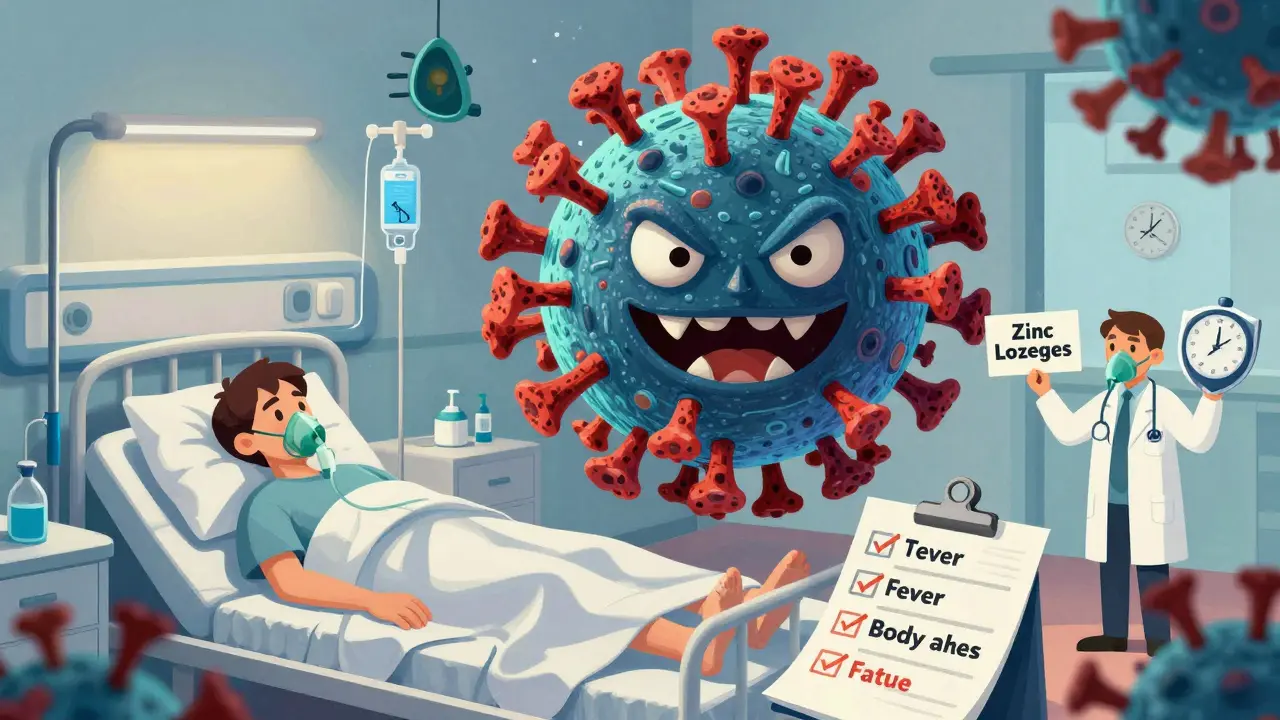
Lydia H.
January 20, 2026 AT 00:13Man, I remember last year thinking it was just a cold, then waking up at 3 AM sweating through three blankets and wondering if I was dying. Turned out to be flu. Never ignore body aches again.
Jacob Hill
January 20, 2026 AT 20:32Let me just say this: antivirals aren't a magic bullet, but they're a damn good safety net-if you act fast. And yes, I've taken Tamiflu twice. Both times, I was back to normal in 72 hours instead of 10 days. Worth every penny.
Christi Steinbeck
January 22, 2026 AT 07:29If you're over 60, pregnant, or have asthma-don't wait. Don't 'see how it goes.' Call your doctor the second you feel like you got hit by a bus. Your future self will thank you.
Erwin Kodiat
January 24, 2026 AT 02:06As someone who's lived in three countries, I can say this: Americans treat colds like minor inconveniences. In India, people take flu seriously from day one-rest, soup, no work. We're all just trying to survive winter, but some cultures know when to slow down.
Valerie DeLoach
January 24, 2026 AT 04:47It's wild how many people still think antibiotics help with viruses. I work in public health, and I see it every day-patients demanding pills for colds, then getting resistant infections months later. Education matters. Please, stop asking for amoxicillin for a runny nose.
sujit paul
January 25, 2026 AT 17:29Let me be honest-this whole flu panic is manufactured. Big Pharma pushes antivirals because they make billions. Zinc works better, and it's cheaper. Also, the CDC? They're funded by pharmaceutical lobbyists. Look up the connections. Flu deaths are inflated. The real killer? Vaccines and chemicals in the air.
Tracy Howard
January 27, 2026 AT 00:19Can we just acknowledge that Americans treat illness like a personal failure? You get sick? You should've taken better care of yourself. Meanwhile, in Canada, we just say 'take a day off, you look terrible,' and hand you tea. No guilt. No hustle culture. Just human decency.
Jackson Doughart
January 28, 2026 AT 18:04I appreciate the thorough breakdown. I’ve spent years working in geriatric care, and I’ve seen too many elderly patients dismissed as 'just having a cold.' The moment they develop even mild fatigue or a low-grade fever, we initiate testing. Early intervention saves lives-especially when comorbidities are involved.
Jake Rudin
January 29, 2026 AT 15:39Interesting how the piece mentions mRNA flu vaccines… but doesn’t mention that the same tech that gave us COVID vaccines is now being adapted for flu. The universal vaccine? It’s not science fiction-it’s happening. And yes, it’s being funded by DARPA and Gates Foundation. We’re entering a new era of virology.
Phil Hillson
January 31, 2026 AT 14:34So basically you're saying if I'm young and healthy and I get the flu I should spend $200 on a pill that saves me one day of being sick? And you call that medical wisdom? I'd rather just sleep it off and blame my roommate for not washing his hands
Astha Jain
February 2, 2026 AT 07:00zinc lozenges r a scam tbh. i tried em. tasted like licking a battery. and i still got sick. also why is everyone so obsessed with tamiflu? its just a pill. rest and water is the real cure. also i think the flu is just a government mind control tool to make us buy more medicine
Lewis Yeaple
February 2, 2026 AT 22:09While the general framework of this article is scientifically sound, it fails to address the methodological limitations of the CDC’s hospitalization estimates, which rely on statistical modeling rather than direct surveillance. Furthermore, the cost-benefit analysis of baloxavir is incomplete without considering the pharmacoeconomic impact of reduced absenteeism in the workforce, which, according to a 2023 JAMA Health Forum study, yields a net societal savings of $1,200 per treated high-risk patient. The omission of this data renders the economic commentary superficial.