
Medication Adherence Calculator
How Medication Adherence Works
Most people estimate their adherence by counting refills or self-reporting. But digital pills provide actual adherence data. As shown in the article, adherence rates can jump from 62% to 84% with this technology.
Calculate Your Adherence Rate
Enter your medication details to see your actual adherence rate
For decades, doctors have known that half of all patients don’t take their medications as prescribed. It’s not laziness or forgetfulness alone - it’s complex. Side effects scare people off. Costs add up. Depression makes routines fall apart. But what if your pill could tell you - and your doctor - exactly when it was swallowed? And not just that, but also detect early signs of a bad reaction before you even feel it?
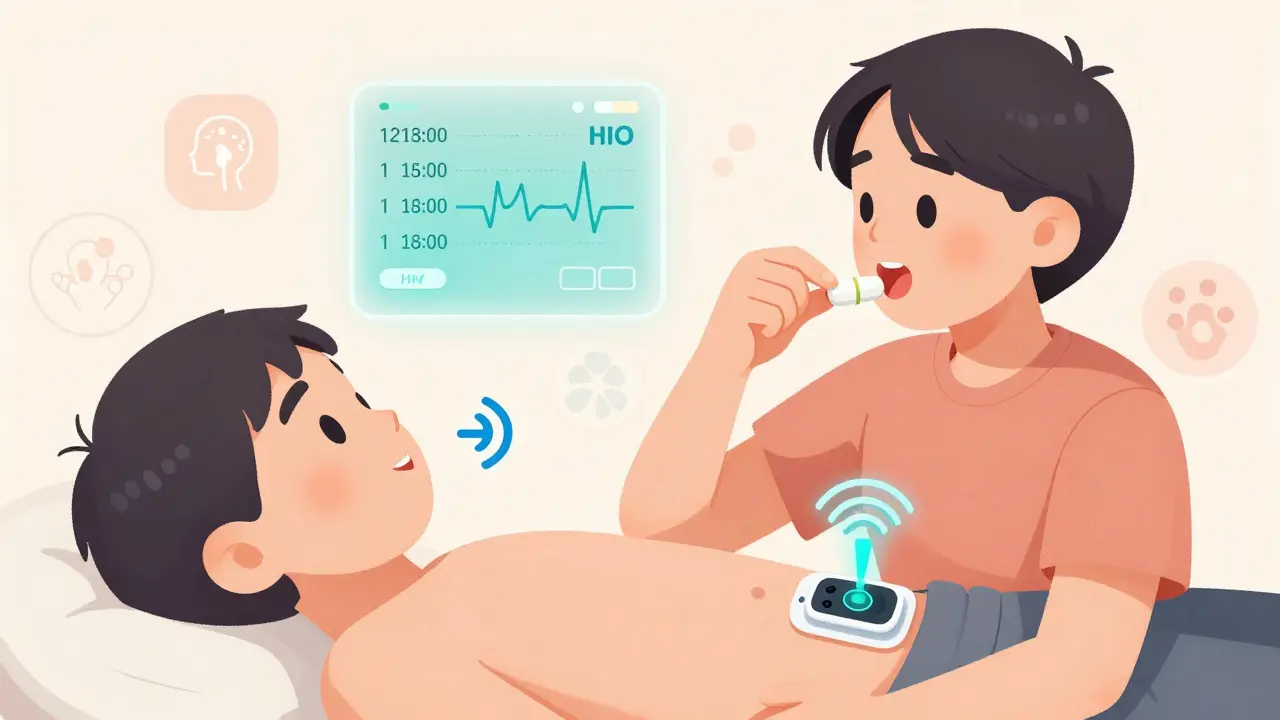
This isn’t science fiction. It’s happening now, quietly, in clinics and research labs. Digital pill sensors are tiny electronic chips embedded inside pills that activate when they hit stomach acid. They send a signal to a patch on your skin, which then transmits data to your phone and your doctor’s dashboard. The goal? To fix the broken link between prescription and practice.
How Digital Pills Actually Work
At the heart of every digital pill is a sensor no bigger than a grain of sand. Made from copper and magnesium, it’s harmless and dissolves after use. When you swallow the pill, stomach fluid triggers a tiny electrochemical reaction - like a mini battery - generating enough power to send a unique digital code via Bluetooth Low Energy.
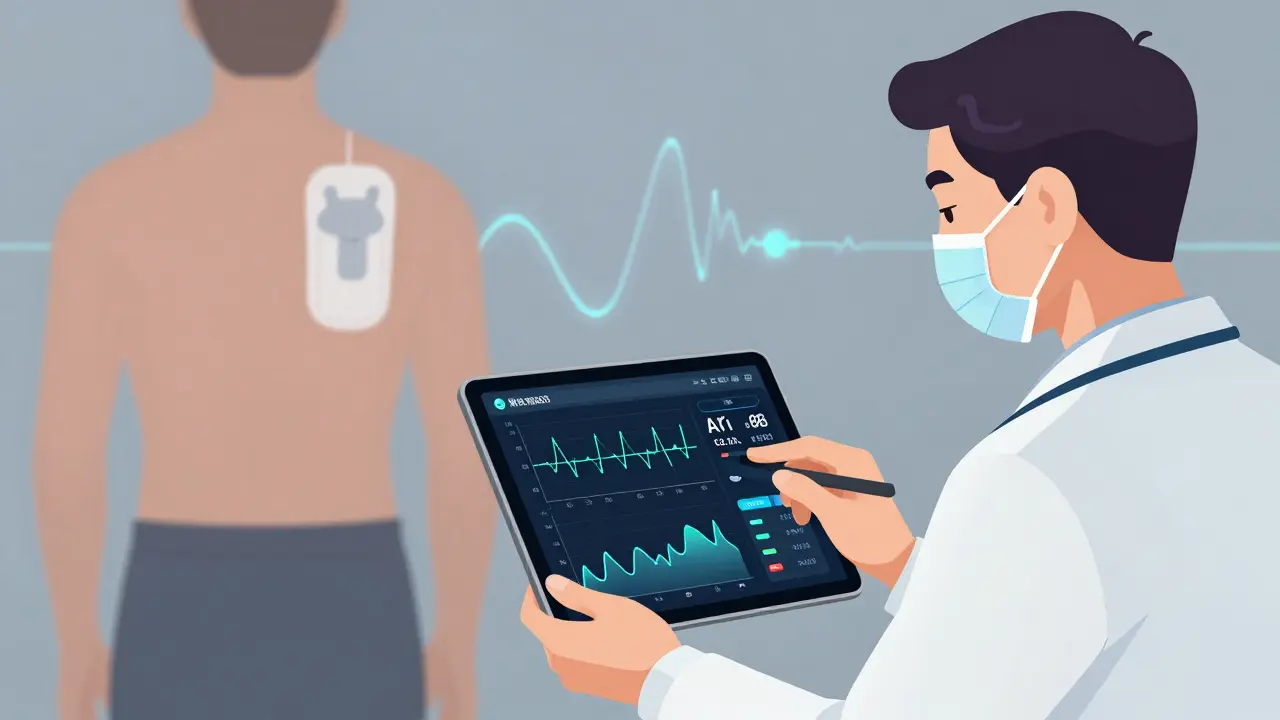
That signal is picked up by a wearable patch, usually stuck to your abdomen. The patch doesn’t just receive data - it also tracks your heart rate and movement. Some systems, like Philips’ IntelliCap, go further, measuring stomach temperature and pH levels in real time. All of this flows securely to a cloud platform, encrypted with AES standards, so only authorized people can see it.
It’s not magic. It’s engineering. The sensor doesn’t know if the drug was absorbed - only that it was ingested. But that’s still a huge leap. Before these sensors, adherence was estimated through pharmacy refills or patient self-reports. Both are unreliable. Now, you get a timestamped record: 10:17 a.m., December 12 - pill ingested.
Where It’s Making the Biggest Difference
Digital pills aren’t for everyone. They’re being used where missing a dose can be dangerous - or deadly.
In mental health, the impact is clear. A 2022 study of 157 patients on antipsychotics showed adherence jumped from 62% to 84% over 12 weeks. One patient on Reddit said, “Seeing the records made me realize I was skipping doses on weekends. I didn’t even know I was doing it.” For someone with schizophrenia, that kind of insight can mean the difference between hospitalization and stability.
HIV treatment is another key area. Missing even one dose can lead to drug resistance. Digital pills help ensure the strict daily regimen is followed, especially in populations with unstable housing or limited access to care.
In 2023, the FDA approved the first digital pill for tuberculosis - a disease that requires months of multi-drug therapy. Non-adherence here fuels drug-resistant strains that spread in communities. Now, public health workers can track treatment in real time, even in remote areas.
Cardiovascular and diabetes patients are next in line. High blood pressure and Type 2 diabetes often have no symptoms until damage is done. If a patient skips their pill for a week, their blood pressure might spike - and they might not notice. Digital sensors give clinicians early warnings before complications arise.
Side Effect Detection: The Next Frontier
Adherence is just the beginning. The real breakthrough is side effect detection.
Current systems monitor heart rate, activity levels, and gastric pH. A sudden drop in step count? A spike in resting heart rate? A change in stomach acidity? These aren’t just random data points. They’re early signals.
For example, a patient taking a new antidepressant might develop serotonin syndrome - a rare but dangerous reaction. Early signs include increased heart rate, sweating, and restlessness. If the wearable patch detects a 15% rise in heart rate over 48 hours, paired with reduced movement, the system can flag it before the patient even feels unwell.
etectRx announced in late 2023 that its AI model, built with IBM Watson Health, predicts adherence lapses with 82% accuracy. The next step? Predicting adverse reactions. By 2026, 60% of digital pill systems are expected to include side effect detection as standard, according to the Digital Medicine Society’s 2023 roadmap.
This isn’t about surveillance. It’s about prevention. Imagine catching a dangerous reaction before it becomes an emergency. That’s the promise.
What Patients Really Think
Technology doesn’t work if people won’t use it.
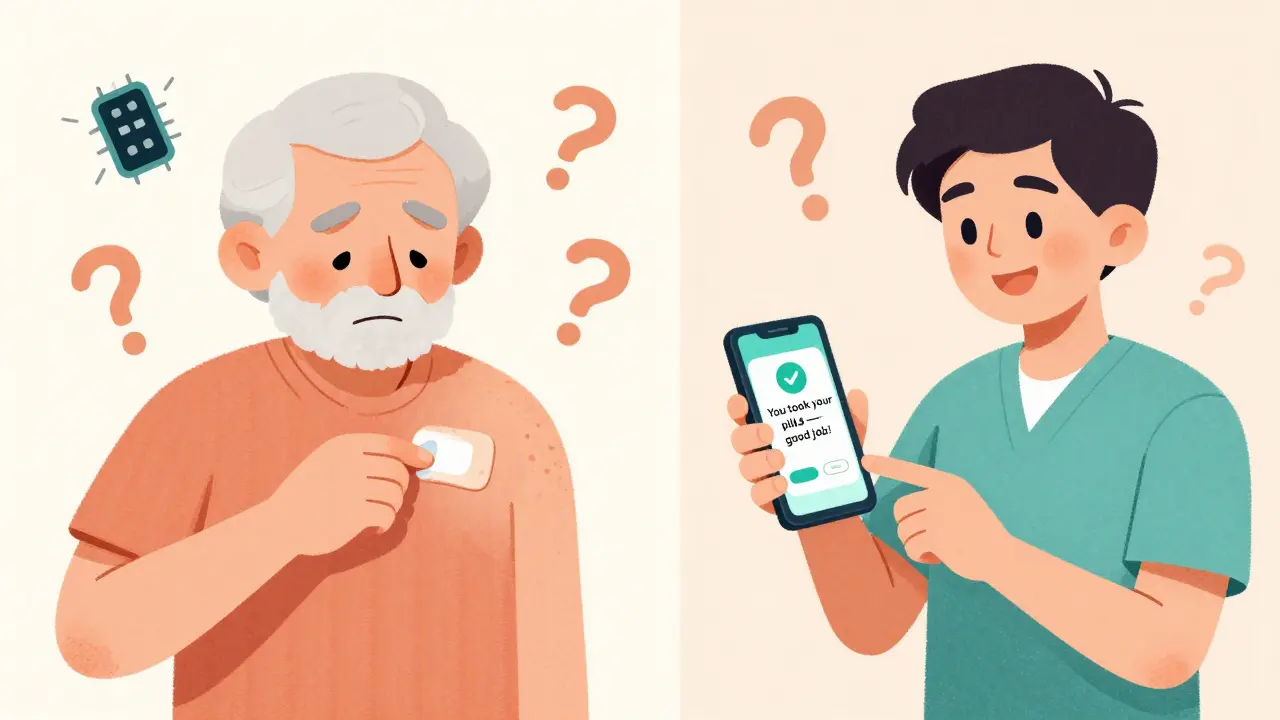
A 2022 survey of 412 patients showed 68% were willing to use digital pills for serious mental illness. But only 42% said yes for high blood pressure. Why? Perception. People don’t fear missing a blood pressure pill the way they fear relapsing into psychosis.
Privacy is the biggest concern. Seventy-three percent of hesitant patients cited fear of being watched. One user wrote: “It felt like my psychiatrist was watching me swallow pills.” That’s not paranoia - it’s valid. When your medication habits are tracked in real time, who sees it? Your doctor? Your insurer? Your employer?
HIPAA protects data in the U.S., but 14 states have stricter rules. And while the patch is designed to only transmit when the pill is ingested, the psychological weight remains. Elderly patients struggled most - 38% needed help connecting the patch to their phone. For them, the tech became another barrier, not a help.
And then there’s the patch itself. In clinical trials, 22% stopped using the system because of skin irritation. It’s not just discomfort - it’s a physical reminder that you’re being monitored. That’s hard to live with every day.
Technical Hurdles and Real-World Limits
Even the best tech has flaws.
Signal loss happens. In real-world use, 8-12% of ingestions aren’t detected. For patients with a BMI over 35, that rate jumps to 18%. Why? Body fat can block the Bluetooth signal between the pill and the patch. Sensor orientation in the stomach matters too. If the chip lands upside down, the connection might fail.
The wearable patch only lasts 72 hours. That means daily recharging or replacement. For someone with limited mobility or dexterity, that’s a burden.
And here’s the biggest gap: the system confirms ingestion - not absorption. Just because you swallowed the pill doesn’t mean your body took it. If you vomit five minutes later? The system still logs it as taken. That’s a blind spot.
Healthcare providers report needing 3-5 hours of training just to interpret the data correctly. Many dashboards show graphs and alerts, but don’t explain what they mean. A drop in activity could mean depression. Or it could mean the patient went hiking. Without context, data can mislead.
Market Reality: Who’s Using This and Why
The global digital pill market hit $627.8 million in 2022. By 2029, it’s projected to grow to over $2.4 billion. But growth isn’t evenly spread.
Pharmaceutical companies are the biggest users - 78% of digital pill deployments are in clinical trials. Why? Because they need hard proof that patients are taking the drug as directed. It reduces noise in trial data and speeds up approval.
For direct patient use? Only 12% of systems are used outside trials. Why? Reimbursement. Medicare and private insurers rarely cover the cost of the patch or the software. The pill itself might be covered, but the tech? Not yet.
Market leaders include Otsuka (Abilify MyCite), which holds 52% of the mental health segment. etectRx’s ID-Cap system leads in research, with 38% market share. Proteus Digital Health, now owned by Medtronic, was the pioneer - but its future is uncertain after a major legal settlement in 2022.
Regulatory approval is slow. The FDA requires separate clearance for the drug and the sensor. That adds 22 months to the approval timeline. It’s why there are only a handful of approved digital pills - and why most are still in trials.
The Future: AI, Automation, and Ethical Boundaries
The next wave of digital pills won’t just track - they’ll predict.
AI models are being trained to spot patterns: a patient who usually takes their pill at 8 a.m. but skips it on weekends. Or someone whose heart rate spikes every time they take a new medication. These aren’t random events. They’re signals. And AI can connect them before a crisis hits.
By 2026, systems may automatically adjust dosing schedules or alert caregivers if side effects are detected. Imagine a pill that doesn’t just tell you it was taken - but also says, “Your body isn’t responding well. Talk to your doctor.”
But with power comes responsibility. Who owns this data? Can an insurer deny coverage if they see you missed doses? Can an employer demand access to your pill logs? Current laws don’t fully answer these questions.
Dr. Michelle Mello from Stanford warned about “therapeutic misconception” - the idea that patients think the sensor is healing them, not just tracking them. That’s dangerous. A digital pill doesn’t cure. It informs. That distinction must be crystal clear.
What This Means for You
If you’re on a complex medication regimen - mental health, HIV, TB, or multiple chronic conditions - digital pills could be a lifeline. They turn guesswork into clarity. They help you understand your own habits. They give your doctor real-time insight, not just a checklist.
If you’re not in that group? It’s probably not for you. The cost, the patch, the privacy trade-offs - they don’t make sense for someone managing a simple daily vitamin or a short-term antibiotic.
For now, this tech is for high-risk, high-stakes situations. Not for convenience. Not for control. For safety.
And as the sensors get smarter - as they start predicting side effects before you feel them - the line between monitoring and medicine will blur. That’s not a threat. It’s evolution. The question isn’t whether we’ll use this tech. It’s how we’ll use it ethically, fairly, and with full respect for the person wearing the patch.
Do digital pills actually work to improve medication adherence?
Yes, in specific cases. Clinical trials show adherence rates jump from around 60% to over 80% when digital pills are used for serious conditions like schizophrenia or HIV. The key is consistency - the system works best when patients are already motivated to improve their habits, not when they feel forced.
Can digital pills detect if a drug is actually absorbed by the body?
No. Current systems only confirm ingestion - that the pill was swallowed. They cannot measure whether the drug entered the bloodstream or had any effect. That’s a major limitation. Future versions may include biomarker sensors, but as of 2025, absorption data is still outside their scope.
Are digital pills safe to swallow?
Yes. The sensors are made from biocompatible materials - copper and magnesium - and are designed to dissolve harmlessly after passing through the digestive system. They’re smaller than a grain of rice and have been tested in thousands of patients without serious side effects.
How long does the wearable patch last?
Most patches last 72 hours and must be replaced every three days. Some newer models are being tested with longer battery life, but current systems require regular changes. Skin irritation is the most common complaint, affecting about 1 in 5 users.
Can my insurance company see my digital pill data?
Legally, no - under HIPAA, your health data is protected. But if your insurer pays for the system, they may receive aggregated, anonymized reports on adherence rates for their members. Individual data is only accessible to your care team unless you give explicit permission. State laws in 14 U.S. states add extra layers of protection.
Why aren’t digital pills more widely used if they work so well?
Cost and reimbursement. The patch, app, and data service add hundreds of dollars per year per patient. Most insurers won’t cover it unless it’s tied to a high-risk condition in a clinical trial. Until the price drops or payment models change, it’ll remain a tool for specific cases - not everyday use.
Will digital pills replace regular check-ins with doctors?
Not replace - enhance. The data helps doctors spot problems faster, but it doesn’t eliminate the need for human judgment. A missed dose might mean forgetfulness. Or it might mean depression. Or it might mean the patient can’t afford the pill. Only a clinician can tell the difference.
What’s Next?
The next five years will decide whether digital pills become standard care - or remain a niche tool for the most vulnerable patients.
For now, they’re not a cure. They’re a mirror. They show us where we fall short - not because we’re lazy, but because managing chronic illness is hard. And sometimes, knowing you’re being watched is the thing that helps you stay on track.
The future won’t be about tracking every pill. It’ll be about understanding every person - and giving them the right support, at the right time, without making them feel like a data point.
Nancy Kou
December 20, 2025 AT 04:29Isabel Rábago
December 21, 2025 AT 06:50Hussien SLeiman
December 21, 2025 AT 09:28Anna Sedervay
December 22, 2025 AT 04:37Matt Davies
December 22, 2025 AT 19:58Mike Rengifo
December 24, 2025 AT 12:10Meenakshi Jaiswal
December 25, 2025 AT 10:22bhushan telavane
December 26, 2025 AT 13:19Mahammad Muradov
December 28, 2025 AT 08:31mark shortus
December 30, 2025 AT 07:40Alex Curran
December 31, 2025 AT 19:56Allison Pannabekcer
January 2, 2026 AT 05:52Kathryn Featherstone
January 4, 2026 AT 03:36Mark Able
January 4, 2026 AT 03:43Marsha Jentzsch
January 4, 2026 AT 19:31