
To understand where we are, we have to look at Global Generics is the practice of producing and distributing therapeutically equivalent versions of branded medications after their patents expire. This modern era of affordable medicine largely traces back to the 1984 Hatch-Waxman Act in the U.S., which created the blueprint for how a company can prove a drug works without repeating expensive clinical trials. Today, the World Health Organization (WHO) notes that smart substitution policies can slash pharmaceutical spending by 30% to 80%.
How Different Countries Control Drug Prices
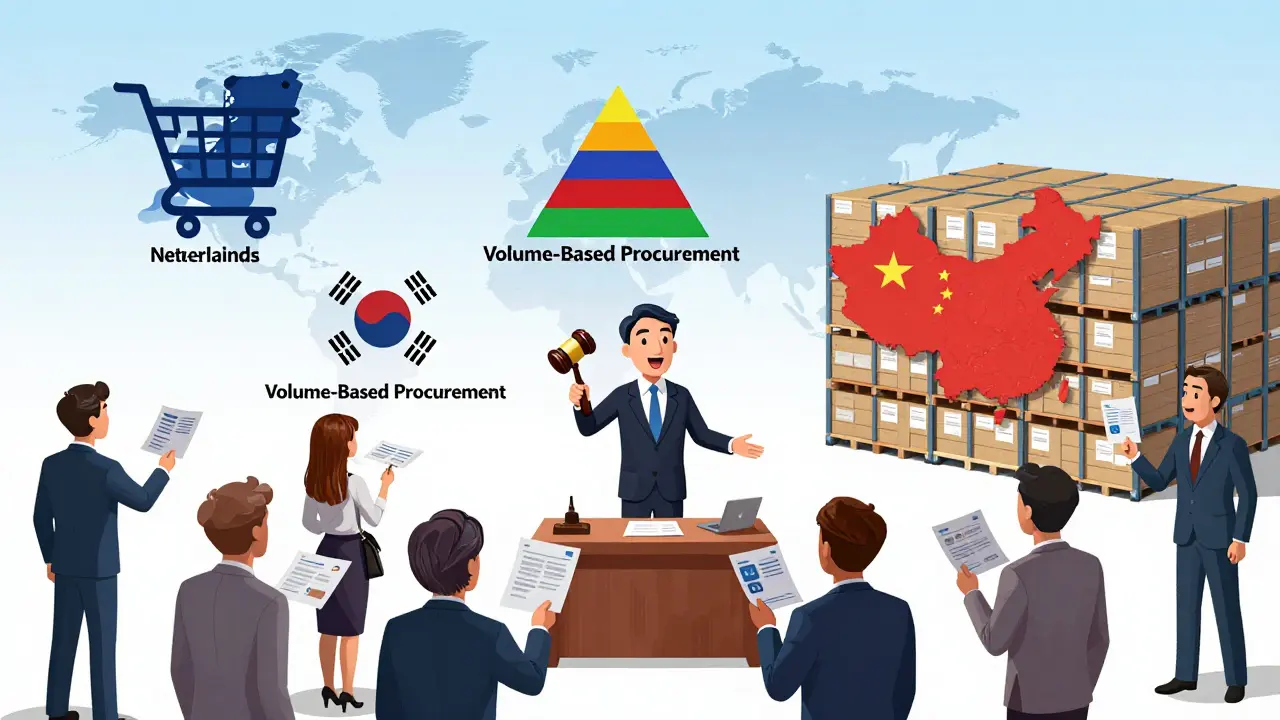
Not all generic strategies are created equal. Some countries use a "surgical" approach to pricing, while others go for "bulk" discounts. For example, South Korea uses a specific 1+3 Bioequivalence Policy. Instead of letting twenty different companies launch the same generic, they limit approvals to a maximum of three products that use previously submitted data. They also use a tiered pricing system: if a drug meets high quality and price standards, it's set at 53.55% of the original brand price. If it's lower quality, it drops to 38.69%.
Then you have China, which plays a completely different game called Volume-Based Procurement (VBP). Think of this as a giant government auction. The state tells manufacturers, "If you want to sell your drug in our hospitals, give us the lowest possible price for a massive volume." This has led to some staggering results, with average price cuts exceeding 54.7% and some specific drugs seeing prices drop by 93%. While this sounds like a win for the wallet, it's a nightmare for the manufacturers' margins, with about 23% of them reporting they are actually losing money on these contracts.
The Netherlands takes a more comparative approach using an external reference pricing system. They essentially "shop around," benchmarking their prices against countries like France, Belgium, the UK, and Norway. By picking the lowest prices from a specific list of reference nations, they keep their internal costs suppressed.
| Country/Region | Primary Mechanism | Key Outcome/Metric | Trade-off |
|---|---|---|---|
| United States | High Market Penetration (ANDA) | 90.1% generic utilization | High branded costs elsewhere |
| China | Volume-Based Procurement (VBP) | 54.7% average price reduction | Risk of drug shortages |
| South Korea | Tiered Pricing & Bioequivalence | Strict quality-price tiers | Fewer new generic launches |
| European Union | Centralized Approval (EMA) | 65% of prescriptions are generics | Price gaps up to 300% between nations |
The Regulatory Balancing Act: Innovation vs. Access
Here is the million-dollar question: if we make generics too cheap, why would anyone bother inventing new drugs? This is the central tension in pharmaceutical policy. The U.S. model is often cited as a successful balance. According to health economists, the U.S. allows high prices for brand-new, innovative therapies to fund R&D, but then aggressively pushes generics once the patent expires. This resulted in $142 billion in Medicare savings alone in 2025.
In contrast, the European Medicines Agency (EMA) provides a centralized way to get a drug approved across 27 countries, but they leave the actual pricing to individual nations. This creates a fragmented market. You might find the same generic drug is three times more expensive in one EU country than in its neighbor, which limits competition and creates inefficiency.
Then there's India, the "pharmacy of the world." India uses Compulsory Licensing, which allows the government to let other companies produce a patented drug without the owner's consent in public health emergencies. This makes India the largest provider of generics by volume, supplying about 20% of the global market. However, this aggressive stance often leads to legal wars with big pharmaceutical companies over patent rights.
Real-World Impact: What Patients Actually Experience
On paper, generics are a miracle. In reality, the experience is mixed. In the U.S., while most patients are happy with the drugs themselves, there's a lot of frustration with Pharmacy Benefit Managers (PBMs). Some patients find that their insurance makes them pay a higher copay for a generic than for a branded version, which defeats the whole purpose of the policy.
In China, the VBP reforms have been a double-edged sword. Patients love that their out-of-pocket costs for chronic diseases have dropped by an average of 63%. But the "race to the bottom" on pricing has led to shortages. For example, in 2024, some provinces saw a total lack of Amlodipine besylate for up to eight weeks because manufacturers simply couldn't afford to make it at the government's mandated price.
Quality concerns also linger. In India, some physicians have reported inconsistent bioavailability for critical drugs like antiepileptics. When a drug's absorption varies, it can be dangerous for patients who need a precise dose. This is mirrored by a rise in FDA warning letters to Indian manufacturers regarding data integrity, which jumped from 1,247 in 2020 to 2,183 in 2024.
The Path to Approval: Timelines and Costs
Getting a generic drug to market isn't as simple as copying a recipe. In the U.S., companies use the Abbreviated New Drug Application (ANDA) pathway. Typically, this takes 18 to 24 months and costs about $5.9 million per product. However, the FDA offers "Competitive Generic Therapy" (CGT) designations for drugs that fill an unmet need, which can slash that timeline to 8-12 months.
In Europe, the approval through the EMA might take 14 months, but the real delay happens afterward. Navigating the pricing and reimbursement rules of each individual country can add another 6 to 18 months of waiting. In emerging markets, the gap is closing; India's CDSCO reduced approval times from 36 months in 2019 to just 14 months by 2025.
For a generic to be accepted, it must meet strict Bioequivalence standards. This means the generic version must deliver the active ingredient into the bloodstream at a rate and extent that is essentially the same as the brand name (usually within an 80-125% range). When this is communicated clearly by pharmacists, patient acceptance rates jump by 22-35%.
What's Next for Global Pharma?
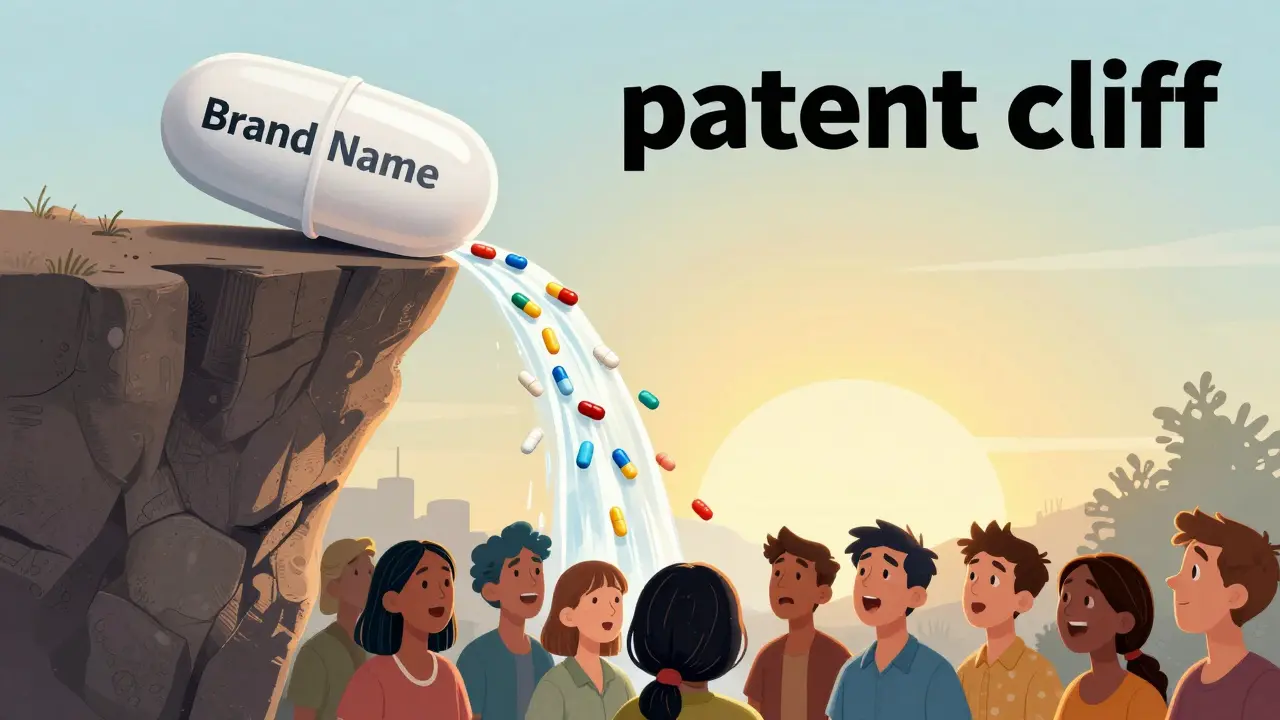
We are entering a "patent cliff" era. Between 2025 and 2030, branded drugs that currently make over $200 billion annually will lose their exclusivity. This opens a massive door for generics, potentially adding $200 billion in new sales opportunities. But the landscape is shifting.
The U.S. is implementing the Inflation Reduction Act (IRA), which allows the government to negotiate prices for the most expensive drugs. This will likely force brand-name companies to lower prices, potentially changing the incentive for generics to enter the market. Meanwhile, the EU is working on a new Pharmaceutical Package to harmonize pricing and help the "first generic" enter the market faster.
The long-term risk is sustainability. If governments push prices too low, we might see a collapse in manufacturing quality or a total disappearance of certain essential medicines. Experts predict that the number of global generic manufacturers will shrink from 3,500 to about 2,200 by 2030. Only the companies that can integrate R&D and manufacturing efficiently will survive the squeeze.
Are generic drugs as effective as brand-name drugs?
Yes. To be approved, generics must demonstrate bioequivalence, meaning they have the same active ingredient, strength, and dosage form, and they must deliver the drug into the bloodstream at the same rate as the original. While inactive ingredients (like fillers or dyes) may differ, the therapeutic outcome is designed to be identical.
Why are generic drugs so much cheaper?
Generics don't have to repeat the expensive clinical trials, drug discovery, and marketing campaigns that the original developer paid for. Once the patent expires, other companies can use the established safety and efficacy data to launch their version, passing those savings on to the consumer.
What is the 'patent cliff' and why does it matter?
The patent cliff refers to the period when a blockbuster drug's patent expires, allowing generics to enter the market. This typically causes the original manufacturer's revenue to drop sharply while making the medication significantly more affordable for the general public.
What is Volume-Based Procurement (VBP)?
VBP is a system used extensively in China where the government buys drugs in massive quantities through centralized tenders. Manufacturers bid for these contracts by offering the lowest price possible, which drastically reduces costs for patients but puts extreme pressure on manufacturer profit margins.
Can a generic drug cause different side effects than a brand name?
While the active ingredient is the same, the inactive ingredients (excipients) can vary. In rare cases, a patient might be allergic to a specific filler or dye used in a generic version that wasn't in the brand name, or vice versa. This is why consistency in switching is important, especially for narrow therapeutic index drugs.
Sam Dyer
April 13, 2026 AT 17:34Typical government bureaucratic nightmare in China. Imagine thinking a "race to the bottom" on price actually helps people when it just leads to empty shelves and garbage quality. 🙄 The US model is the only one that actually respects innovation while eventually letting the little guys in. Everything else is just a glorified socialist experiment that's bound to crash and burn. 🇺🇸
Haley Moore
April 15, 2026 AT 09:19Ugh, this is just so... basic? 🙄 Like, we all know the FDA is a slog. But can we talk about the absolute audacity of PBMs making us pay more for generics? It's literally a scam and I'm honestly exhausted by the whole system. 💅✨
Mark Dueben
April 16, 2026 AT 08:10It might be helpful to consider that the PBM issue is a systemic failure rather than just a clerical error. Many people don't realize how much these middlemen influence their out-of-pocket costs, regardless of whether the drug is generic or branded.
Clare Elizabeth
April 17, 2026 AT 17:51love seeing how different countries handle this!! its so cool that we can learn from south korea or the netherlands to maybe make things better here too!! lets hope for more affordable meds for everyone everywhere 🌟
S.A. Reid
April 17, 2026 AT 23:24One must ponder if the "patent cliff" is merely a convenient narrative constructed by the pharmaceutical industrial complex to manage the optics of their profit cycles. It is quite plausible that the bioequivalence standards are far more flexible than the public is led to believe, perhaps to facilitate the distribution of suboptimal compounds under the guise of affordability. I find it most curious that the FDA warning letters to India spiked exactly as global reliance shifted, suggesting a deeper, perhaps more orchestrated, systemic instability. Truly, the notion that a government "auction" in China results in anything other than a facade for state control is simply naive. We are merely pawns in a geochemical game of healthcare chess, and the board is rigged from the start. I say this with the utmost friendliness, of course, but the evidence of collusion is practically screaming from the rooftops. It is a fascinating tragedy of the modern era.
David Snyder
April 18, 2026 AT 11:53It's great to see that approval times are dropping in places like India. That's a huge win for global health access!
Rim Linda
April 20, 2026 AT 08:25WAIT so you're telling me I could be paying 93% LESS if I lived in China?? 😱 I am actually screaming right now because the US healthcare system is literally a horror movie! 😭💔
Becca Suttmiller
April 21, 2026 AT 09:35The point about inactive ingredients causing different reactions is very important. It explains why some people feel differently on a generic even when the active chemical is identical.