
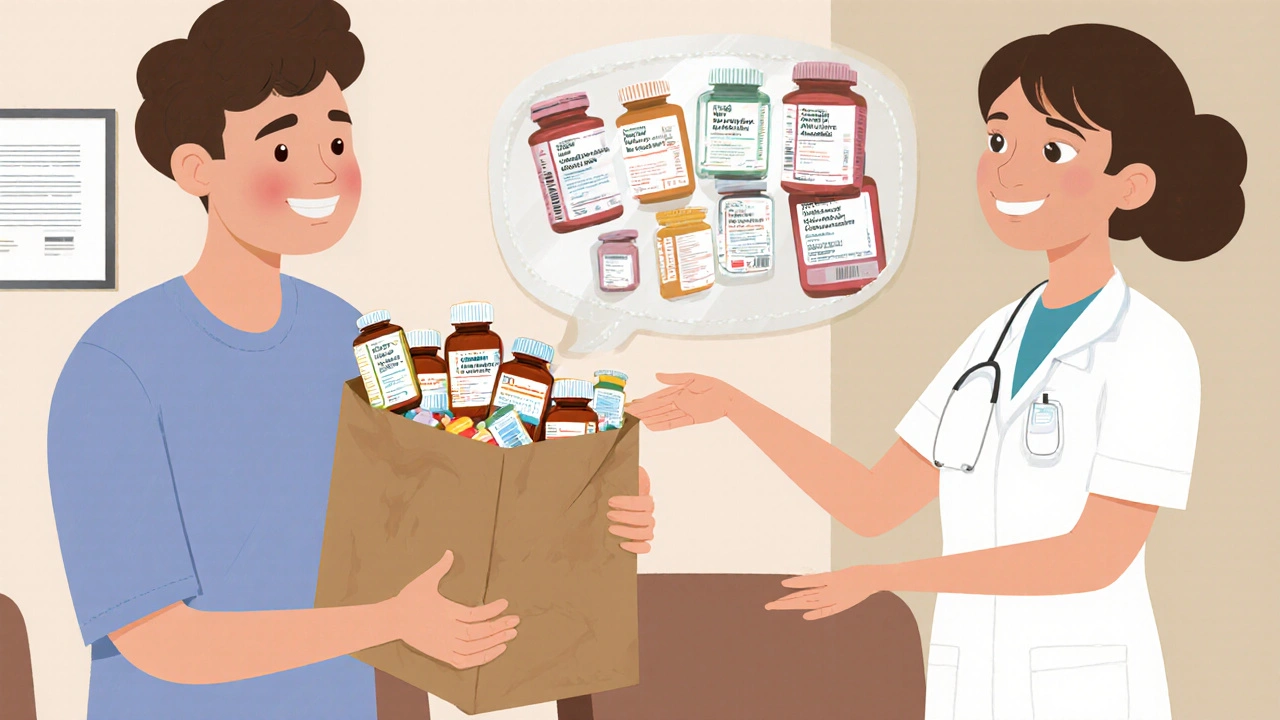
When you walk into a doctor’s office, your list of medications might look perfect on paper. But if you’re not bringing the actual bottles, that list could be wrong - and dangerously so. About 60 to 70% of medication errors happen during care transitions, and most of them come from mismatched or incomplete lists. The fix? Bring your pill bottles. Not just a list. Not just a photo. The real bottles, with labels still on.
Why Pill Bottles Matter More Than You Think
Your doctor doesn’t just want to know what you’re supposed to take. They need to know what you’re actually taking. That’s the difference between a prescription and reality. A 2024 study from the American Academy of Family Physicians found that when patients brought their physical pill bottles to appointments, medication discrepancies dropped by 67%. That’s not a small number. It means fewer bad reactions, fewer hospital visits, and fewer trips back to the clinic because something went wrong. Think about it: you might be taking a pill you stopped using six months ago. Or maybe you’re skipping doses because the bottle says “take twice daily,” but you only take it in the morning. Or worse - you’re taking two different pills that do the same thing because you forgot they were both prescribed. These aren’t hypotheticals. They happen every day. The labels on pill bottles aren’t just for show. They include the drug name, strength, dosage instructions, expiration date, pharmacy info, and lot number - all things your doctor needs to cross-check against your medical record. Even if you think you remember everything, your memory isn’t reliable. A 2023 study showed that 45% of patients unintentionally leave out medications when asked to list them. That’s almost half.What to Bring - Everything, Even the “Unused” Stuff
Don’t sort. Don’t clean out. Don’t throw away the empty bottles. Bring it all. That means:- All prescription medications - even ones you think you stopped taking
- All over-the-counter pills - pain relievers, sleep aids, antacids
- All vitamins, supplements, and herbal remedies
- All liquid medications, inhalers, patches, and injections
- All pill organizers - but only if you also bring the original bottles they came from
The Brown Bag Method: The Simplest Way to Get It Right
The easiest way to do this? The brown bag review. A week before your appointment, grab a plain brown paper bag - the kind grocery stores give you. Put every single medication container inside. No sorting. No labeling. Just dump it all in. This way, you won’t accidentally leave something out. When you get to the office, hand the bag to the nurse or provider. They’ll pull out each bottle, read the label, and compare it to your electronic record. This method cuts the time spent on medication review by 38%, according to practices that use it. It also reduces stress - you don’t have to remember what’s what. The bottles do the talking. Some patients worry about looking disorganized. But here’s the truth: doctors see this every day. They’d rather you bring 15 bottles than miss one that could kill you. In fact, one nurse on Reddit said she caught three dangerous drug interactions in a single month just because patients brought their bottles.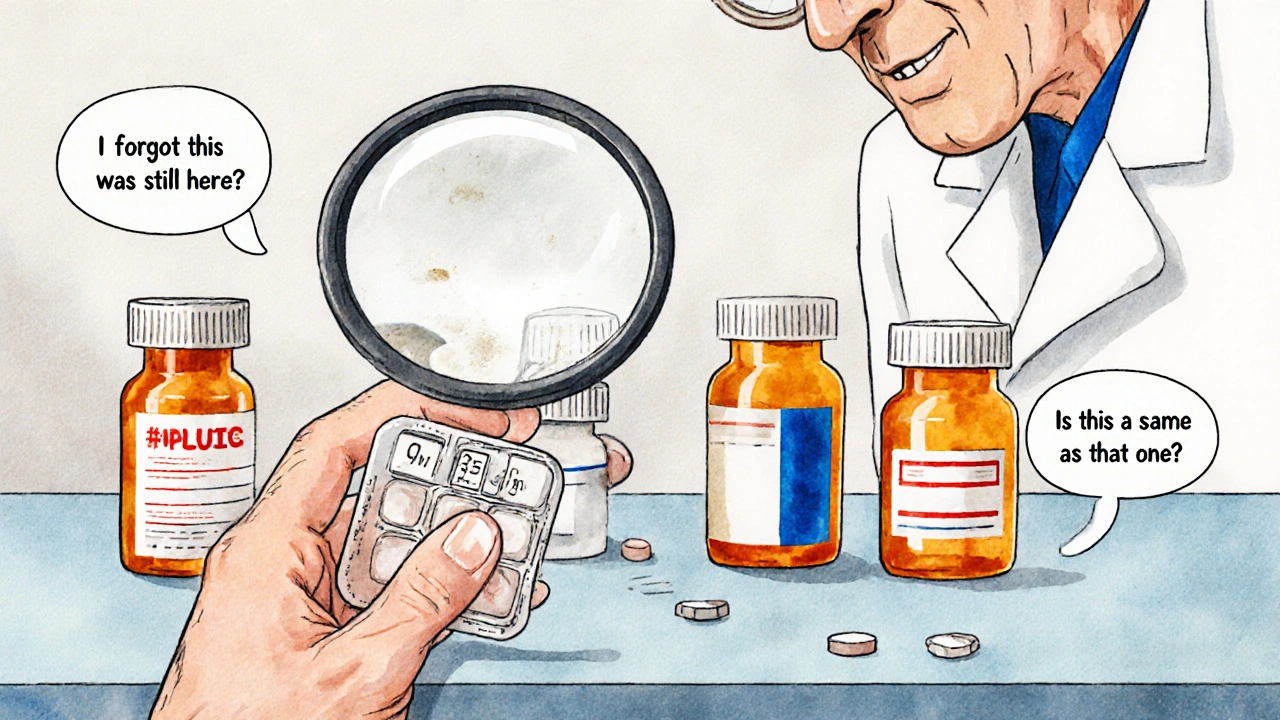
What If You Use Pill Organizers?
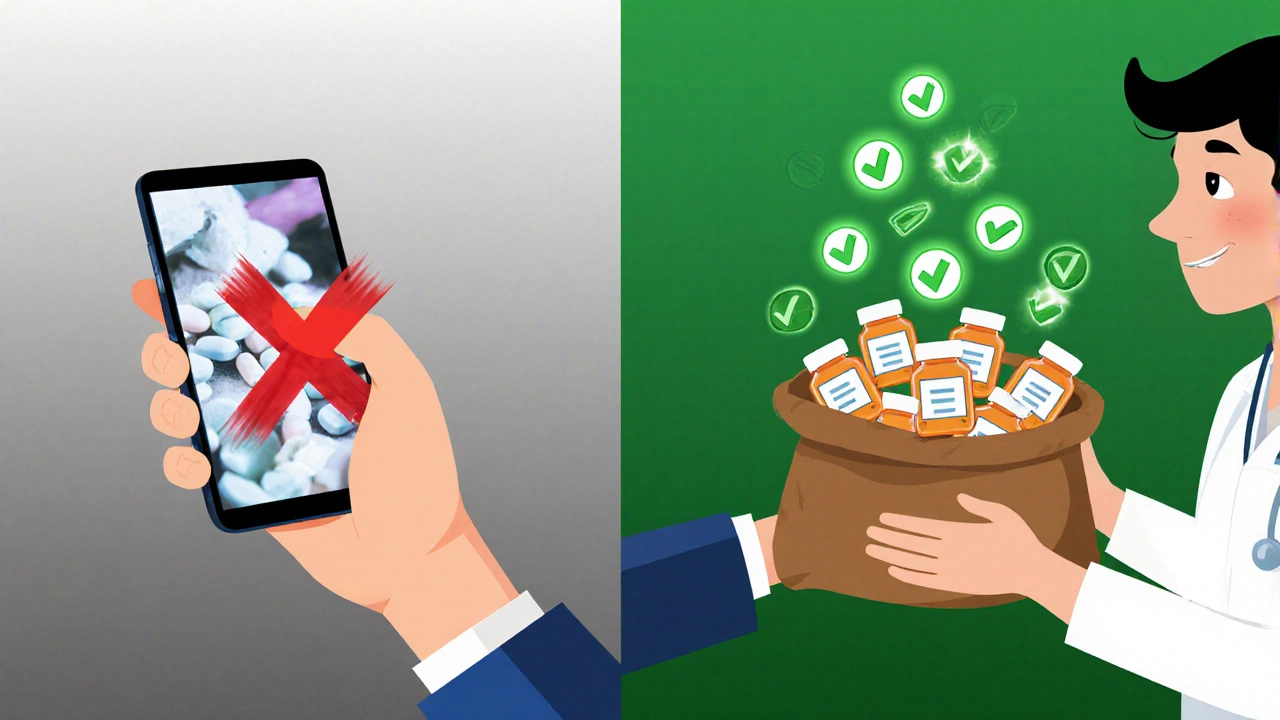
If you use a weekly or monthly pill organizer - and most people over 65 do - you’re not off the hook. In fact, you’re at higher risk. A 2023 study found that 77% of older adults don’t keep medications in their original bottles. Instead, they dump them into organizers to make things easier. But here’s the problem: organizers hide the labels. You might think you’re taking “aspirin,” but the bottle says “clopidogrel.” Or you might have two pills that look identical but do completely different things. The solution? Bring both. Take your pill organizer to the appointment - but also bring the original bottles. The provider will compare what’s in the organizer to what’s on the label. That’s how they spot errors like duplicate prescriptions, wrong doses, or expired meds. Some patients try to take photos of their pills instead. But smartphone cameras can’t read tiny print. And they can’t tell if a pill is expired or if it’s a generic version with a different strength. Even AI-powered pill ID tools - which are now used in 31% of virtual visits - only get it right 78% of the time for generic drugs.What If You Don’t Remember What a Pill Is For?
You’re not alone. Nearly 1 in 5 patients admit they don’t know what most of their pills are for. That’s not a failure - it’s a system failure. Prescriptions get refilled automatically. Labels get faded. Doctors change doses without telling you. Don’t feel embarrassed. Just bring the bottle. The provider will look at the label and explain what it is, why you’re taking it, and whether you still need it. In fact, the American Geriatrics Society says that 56% of potentially harmful medications in older adults are only caught during physical bottle reviews - not by asking the patient. If you’re worried about being judged, remember: your doctor’s job isn’t to shame you. It’s to keep you safe. Bringing the bottles shows you care. That’s what matters.What About Telehealth Visits?
If your appointment is virtual, you might think you can just hold up your bottles to the camera. That’s better than nothing - but it’s not enough. A 2024 study showed that remote verification misses 22% of discrepancies that in-person checks catch. Why? Because you can’t see if a pill bottle is half-empty. You can’t tell if the cap is broken. You can’t check for mold on a liquid medicine. You can’t see if someone’s been taking half a pill because they ran out. If you’re doing a video visit, do this:- Set up good lighting - natural light works best
- Hold each bottle up clearly, one at a time
- Read the label out loud
- Point out any pills that are broken, discolored, or missing
- Have your original bottles ready to show if the provider asks
How to Prepare - Step by Step
Here’s exactly what to do, in order:- 24 hours before your appointment: Gather every pill bottle, box, and container you have at home. Don’t skip anything.
- Check expiration dates: Write down any meds that have expired. Your provider may want to replace them.
- Take photos: Snap a picture of each label before you throw anything away. Save them in a folder on your phone. This helps if you lose a bottle later.
- Use a brown bag: Put everything inside. No need to organize.
- Bring your pill organizer: If you use one, bring it too - but don’t rely on it alone.
- Write down questions: What’s this for? Why did they change my dose? Can I stop this one? Don’t trust your memory.
What Happens After the Appointment?
Your provider will update your electronic record with the correct list. They might remove a duplicate, change a dose, or stop a medication you no longer need. They’ll also tell you what to do with leftover pills. Don’t throw them in the trash. Don’t flush them. Take them to a pharmacy drop-off box. Most pharmacies have them. If you’re not sure, ask. And after your visit, update your phone’s medication app - if you use one. Apps like Medisafe can sync with your pharmacy records and remind you when to refill. But they’re not a substitute for the real bottles.Why This Isn’t Going Away
There are apps. There are smart pill dispensers. There are AI tools that can scan pills. But none of them replace the physical bottle. The FDA requires every prescription bottle to include specific details - drug name, strength, instructions, expiration, lot number, pharmacy info. That’s the gold standard. Nothing else has all that. And the data backs it up. Combining physical bottle review with pharmacy records reduces medication errors by 89%. Patient self-reporting? Only 41%. Dr. Michael A. Steinman, a leading expert in geriatric medicine, calls the pill bottle the “Rosetta Stone of medication reconciliation.” It’s the one thing that tells you exactly what’s in your home - not what’s on paper. This isn’t about being perfect. It’s about being safe. Bring the bottles. Even if it’s messy. Even if you’re embarrassed. Even if you think it’s not important. It is.Do I need to bring every pill bottle, even if I haven’t taken it in months?
Yes. Even if you stopped taking a medication weeks or months ago, bring the bottle. Your provider needs to know you still have it - and why you stopped. Many dangerous interactions happen because patients accidentally restart old meds. Empty bottles should be photographed before disposal so you can still prove what you took.
What if I use a pill organizer? Do I still need the original bottles?
Yes. Pill organizers hide the labels, making it impossible to verify the drug name, strength, or dosage. Bring both the organizer and the original bottles. Your provider will compare what’s in the organizer to the label to catch mistakes like duplicate prescriptions or wrong doses.
Can I just take a photo of my pills instead of bringing the bottles?
Photos are better than nothing, but they’re not enough. Smartphone cameras can’t read small print, and they can’t detect expired pills, broken seals, or pill organization errors. Even AI tools only identify generic pills correctly 78% of the time. Physical bottles are still the gold standard.
Why do I need to bring over-the-counter meds and supplements?
Over-the-counter drugs and supplements can interact with your prescriptions. For example, taking ibuprofen with blood thinners can cause bleeding. St. John’s Wort can cancel out antidepressants. Your provider doesn’t know you’re taking them unless you tell them - and the bottle is the only way to prove it.
What if I’m too embarrassed to bring all my pills?
You’re not alone. Many patients feel ashamed about having unused or expired meds. But doctors see this every day. They’re not judging you - they’re trying to keep you safe. Bringing your bottles shows you care about your health. That’s what matters.
Tina Dinh
November 30, 2025 AT 23:56OMG YES THIS!!! 🙌 I brought my brown bag to my last appointment and the nurse literally gasped like I’d brought treasure 🎉 Turns out I was still taking a blood pressure med I’d stopped in 2021-my doctor had forgotten to cancel it. Saved me from a stroke, maybe. Bring. The. Bottles. 🏆
Andrew Keh
December 1, 2025 AT 13:38This is simple advice that could save lives. Many people don’t realize how often medications are misreported. Even if you think you know what you’re taking, the bottle tells the truth. Doctors appreciate it. You don’t need to be perfect-just honest.
Peter Lubem Ause
December 1, 2025 AT 18:12Let me tell you something: in my village back home, we don’t have pill organizers or apps. We keep our medicines in old biscuit tins labeled with pen. But when we go to the clinic, we bring the tins. Why? Because the label on the tin says ‘aspirin’-but the pill inside might be from last year’s flu treatment. The doctor doesn’t care if it’s messy. He cares if you’re alive. Bring everything. Even the dusty ones. Even the half-empty ones. Even the ones you’re embarrassed about. Your life is not a closet to be organized-it’s a system to be protected.
gerardo beaudoin
December 3, 2025 AT 11:53I used to think this was overkill. Then my grandma had a bad reaction because she didn’t bring her herbal tea packets. Turns out it messed with her heart med. Now I bring everything. Even the gummy vitamins. Even the ones that taste like sour candy. Worth it.
Joy Aniekwe
December 3, 2025 AT 14:04Oh sweet mercy, another post telling people to bring their pill bottles like we’re all just lazy hoarders who can’t throw anything away. Meanwhile, my pharmacist just called me because I had 17 bottles of the same blood thinner. But hey, at least I’m not the one who forgot to tell them I take CBD oil for ‘anxiety’-which, by the way, is basically just weed gummies I bought off a guy named Dave. 😌
Latika Gupta
December 4, 2025 AT 05:01Wait, so you’re saying I should bring my mom’s old blood pressure pills too? Even though she passed last year? I keep them because I think she’d want me to… but what if someone thinks I’m still taking them? What if they think I’m depressed? I don’t want them to think that.
Geoff Heredia
December 5, 2025 AT 08:08They want you to bring the bottles… but did you know the FDA and Big Pharma designed pill labels to confuse you? The lot numbers? They’re tracking chips. The expiration dates? Fake. They want you to keep buying. Bring the bottles? Sure. But take a photo of the barcode and upload it to the blockchain. That’s the only way to be sure.
linda wood
December 5, 2025 AT 22:14Wow. So the solution to medical errors is… more stuff to carry? And the doctor doesn’t even have to do anything? Just stare at the bottles like they’re sacred relics? I guess if you’re too busy to read your own prescriptions, maybe you shouldn’t be taking them. But hey, at least now you can feel virtuous while lugging a grocery bag full of expired ibuprofen.
LINDA PUSPITASARI
December 6, 2025 AT 20:11I brought my bottles last week and my doctor cried 😭 Not because I was messy-because I brought my late dad’s heart med. He was on it for 12 years. I kept the bottle because I didn’t know what else to do. She said she’s seen 500 patients this year and I was the only one who brought something that meant something. I didn’t know my grief mattered to a medical record. But it did. 🤍
Sullivan Lauer
December 8, 2025 AT 18:56Let me tell you what happened when I didn’t bring my bottles last time. I got prescribed a new antidepressant. Three days later, I was in the ER because I didn’t realize I was still taking the old one-same color, same shape, same bottle, different name. My brain was a battlefield. I thought I was fine. I thought I remembered. I didn’t. The bottle? It was in the back of my closet. Covered in dust. And if I hadn’t gone back and dug it out? I might not be here. So don’t roll your eyes. Don’t say ‘I’m fine.’ Bring the damn bottles. Your future self is begging you.
Jennifer Wang
December 9, 2025 AT 06:49As a clinical pharmacist with over 18 years of experience in medication reconciliation, I can unequivocally state that the physical pill bottle remains the single most reliable source of accurate pharmacotherapeutic data during care transitions. Digital lists, photographs, and patient recall are all subject to cognitive bias, transcription error, and omission. The FDA-mandated labeling on prescription containers contains critical information-including active ingredient, strength, dosage form, manufacturer, lot number, and expiration date-that cannot be reliably replicated by any other medium. Furthermore, the presence of residual medication in a bottle may indicate non-adherence, improper storage, or potential diversion-all of which are clinically significant findings. The brown bag method, while seemingly rudimentary, is evidence-based, cost-effective, and reduces medication error rates by over 60%. This practice should be institutionalized as a standard of care, not treated as a suggestion. Patients who engage in this process demonstrate a commendable level of health literacy and self-advocacy. We must continue to educate providers and patients alike: when in doubt, bring the bottle.