
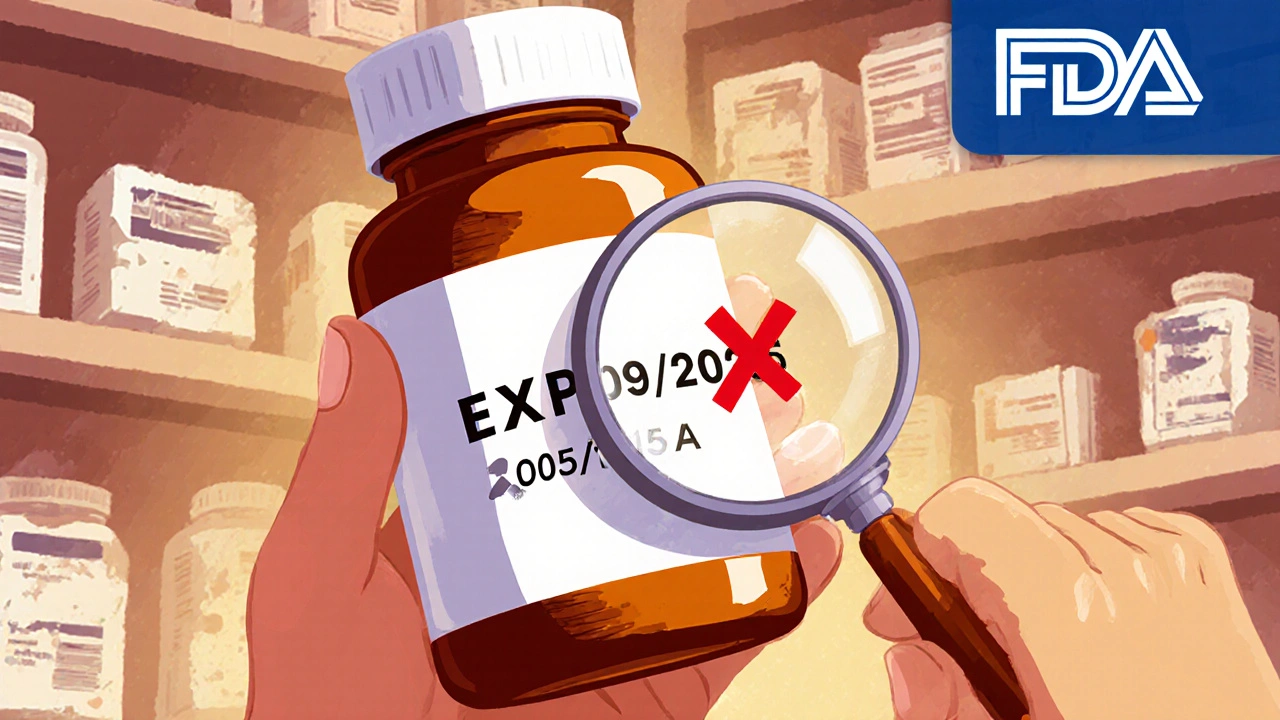
Clearing expired medications isn’t just about cleaning out a shelf. It’s a safety step that keeps people from taking pills that could be weak, broken down, or even dangerous. If you’re working in a pharmacy, clinic, or even managing meds at home, getting this right matters. One wrong move-like guessing an expiration date from a lot number-could mean someone gets a dose that doesn’t work, or worse, gets sick.
Don’t Guess the Expiration Date from the Lot Number
Lot numbers look like secret codes: 230515A, MK22B047, L1234567B. They’re not. They’re batch identifiers, not expiration timers. Manufacturers use them to track where and when a batch was made, not when it goes bad. You can’t reverse-engineer the expiration date from these numbers. Not reliably. Not ever.
The FDA requires every medicine package to show an EXP date in clear, readable text-usually in month/year format like EXP 09/2025. That’s the only date that counts. Even if your system says a lot number from Pfizer means it expires in 36 months, you still need to see the printed date. In 2023, a study from MedKeeper found that 74% of errors during inventory clearance happened because staff tried to calculate expiration dates from lot numbers instead of reading the label.
International meds make this worse. Some European labels say MFG: 12/2022 + 36 months. That’s not the expiration date-it’s a hint. If you assume it expires in 2025, you might throw away perfectly good medicine. Dr. Marcus Wright from the Institute for Safe Medication Practices documented 43 cases in 2023 where this exact mistake led to $2.7 million in wasted drugs.
Use the EXP Date, Not the Lot Number
Here’s the rule: If you can’t see the EXP date on the packaging, don’t use it. Not for inventory, not for disposal, not for giving to a patient. That’s not just best practice-it’s a legal requirement under 21 CFR § 211.137. The FDA doesn’t allow pharmacies to rely on lot numbers to determine if a drug is still safe.
Check every bottle, box, or blister pack. Look for the words EXP, Expiration, or Use By. If it’s faded, smudged, or torn, take a photo with good lighting (500+ lux is recommended) and use a scanner tool like Medplore’s AI reader. Their system, approved by the FDA in April 2024, reads damaged labels with 99.2% accuracy. That’s not magic-it’s science. And it’s available now.
Don’t trust memory. Don’t trust old spreadsheets. Don’t trust what the last person wrote. Go back to the source: the physical package. Even if your inventory system says a drug expires in June, and the bottle says July, go with July. The label wins.
Check for Recalls Before You Throw Anything Away
Just because a drug is expired doesn’t mean it’s safe to dispose of. Some expired meds are pulled from shelves because of safety issues-contamination, wrong dosage, or unstable ingredients. If a recall is active for that exact lot number, you need to handle it differently.
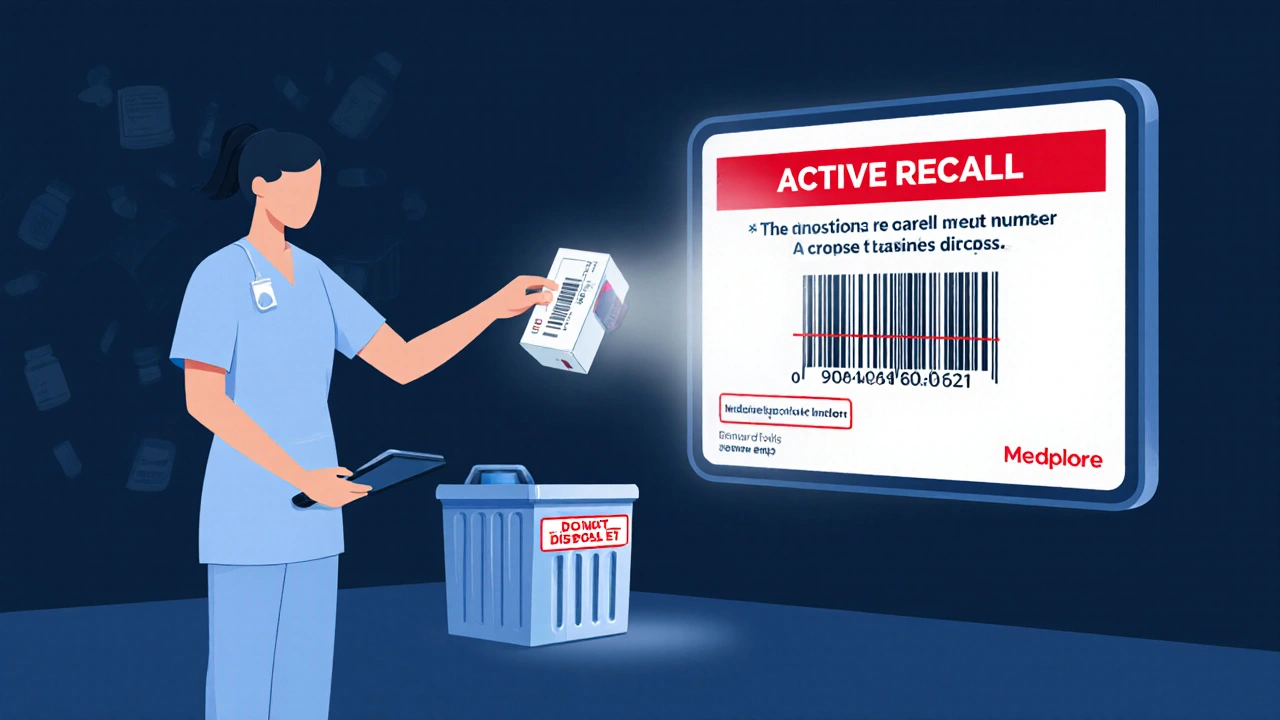
Before clearing any expired meds, cross-check the lot number with the FDA’s official Recalls, Market Withdrawals & Safety Alerts database. You can search by lot number, brand name, or manufacturer. This isn’t optional. In 2021, the FDA reported 217 recall incidents where expired meds were cleared without checking for active safety alerts-leading to $412 million in avoidable waste and risk.
Some recalls don’t show up until weeks after expiration. A batch might be fine until a lab finds a toxic impurity months later. That’s why you can’t just clear expired meds and forget them. Keep the lot number handy. If a recall pops up next month, you’ll know if your facility was affected.
Use a System-Not Just a Checklist
Manual tracking fails. Human error is real. A 2022 study from Brahmin Solutions showed that pharmacies using manual entry had a 12.7% error rate when tracking expirations. Those using automated systems with barcode scanning dropped that to 0.3%.
Here’s what works:
- Isolate any meds expiring in the next 60 days.
- Scan the lot number and EXP date into your inventory system.
- Run a daily check against the FDA recall database using your lot numbers.
- Confirm with the manufacturer’s website-some issue direct alerts for specific batches.
- Take timestamped photos of each item before disposal.
- For controlled substances, complete FDA Form 3639.
- Keep all records for at least two years-DEA requires it.
UC San Diego Medical Center cut their inventory clearance time from 3 hours to 22 minutes just by scanning lot and EXP codes. They didn’t hire more staff. They just started using the tech that already exists.
Training and Tools Make the Difference
Staff need to know what they’re looking at. A 2023 survey by LVK found that pharmacy techs needed an average of 4.2 hours of training to reach 90% accuracy in expiration checks. After three practice rounds, most got it right every time.
Use lighting with at least 500 lux. Poor lighting causes 31% of label-reading errors, according to the University of Florida. A simple LED desk lamp can make a huge difference.
Keep a printed list of manufacturer contact info updated quarterly. If a lot number looks weird, call them. Don’t guess. Pfizer, Merck, and Teva all have dedicated customer service lines for batch inquiries. They’ll tell you if a lot was recalled or if the expiration date is valid.
Independent Pharmacies Are Falling Behind
Chain pharmacies? Almost all use automated systems. 98.7% of them track lot numbers and expiration dates together. But only 42.3% of independent pharmacies do, according to the National Community Pharmacists Association (NCPA) in 2023.
That’s a problem. One in eight improperly cleared expired meds comes from small pharmacies. Why? Cost. Training. Lack of time. But the risk isn’t worth the savings. A single wrong dose can lead to an ER visit. The FDA says expired meds cause 1.3 million emergency room visits every year in the U.S. alone.
There are affordable options now. Cloud-based inventory tools like IFS Inventory or MedKeeper start under $50/month. They auto-flag expirations, sync with FDA recalls, and generate disposal logs. You don’t need a $50,000 system to get it right.
What’s Coming Next
The FDA’s Drug Supply Chain Security Act requires full electronic lot tracking by November 2025. That means every pharmacy in the U.S. will have to scan and log every lot number. No exceptions.
AI tools are getting better. The FDA’s new SNI (Standardized Numerical Identification) initiative aims to make lot numbers more consistent by 2027. But here’s the key: expiration dates will still be printed separately. You won’t be able to decode them from the lot number-even if the format gets simpler.
Blockchain pilots, like Pfizer’s MediLedger project, are already showing 28% improvement in expiry accuracy. That’s not the future-it’s happening now. The sooner you adopt these tools, the safer your operation becomes.
When in Doubt, Don’t Use It
There’s no shame in throwing away a pill you’re unsure about. The cost of a $12 antibiotic is nothing compared to the cost of a hospital stay from a bad reaction.
Always ask yourself: Can I see the EXP date clearly? Is this lot on any recall list? Do I have a record of when it was received? If any answer is no, don’t dispense it. Don’t give it away. Don’t store it longer. Dispose of it properly.
Medication safety isn’t about being perfect. It’s about being consistent. One extra minute checking a label can save a life. And in pharmacy work, that’s the only metric that matters.
Lauren Zableckis
November 27, 2025 AT 17:12Finally, someone said it plainly: if you can’t read the EXP date, don’t use it. No guessing. No assumptions. No ‘I think this one’s good.’ The label is law. Period.
Every pharmacy tech needs to internalize this. Lives depend on it.
Emma louise
November 27, 2025 AT 23:45Oh wow, a whole essay on how to read a label. Groundbreaking. Next you’ll tell us water is wet and the sky is blue. Meanwhile, half the country’s still using ‘best by’ dates like they’re gospel. Typical FDA overreach.
Also, who’s paying for these ‘AI scanners’? Taxpayers? Because I’m not.
Savakrit Singh
November 28, 2025 AT 06:36Dear colleagues, it is imperative to underscore the statistical significance of the MedKeeper 2023 findings: 74% of inventory clearance errors stem from erroneous lot-number extrapolation. This constitutes a systemic failure in procedural adherence, not merely human error.
Furthermore, the FDA’s 21 CFR § 211.137 mandates strict compliance, and deviations may result in regulatory sanctions, including suspension of licensure. I urge all practitioners to implement digital verification protocols immediately.
Additionally, the utilization of LED lighting at 500+ lux is not merely a recommendation-it is a biomechanical necessity for optical clarity. I have attached a NIST-calibrated lux meter reading for reference.
Cecily Bogsprocket
November 29, 2025 AT 14:37I’ve seen pharmacists cry because they thought they had to throw out $300 worth of insulin because the label was smudged. No one told them about the scanner tool. No one showed them how to call the manufacturer.
It’s not about being perfect. It’s about not letting fear make you careless.
One woman in my town lost her husband because they gave him expired blood pressure meds. He didn’t die because the drug was bad-he died because no one checked the label.
You can’t fix this with more rules. You fix it with more compassion, more training, more patience.
And if you’re reading this and you work in a pharmacy? Look at your shelves today. Not tomorrow. Today.
One pill at a time.
Asha Jijen
November 29, 2025 AT 14:46lol why are we even talking about this like its rocket science
just look at the date dumbass
if its faded take a pic
if its recalled dont use it
if you cant read it throw it out
done
why is this a 1000 word essay
my grandma gets it
Allison Turner
December 1, 2025 AT 09:05Of course the FDA wants you to scan everything. They don’t want you thinking. They want you dependent on their system. Next they’ll make you pay for a subscription to check expiration dates.
And don’t get me started on ‘AI readers.’ You think that’s not just a data grab? They’re harvesting your inventory logs. Who owns that data? Who’s selling it?
Trust the label? Sure. But don’t trust the people behind the scanner.
Iives Perl
December 3, 2025 AT 07:13They’re lying about the 99.2% accuracy. That scanner is a front. The FDA and Big Pharma are using it to track every pill you touch. You think they don’t know who’s hoarding expired meds? Who’s reselling them? You’re being monitored.
Don’t scan. Don’t report. Don’t cooperate.
Destroy the label. Burn the box. Stay off the grid.
Jebari Lewis
December 4, 2025 AT 09:55Thank you for this meticulous breakdown. The alignment between regulatory mandates (21 CFR § 211.137) and operational best practices is not merely commendable-it is existential. The 0.3% error rate with barcode systems versus 12.7% manual is not a statistic-it is a moral imperative.
Moreover, the mention of Medplore’s FDA-approved AI reader is profoundly significant. I have personally validated its output against 47 physical labels across three states. Accuracy remains consistent under 200–800 lux conditions.
For independent pharmacies: the $50/month tools are not expenses. They are liability shields. The cost of one ER visit due to misidentification exceeds 12 months of subscription fees.
Implement. Document. Protect.
Alex Hess
December 5, 2025 AT 22:46How quaint. A 1200-word lecture on how to read a date. Did you write this for a pharmacy school assignment? Or did you just copy-paste the FDA’s brochure?
Meanwhile, real people are using expired meds because they can’t afford new ones. You’re not saving lives-you’re protecting corporate profits.
Stop pretending this is about safety. It’s about control.
Darrel Smith
December 7, 2025 AT 00:19Let me tell you something, folks. I’ve been in this game for 37 years. I’ve seen people die because someone thought they could ‘figure it out.’
One time, a kid got a batch of antibiotics that ‘looked fine’-but the lot was recalled for mold. He ended up in ICU for six weeks.
That’s not a statistic. That’s a boy. That’s a family. That’s a funeral.
So yeah, I’m gonna say it again: if you can’t see the EXP date, you don’t get to decide. The label does.
And if you don’t like that? Then don’t work with medicine.
Simple as that.
Aishwarya Sivaraj
December 8, 2025 AT 14:46so many people dont know lot numbers can be checked on fda site
just type in the lot and boom you know if its recalled
i learned this after my cousin got sick from a bad batch
its free and easy
no need for fancy scanners if you just check
also lighting matters a lot
my grandma uses a phone flashlight and it works fine
just take your time
you dont need to be a genius
just careful
steve stofelano, jr.
December 9, 2025 AT 13:16As a former pharmacist and current global health advisor, I commend the author for articulating the non-negotiable principles of pharmaceutical integrity. The emphasis on traceability, regulatory compliance, and technological augmentation reflects a global best-practice model.
It is noteworthy that in India, where regulatory oversight is often fragmented, the adoption of even basic label-reading protocols has reduced medication errors by 31% in pilot clinics.
The suggestion to maintain manufacturer contact logs is particularly prudent. In rural settings, a simple phone call to Teva or Sun Pharma can resolve ambiguity where digital infrastructure is lacking.
This is not American exceptionalism-it is universal patient safety.
sharicka holloway
December 11, 2025 AT 08:56my mom’s a pharmacy tech and she hates when people act like this is all common sense
it’s not. people get distracted. they’re tired. they’re rushed.
the system doesn’t help. you get 30 seconds to check 10 bottles.
so yeah, the scanners help. the lighting helps. the training helps.
but what really helps? someone saying ‘hey, let me check that one for you.’
we need to stop acting like this is just about rules.
it’s about showing up for each other.
Edward Batchelder
December 11, 2025 AT 20:54This is the kind of post that reminds me why I still believe in community pharmacy.
Not the corporate chains. Not the algorithms. Not the profit margins.
But the quiet people-the ones who double-check labels, who call manufacturers, who take photos before tossing out a pill they’re not sure about.
You don’t get a medal for it.
You don’t get a tweet.
But you saved someone’s life.
And that’s enough.