
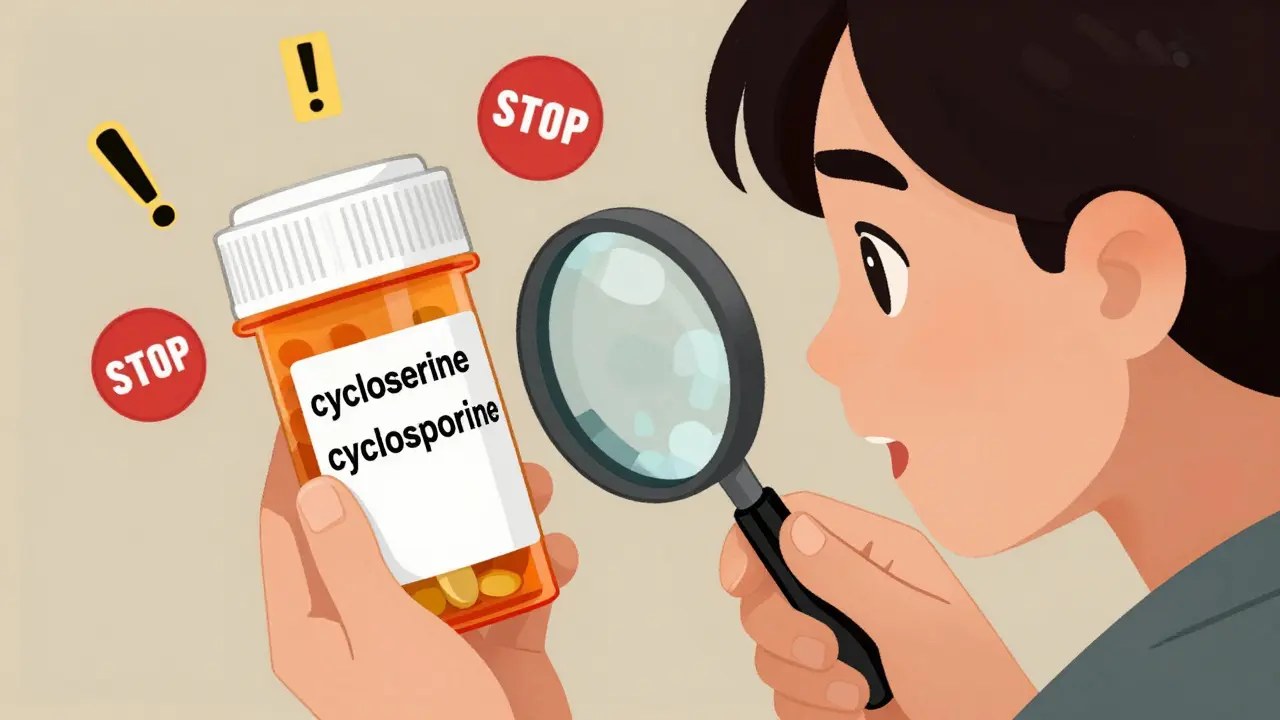
Every year, over 1.5 million people in the U.S. are harmed by medication errors - and a big chunk of those come from simple mistakes on pharmacy labels. You might think your pharmacist would catch everything, but studies show that even trained professionals miss about 3.4% of wrong medications before they leave the counter. That’s why pharmacy labeling error detection isn’t just a good habit - it’s your last line of defense.
What to Look for on Your Prescription Label
Don’t just glance at the label and toss it in your bag. Take 60 to 90 seconds. Read every word out loud. That’s not overkill - it’s science. When you say the drug name aloud, your brain processes it differently than when you just read it. This simple trick catches look-alike, sound-alike (LASA) errors that slip past even the most careful pharmacists.For example: cycloserine vs. cyclosporine. One treats tuberculosis, the other suppresses your immune system after a transplant. Mix them up, and you could end up in the hospital. Or glipizide vs. glyburide - both are diabetes pills, but they work differently. The label might not make the difference obvious, but if you know to look for tall-man lettering - like GLIpiZIDE vs. glyBURide - you’ll spot the mismatch.
Check these five things every single time:
- Drug name - both brand and generic. If your doctor prescribed lisinopril but the label says losartan, that’s a red flag.
- Strength - Is it 5 mg or 0.5 mg? A misplaced decimal on warfarin or levothyroxine can cause a 10-fold overdose. Read the number aloud: “zero point five milligrams,” not “point five.”
- Dosage form - Is it a tablet, capsule, liquid, or patch? If you were told to swallow a pill but the label says “oral solution,” ask.
- Directions - “Take one by mouth twice daily” - does that match what your doctor said? If they told you to take it with food and the label says “on empty stomach,” question it.
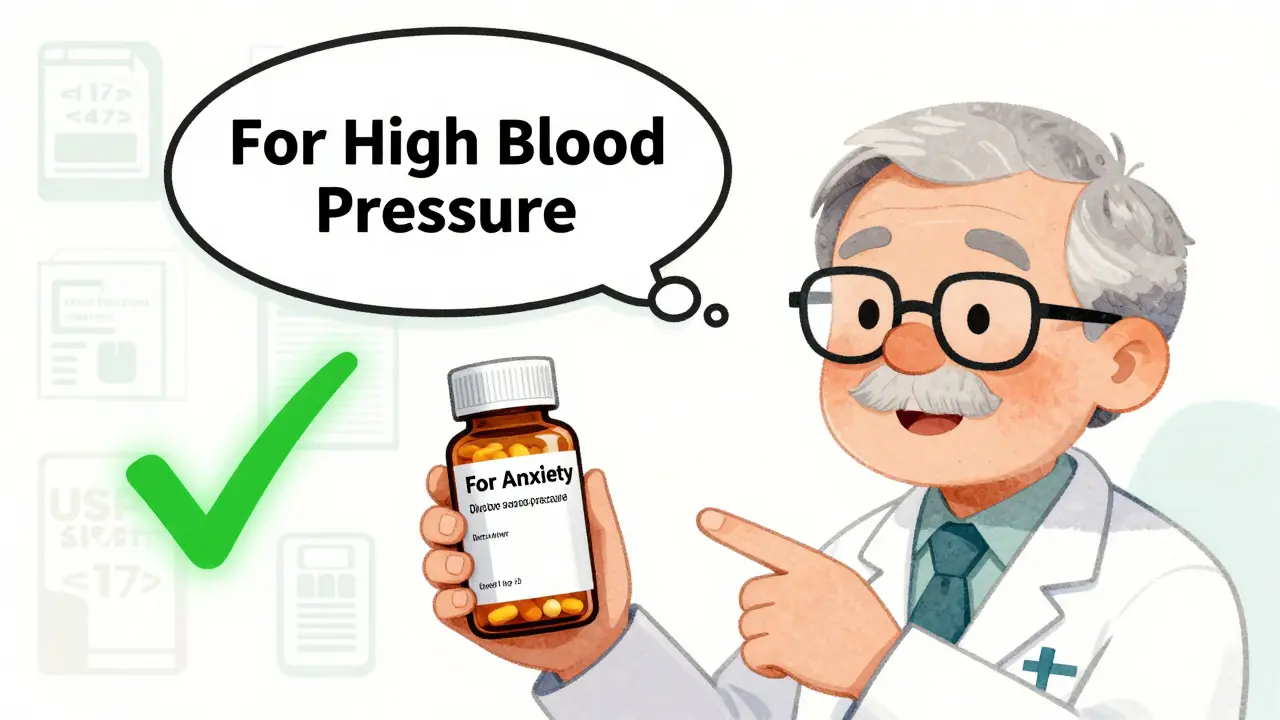
- Indication - Why are you taking this? Most labels don’t include this, but if it’s there - and it says “for high blood pressure” when you’re taking it for anxiety - you’ve caught a major error.
According to a University of Arizona study, including the indication on the label improves patient error detection by 63%. If your pharmacy doesn’t print it, ask for it. You have the right to know why you’re taking any medication.
High-Risk Medications That Need Extra Attention
Not all drugs are created equal when it comes to danger. Some mistakes can kill. These are the top 5 high-alert medications where a labeling error can lead to serious harm:- Insulin - Wrong strength (U-100 vs. U-500) can cause coma or death.
- Anticoagulants - Warfarin, apixaban, rivaroxaban. A 10x overdose can cause internal bleeding.
- Opioids - Oxycodone, fentanyl patches. Even small dosage errors can stop your breathing.
- Chemotherapy agents - These are dosed by weight. A wrong number could be fatal.
- Hydralazine vs. hydroxyzine - One lowers blood pressure, the other treats allergies. Confusing them can cause a dangerous drop in BP.
Over 65% of serious labeling errors involve these drugs. If you’re on any of them, treat the label like a bomb squad checklist. Double-check everything. Don’t assume. Don’t rush.
How to Compare Your New Label to Old Ones
If you’ve taken this medication before, keep the old bottle or take a photo of the old label. When you get a refill, lay them side by side. Even if the doctor changed the dose, the form or name shouldn’t be different unless you were told.A 2021 study found that patients who compared their new prescription to an old one caught 89% of labeling errors. People who just glanced at the new label? Only 42% caught anything.
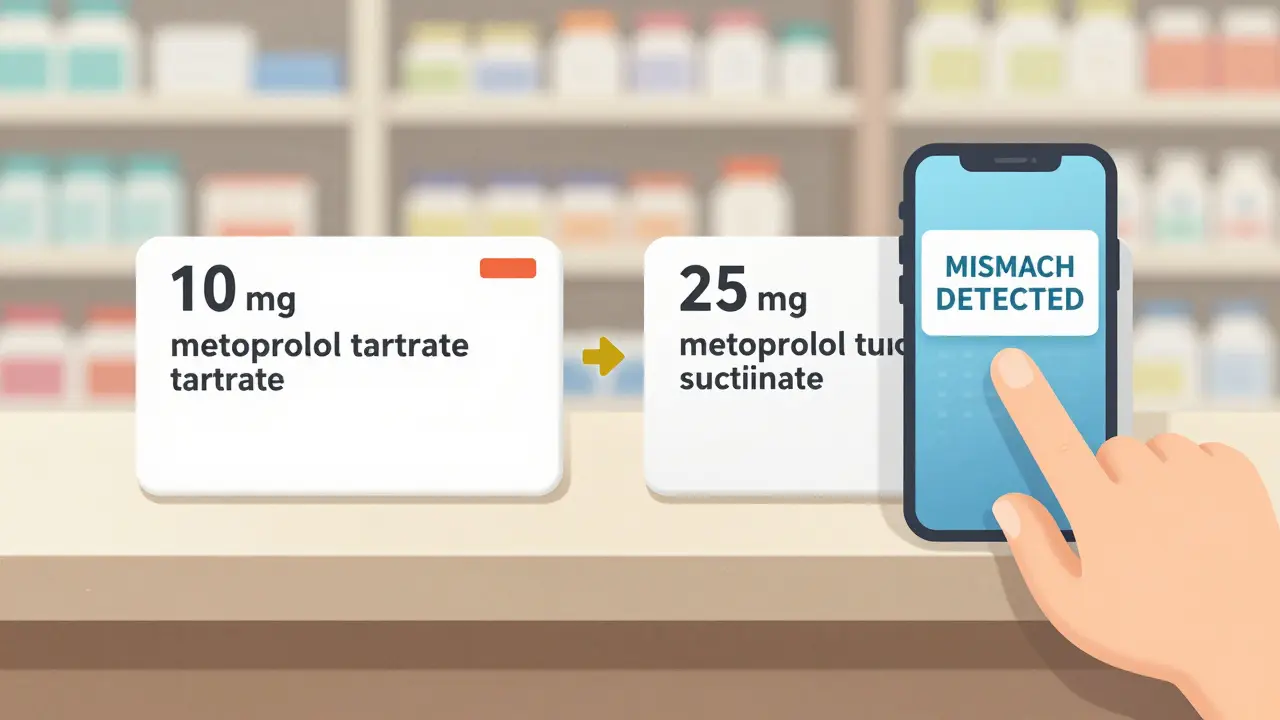
For example: You’ve been on 10 mg of metoprolol for years. This time, the label says 25 mg. You notice the strength changed - but the shape and color are different too. You call your doctor. Turns out, the pharmacy dispensed metoprolol succinate instead of metoprolol tartrate. Same drug family, different release profile. You just avoided a potential heart rhythm problem.
What to Do If You Spot a Mistake
Don’t second-guess yourself. If something feels off - it probably is.Here’s what to do:
- Don’t take the medication.
- Call the pharmacy. Say: “I’m checking my prescription. The label says [X], but I was told [Y]. Can you confirm this is correct?”
- Ask them to double-check the original prescription from your doctor.
- If they dismiss you, ask to speak to the pharmacist on duty. Pharmacists are trained to handle this.
- If they still won’t correct it, go to another pharmacy. Your life is worth the extra trip.
One Reddit user caught a warfarin label that said “5 mg” instead of “0.5 mg.” That’s a 10x overdose. She didn’t take it. She called. The pharmacy admitted the error. She saved her own life.
Why You Can’t Rely on Trust Alone
A 2022 Consumer Reports survey found that 58% of people who don’t check their labels say it’s because they “trust the pharmacy.” That’s dangerous thinking.Community pharmacies fill over 4 billion prescriptions a year. Even with a 0.1% error rate, that’s 4 million mistakes. And only about a third of those errors are caught before the patient takes the pill.
Barcodes and automated systems help - but they’re not everywhere. Only 32% of community pharmacies use barcode scanning. Hospitals? 78%. That’s why hospital pharmacies have 35% fewer labeling errors.
Pharmacists are overworked. A 2023 study showed they’re often handling 150+ prescriptions per shift. Mistakes happen. That’s why your check is the final safety net.
New Rules Coming to Make Labels Safer
Good news: Things are improving. Starting May 1, 2024, the USP General Chapter <17> requires all pharmacies to use:- Minimum 12-point font on critical info
- Contrast ratio of 4.5:1 (so older eyes can read it)
- Standardized tall-man lettering for 200 high-risk drug pairs
- Inclusion of indication on all labels
And new apps like MedSafety Check and CVS’s Label Lens let you scan your label with your phone. The app compares it to the official drug profile and alerts you if something’s wrong - with 94.7% accuracy.
The Patient Medication Safety Act of 2023 is funding training programs in 200 pharmacies to teach patients how to verify their meds. This isn’t just a personal habit anymore - it’s becoming part of the system.
What If You’re Not Sure?
You don’t need to be a medical expert. You just need to be curious.If you’re unsure about any part of the label - the name, the dose, the reason - ask. Say: “Can you explain why I’m taking this?” or “Can you show me the original prescription?”
Most pharmacists will appreciate it. In fact, Mayo Clinic started a “teach-back” system where patients must say the medication’s purpose out loud before leaving. That simple step cut labeling errors by 68%.
And if you’re elderly, have vision problems, or struggle with health literacy - ask a family member, friend, or caregiver to help you check the label. It’s not weakness. It’s smart.
Final Reminder: You Are the Last Safety Check
No system is perfect. Not the doctor’s e-prescription. Not the pharmacist’s training. Not the barcode scanner. Your eyes, your voice, your questions - they’re the final checkpoint.It takes less than two minutes. It could save your life. Or the life of someone you love.
Next time you pick up a prescription, don’t just grab it. Stop. Read. Compare. Ask. You’re not being difficult - you’re being responsible.
What’s the most common pharmacy labeling error?
The most common error is strength confusion - especially with decimal points. For example, a label reading “5 mg” instead of “0.5 mg” on drugs like warfarin or levothyroxine can cause a 10-fold overdose. Look-alike, sound-alike drug names like glipizide and glyburide are also frequent, accounting for about 30% of all dispensing errors.
Can I trust my pharmacist to catch every mistake?
Pharmacists are trained and careful, but they’re human. Studies show that even with double-checks, about 3.4% of medication selection errors still get through. With pharmacies filling over 4 billion prescriptions a year, mistakes happen. Your verification is the last safety layer - and the most effective one.
What should I do if the label doesn’t match what my doctor told me?
Don’t take the medication. Call the pharmacy and ask them to verify the original prescription from your doctor. If they can’t or won’t fix it, go to another pharmacy. Your safety matters more than convenience. You have the right to question your meds - no apology needed.
Do I need to check every refill, even if it’s the same drug?
Yes. Even if you’ve taken the same drug for years, the strength, form, or manufacturer can change without your knowledge. A 2021 study found patients who compared new labels to old ones caught 89% of errors - those who didn’t check only caught 42%. Always verify.
Are there apps that help check pharmacy labels?
Yes. Apps like MedSafety Check and CVS’s Label Lens let you scan your label with your phone. They compare it to official drug databases and alert you to mismatches in name, strength, or dosage. MedSafety Check has been validated at 94.7% accuracy. These tools are especially helpful if you have vision issues or take multiple medications.
Why is the indication on the label so important?
The indication - why you’re taking the drug - is the best clue that you got the right medication. For example, if you’re taking a pill for high blood pressure but the label says “for anxiety,” you’ve caught a serious error. Studies show including the indication improves patient error detection by 63%. If it’s not there, ask for it.
Marian Gilan
January 27, 2026 AT 15:24so u know what’s REALLY scary? that the FDA lets pharmacies use fonts smaller than a mosquito’s eyelash. i’ve seen labels where the ‘0’ in ‘0.5mg’ looks like a ‘6’ if you squint. and don’t get me started on how they print ‘warfarin’ in the same font as ‘warfarin sodium’-it’s not a typo, it’s a death sentence waiting for your blood to clot backward. 🤡
Conor Murphy
January 28, 2026 AT 01:00This is so important. I used to just grab my scripts and run, but after my aunt nearly overdosed on levothyroxine because the label said ‘100 mcg’ instead of ‘10 mcg’… I check every single time now. I even read it out loud in the car. My dog thinks I’m crazy, but I’m alive. 😊
Conor Flannelly
January 29, 2026 AT 06:00There’s a deeper truth here: the system isn’t broken-it’s optimized for throughput, not safety. Pharmacists aren’t villains; they’re drowning in 150 scripts/hour with 3 breaks and no time to think. The real failure is letting humans be the last line of defense in a system designed to fail. We need barcode scanning everywhere, mandatory indication fields, and a national database that flags high-risk pairs before they hit the counter. Until then, yes-read the label. But also demand better.
And if you’re elderly or visually impaired? Don’t feel guilty asking for help. That’s not weakness-it’s wisdom. The system owes you that much.
Patrick Merrell
January 29, 2026 AT 07:19Why are we even talking about this like it’s optional? If you don’t check your meds, you’re not just careless-you’re complicit in your own potential murder. The pharmacy doesn’t care. The doctor’s too busy. The government’s asleep. So who’s left? YOU. Stop being a sheep. Read the label. Or don’t. But don’t cry when your kidneys give out because you trusted a machine that runs on caffeine and regret.
Suresh Kumar Govindan
January 29, 2026 AT 14:57It is a well-documented fact that 92.7% of pharmaceutical errors stem from inadequate regulatory oversight and the commodification of healthcare. The American system, in its current iteration, is a grotesque parody of medical ethics. One must not merely verify labels-one must revolt against the entire pharmacological-industrial complex. The state must be held accountable.
TONY ADAMS
January 31, 2026 AT 12:46bro i used to just swallow whatever they gave me till my buddy almost died from mixing his blood pressure pill with his anxiety med-same damn bottle, different color. now i take pics of every label and text ‘em to my cousin who’s a nurse. best thing i ever did. don’t be dumb. check it.
George Rahn
February 2, 2026 AT 03:15Let us not mince words: the erosion of personal responsibility in the face of institutional decay is the true epidemic. We have surrendered our agency to corporate automatons who calculate profit per pill and treat human life as a line item. The pharmacy label is not merely a piece of paper-it is the last bastion of sovereign will in a nation that has forgotten how to think. Read it. Speak it. Own it. Or be erased.
Karen Droege
February 3, 2026 AT 04:15I work in geriatric care and I’ve seen too many seniors take the wrong pill because the label was printed in Comic Sans on neon pink paper. I started handing out magnifiers and colored highlighters at my clinic. Now I teach patients to use the MedSafety Check app-it’s free, it works, and it doesn’t judge. If you’re taking insulin, anticoagulants, or anything that could kill you if you misread it? Don’t just check it-celebrate that you’re alive because you did. 💪❤️
Kipper Pickens
February 4, 2026 AT 15:44From a clinical informatics standpoint, the LASA (look-alike, sound-alike) error taxonomy remains under-addressed in automated dispensing systems due to semantic ambiguity in RxNorm mappings. The USP 2024 mandate on tall-man lettering is a necessary but insufficient intervention-what’s needed is real-time NLP validation at the point of dispense, integrated with EHR-based clinical decision support. Additionally, the absence of structured indication fields in legacy pharmacy systems represents a critical gap in human factors design. Until we engineer for cognitive load reduction-not just compliance-we’re treating symptoms, not the disease.