
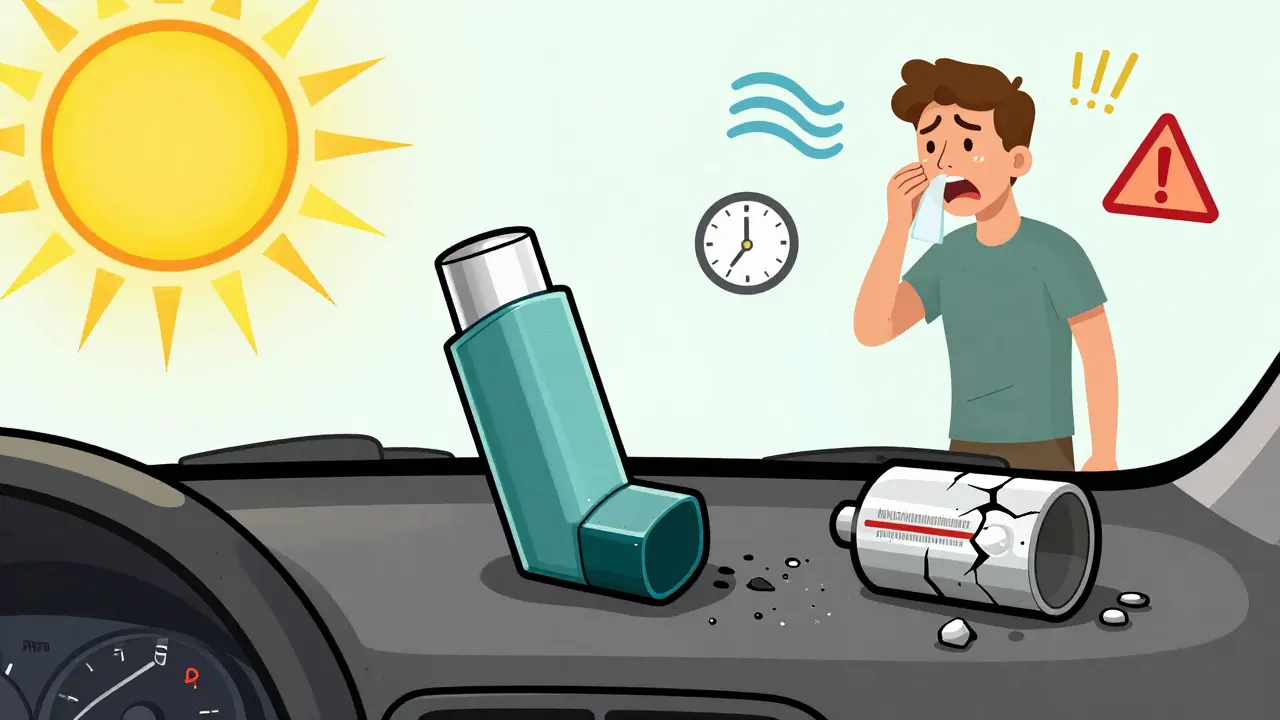
When your inhaler stops working during an asthma attack, it’s rarely because the medication ran out. More often, it’s because it was stored wrong.
Every year, thousands of people end up in emergency rooms because their rescue inhaler didn’t deliver the right dose. And in most cases, the problem wasn’t the device-it was the storage. Heat, moisture, and even sunlight can wreck your medication long before the expiration date shows up. If you or someone you care for relies on an inhaler or nebulizer, knowing how to store it properly isn’t just good advice-it’s life-saving.
What Temperature Is Safe for Inhalers?
Most inhalers need to stay between 59°F and 77°F (15°C to 25°C). That’s room temperature-not hot, not cold. But many people don’t realize how easily that range gets broken.
Leaving an inhaler in your car on a summer day is one of the most common mistakes. Even on a mild 80°F day, the inside of a parked car can hit 120°F in under 30 minutes. At that heat, the propellant in metered-dose inhalers (MDIs) can expand and damage the valve. The active drug, like albuterol, can break down too. A 2023 study from the University of North Carolina found that after just 24 hours in a 95°F car, inhalers delivered only 62% of their labeled dose-down from 95%.
Dry powder inhalers (DPIs) like Spiriva or Advair are even more sensitive. They don’t use propellant, but they do use tiny, brittle powder capsules. Moisture turns them into clumps. Heat makes them crack. Both mean the dose won’t come out right. GlaxoSmithKline’s own testing shows DPIs start failing at humidity levels above 60% and temperatures over 86°F.
Some inhalers, like Proventil RespiClick, have tighter ranges: 68°F to 77°F. Always check the package insert. If it says “store at room temperature,” that means 68°F-77°F. Don’t assume it’s the same for all.
Nebulizer Medications: More Fragile Than You Think
Nebulizer solutions like albuterol ampules, Pulmicort Respules, and Xopenex are liquid. And liquids degrade faster than solids when exposed to heat.
Unopened albuterol ampules should be kept between 68°F and 77°F. Once opened, they’re good for only 7 days at room temperature. After that, the concentration drops. A 2022 study in the Journal of Aerosol Medicine found that if a nebulizer solution hits 104°F, the medication starts breaking down in under 30 minutes-completely useless by the time you use it.
Pulmicort Respules are different. They need refrigeration until first use: 36°F to 46°F. Once opened, they can sit at room temperature for up to 7 days. But if you leave them in a hot car or on a windowsill, they’re ruined. A 2023 study in Respiratory Care found nebulizer solutions were 3.2 times more likely to degrade than inhalers under the same bad conditions.
And don’t forget the compressor. Keep it at least 12 inches away from Wi-Fi routers, microwaves, or other electronics. Philips Respironics warns that electromagnetic interference can mess with the motor’s timing, leading to inconsistent mist delivery-even if the medicine itself is fine.
Why the Bathroom Is the Worst Place to Store Inhalers
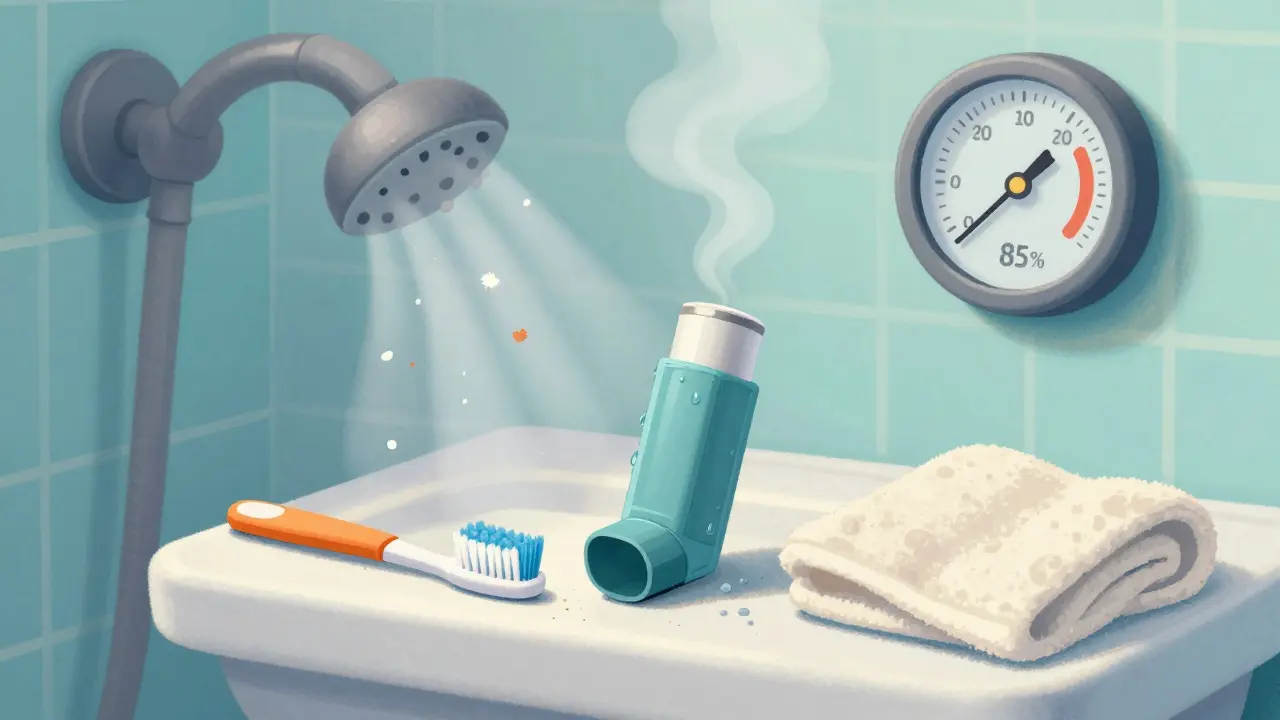
It’s tempting. It’s convenient. You use your inhaler after brushing your teeth. But bathrooms are the #1 storage disaster zone.
Hot showers, steam from the tub, and poor ventilation make bathroom humidity levels regularly hit 70%-90%. That’s way above the 40%-50% sweet spot for inhalers. St. Jude Children’s Research Hospital found that inhalers stored in bathrooms lost 35% of their albuterol concentration in just 14 days.
And it’s not just humidity. Bathroom cabinets are often near heat sources-water heaters, radiators, or even the sun streaming through a window. One Reddit user, ‘AsthmaWarrior87,’ shared that their inhaler failed during an attack because it had been sitting in their gym bag in a hot car. They thought it was just old. It wasn’t. It was cooked.
Don’t store inhalers on the counter, above the sink, or near the shower. Even if you don’t use them daily, the environment will ruin them.
What About Refrigeration?
Some people think cold = better. But refrigerating most inhalers is a mistake.
Putting a metered-dose inhaler in the fridge can cause the propellant to thicken, making the spray uneven. When you take it out, condensation can form inside the mouthpiece, leading to clogs or mold. The American Thoracic Society says no refrigeration for multi-dose inhalers-ever.
There’s one exception: Symbicort. The European Respiratory Society says it’s okay to refrigerate it briefly during extreme heat (above 95°F), but only as a short-term fix. Don’t make it a habit.
For nebulizer solutions like Pulmicort, refrigeration is required before opening. But once opened, keep it at room temperature. Don’t put it back in the fridge. Temperature swings damage the liquid.
How to Store Inhalers When You’re Traveling
Traveling with asthma meds? You need a plan.
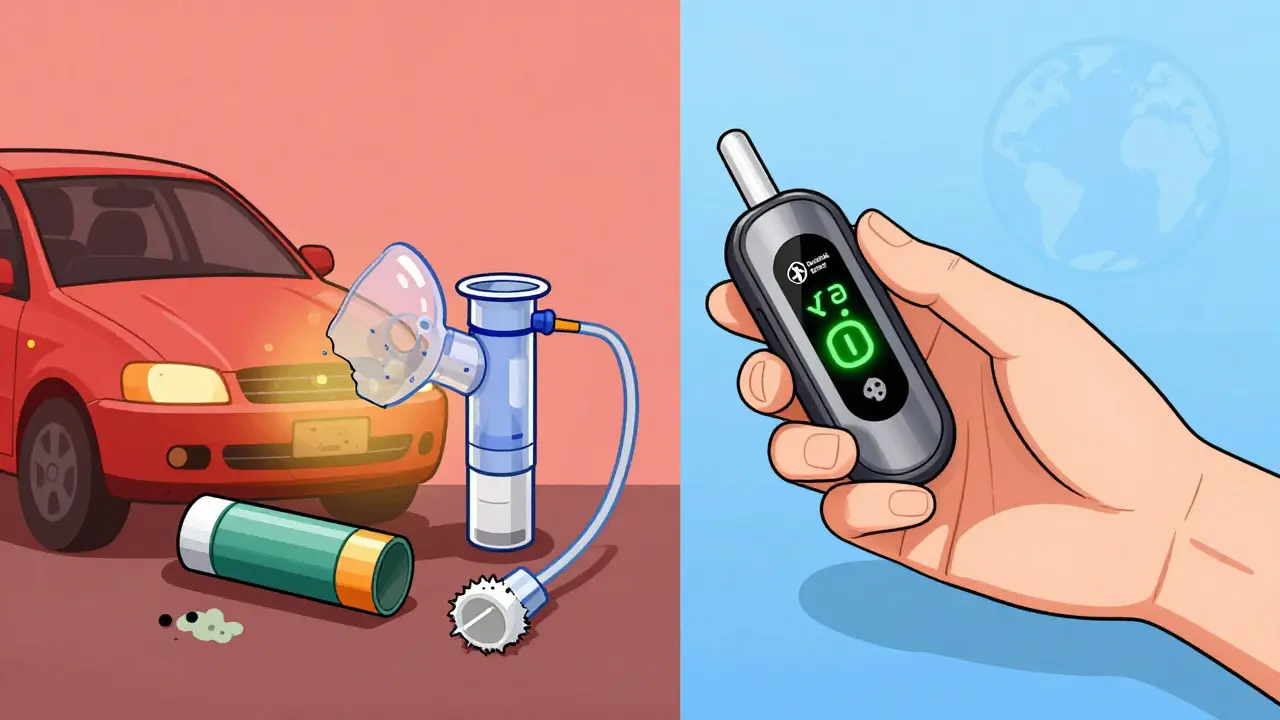
The American College of Physicians recommends the “Rule of 15”: never leave your inhaler unattended in an uncontrolled environment for more than 15 minutes. That means no leaving it on the dashboard while you grab coffee.
Use an insulated case. A simple $15 MediSafe case from Amazon works for most people. It keeps inhalers cool in summer and warm in winter. One user in Florida used theirs for 18 months with zero issues.
For longer trips, consider a SmartInhale case-released in 2023 and FDA-cleared. It has Bluetooth sensors that track temperature and send alerts to your phone if it gets too hot or cold. That’s not just fancy tech-it’s insurance.
If you’re flying, keep inhalers in your carry-on. Checked luggage can go below freezing or over 120°F in the cargo hold. Airlines don’t control that. You do.
What About Nebulizers and Equipment?
Your nebulizer machine isn’t just a box with tubing. It’s a medical device that needs care too.
Store the compressor in a dry, cool place. Avoid garages, basements, or near radiators. Moisture causes rust. Dust clogs filters. Heat warps plastic parts.
Always clean the mouthpiece and tubing after each use. Let them air dry completely before storing. Bacteria grow fast in damp tubing. That’s not just a hygiene issue-it can trigger infections that make asthma worse.
Keep spare parts-masks, tubing, filters-in a sealed plastic container. Label them with the date you opened them. Most filters last 3-6 months. Replace them before they clog.
Common Storage Mistakes (And How to Fix Them)
- Mistake: Storing inhalers with other meds in a pill organizer. Fix: Keep each inhaler in its original box. The box blocks light and has humidity control.
- Mistake: Leaving a nebulizer solution on the kitchen counter all day. Fix: Put it in a drawer or cabinet away from the stove or window.
- Mistake: Assuming “cool” means refrigerated. Fix: Use a digital thermometer to check your storage spot. Most pharmacies sell $5 ones.
- Mistake: Storing multiple inhalers together. Fix: Keep DPIs separate from MDIs. Moisture from one can ruin the other.
- Mistake: Not checking the expiration date. Fix: Write the opening date on the box with a marker. Toss it after 12 months, even if it’s not expired.
How to Know If Your Inhaler Is Still Good
There’s no foolproof way to test it at home-but there are signs it’s failing.
- You hear a weak spray or no spray at all.
- The inhaler feels lighter than usual.
- The mist feels different-thicker, less fine.
- You’ve used it more than the labeled number of puffs.
If any of these happen, replace it. Don’t risk it.
Also, check the expiration date. But remember: expiration dates assume proper storage. If your inhaler was left in a hot car, it could be useless weeks before the date printed on the box.
What Schools and Workplaces Should Do
Most asthma emergencies at school happen because the inhaler was stored wrong. The CDC found that 63% of school-related asthma attacks in 2022 involved inhalers kept in nurse’s offices that were too hot.
Leading schools now use “Cool Cubby” systems-small, temperature-monitored lockers that keep inhalers at 72°F ± 2°F. St. Jude’s pilot program cut medication failures by 89%.
Workplaces should do the same. If you’re an employer, provide a cool, dry cabinet near the break room-not near the coffee machine or microwave. If you’re an employee, ask for one.
What’s Changing in 2025 and Beyond
Things are getting smarter. In 2023, GlaxoSmithKline rolled out humidity-indicating packaging for Ellipta inhalers. The label changes color if moisture got in.
The FDA is pushing for all rescue inhalers to have built-in temperature sensors by 2026. Smart inhalers that track usage and storage conditions are already in development.
But until then, you’re still the best defense. Climate change is making this harder. A 2023 study in The Lancet predicts that by 2030, over a third of the U.S. will face more than 60 days a year hotter than 86°F. That means more people will need to rethink how they store meds.
Proper storage isn’t about being perfect. It’s about being consistent. Keep your inhaler cool, dry, and out of the sun. Check it every few months. Replace it if you’re unsure. Your next breath might depend on it.
Can I store my inhaler in the fridge?
Generally, no. Most inhalers, like albuterol or Flovent, should not be refrigerated. Cold temperatures can cause the propellant to thicken, leading to uneven dosing. Condensation can also form inside the mouthpiece, which may cause clogs or mold. The only exception is Symbicort, which can be briefly refrigerated during extreme heat (above 95°F), but only as a temporary fix. Always check the package insert for your specific medication.
How long do nebulizer solutions last after opening?
Most nebulizer solutions, like albuterol, are good for 7 days after opening when stored at room temperature (68°F-77°F). Pulmicort Respules follow the same rule. Never refrigerate them after opening-temperature swings can damage the liquid. Always write the opening date on the ampule or bottle, and throw it away after 7 days, even if it still looks fine.
Is it safe to keep my inhaler in my purse or gym bag?
Only if it’s protected. A purse or gym bag left in a hot car or direct sunlight can destroy your medication. If you must carry it this way, use an insulated case designed for medications. These cost under $20 and keep the temperature stable for hours. Never leave it unattended in a car-even for 10 minutes.
Why does my inhaler feel like it’s not working anymore?
It could be empty, but it’s more likely the medication degraded due to heat or moisture. Inhalers stored in bathrooms, cars, or near windows often lose potency long before their expiration date. Check if the spray feels weaker, the canister feels lighter, or the mist looks different. If you’re unsure, replace it. A failed inhaler during an attack can be life-threatening.
Should I clean my inhaler regularly?
Yes. For metered-dose inhalers, remove the metal canister and rinse the plastic mouthpiece with warm water once a week. Let it air dry completely before putting it back. For dry powder inhalers, don’t get them wet-just wipe the mouthpiece with a dry cloth. Dirty mouthpieces can cause clogs or harbor bacteria, which may worsen respiratory symptoms.
How do I know if my storage area is too humid?
Buy a digital hygrometer-it costs less than $10. The ideal humidity for inhalers is 40%-50%. If it’s above 60%, moisture can damage dry powder inhalers and cause mold in the mouthpiece. Avoid storing inhalers in bathrooms, basements, or near windows where condensation forms. A kitchen cabinet away from the stove is often better.
If you’re unsure about your storage setup, ask your pharmacist. They can check your meds and give you a personalized plan. Don’t wait until it’s too late.
Tony Du bled
December 22, 2025 AT 22:39Been using my albuterol for years and never thought about the car thing. Learned the hard way after a trip to the ER. Now I keep it in my jacket pocket. Simple fix, huge difference.
Jeremy Hendriks
December 24, 2025 AT 02:00They say storage matters but nobody talks about how climate change is turning every damn car into an oven. We're not just talking about inhalers here-we're talking about a system designed for a world that no longer exists. The FDA’s 2026 sensor mandate? Too little too late. We need infrastructure, not gadgets.
Sai Keerthan Reddy Proddatoori
December 24, 2025 AT 19:38Why do Americans make everything so complicated? In India we just keep inhalers in our shirt pocket. If it works, it works. No fancy cases, no sensors. You think your body can’t handle a little heat? You’re weak.
Johnnie R. Bailey
December 26, 2025 AT 05:00There’s something poetic about how something so small-a plastic canister-holds the line between breath and silence. We treat it like a convenience, but it’s a lifeline wrapped in aluminum. And yet we leave it on dashboards like it’s a soda can. We’ve forgotten how to honor the things that keep us alive.
Vikrant Sura
December 27, 2025 AT 13:03This post is 90% fluff. The real issue is people not taking their meds regularly. Storage? Please. If you’re worried about humidity, maybe you shouldn’t have asthma in the first place.
Herman Rousseau
December 27, 2025 AT 18:04Just got my SmartInhale case last week-game changer. Got a text yesterday when my gym bag hit 92°F. Saved my albuterol. Also, if you’re using a nebulizer, clean that tubing weekly. Bacteria don’t care if you’re busy. 🙏
jenny guachamboza
December 28, 2025 AT 09:58Wait… so you’re telling me the government’s NOT monitoring my inhaler temperature? 😳 This is a conspiracy. They want us to get sick so they can sell more meds. And those ‘cool cubbies’? Totally a Big Pharma scam. I keep mine in my sock drawer. It’s dark. That’s natural.
Ajay Brahmandam
December 29, 2025 AT 23:34Good stuff. I work in a clinic and we see this all the time. One kid came in with a nebulizer solution that was warm to the touch-left in a backpack by the window. We had to give him a new one. Just a little awareness goes a long way. Always ask your pharmacist. They’re the real MVPs.
Nader Bsyouni
December 31, 2025 AT 01:03You talk about temperature ranges like they’re gospel. But who decided 68°F is the magic number? A committee? A corporation? The human body thrives in chaos. Maybe your inhaler should too. Stop trying to control everything. Let the air do its work. The medicine will find its way.