
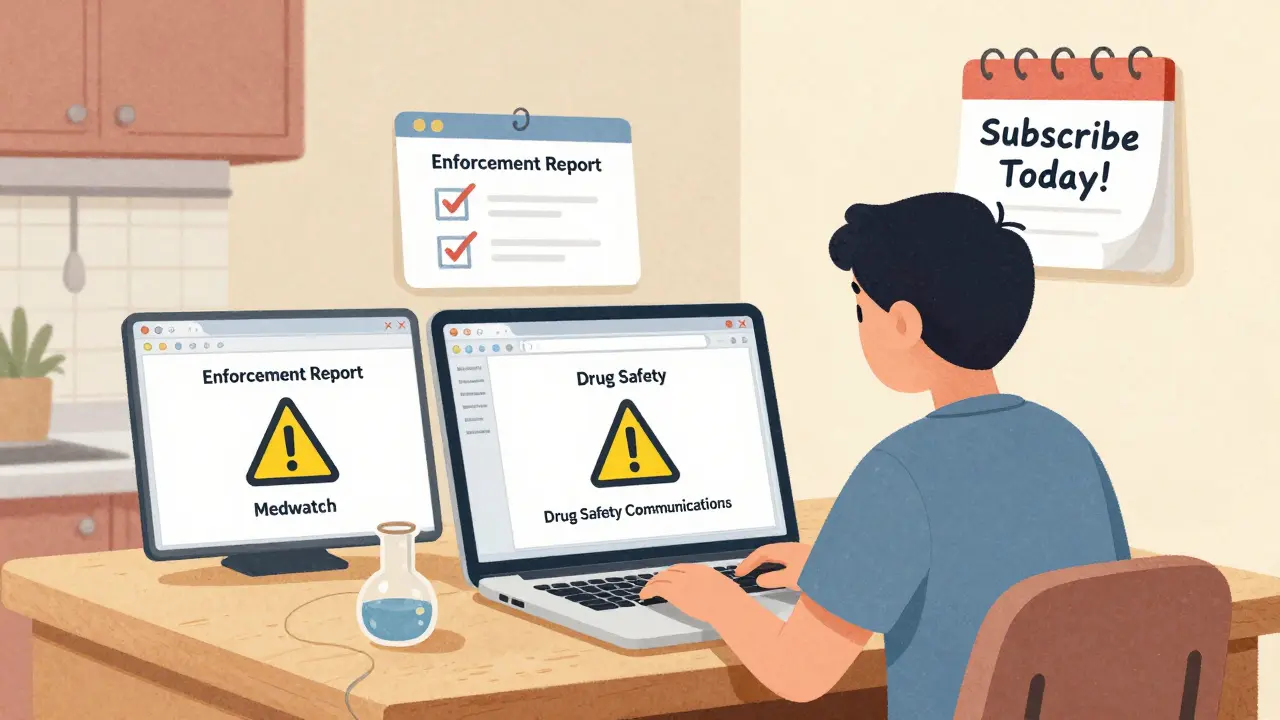
Every year, the FDA issues over 1,200 safety alerts about prescription drugs, over-the-counter medicines, and medical devices. Some of these alerts warn about deadly contaminants. Others reveal hidden side effects or tell you a batch of insulin was recalled last night. If you’re a patient, caregiver, pharmacist, or healthcare provider, missing one of these alerts could mean taking a dangerous medication without knowing it. The good news? You can get these alerts delivered straight to your inbox-for free. The hard part? Knowing which system to sign up for, and how to make them useful instead of overwhelming.
Three Different FDA Alert Systems (And What Each One Does)
The FDA doesn’t have one single alert system. It has three separate ones, each with its own purpose. Confusing them is common-and it’s why so many people miss critical updates.
The Enforcement Report Subscription Service is for recalls. If a drug manufacturer pulls a batch of metformin because it contains a cancer-causing impurity, or if a bottle of children’s cough syrup is found to have unsafe levels of lead, this system sends you an email. You can pick categories like "Drugs," "Medical Devices," or "Cosmetics." You can also set up to five custom keywords-like "insulin," "peanut," or "lisinopril"-so you only get alerts about what matters to you. It’s the only system that lets you filter by keyword. You’ll get daily or weekly emails, depending on your preference.
The MedWatch Safety Alerts system covers broader safety issues, including adverse events, labeling changes, and urgent warnings. It’s been around since 1993 but got a major upgrade in 2015. You can subscribe via email (called the MedWatch E-list), follow @FDAMedWatch on Twitter, or use an RSS feed. This is where you’ll hear about new black box warnings, unexpected side effects, or safety reviews triggered by new data. It doesn’t let you use keywords, but it’s the most comprehensive source for clinical safety updates.
The Drug Safety Communications email alerts are targeted specifically at healthcare professionals and patients. These are detailed, science-backed notices about drug classes-like "new warnings for GLP-1 agonists" or "safety update on SSRIs in adolescents." They’re longer than the other alerts and often include data from clinical studies. If you’re a clinician, this is where you’ll find the evidence behind changes in prescribing guidelines.
Here’s the catch: a 2022 government report found only 38% of healthcare workers knew all three systems existed. Most people sign up for one-and miss the rest.
How to Subscribe: Step-by-Step
Signing up takes less than five minutes per system. But you need to do it three times if you want full coverage.
- For Enforcement Reports: Go to fda.gov/enforcement-report-subscription. Enter your email. Check "Drugs" under product categories. Add your keywords-like your medication names or allergies. Choose daily or weekly. Click "Subscribe."
- For Drug Safety Communications: Visit fda.gov/drugs/drug-safety-and-availability/drug-safety-communications. Scroll down and click "Sign up for email alerts." Enter your email. You’ll get a confirmation link. Click it. Done.
- For MedWatch E-list: Go to fda.gov/medwatch-email-list. Fill out the form. You can choose to receive alerts for drugs, devices, or both. Submit. Check your inbox for the confirmation email.
Pro tip: Use a separate email for these alerts. They’re not spam, but they can pile up. If you’re a pharmacist or nurse, you’ll want to archive them or set up a folder in your inbox labeled "FDA Alerts."
What You Won’t Get (And What You Should Know)
These systems are powerful-but they’re not perfect.
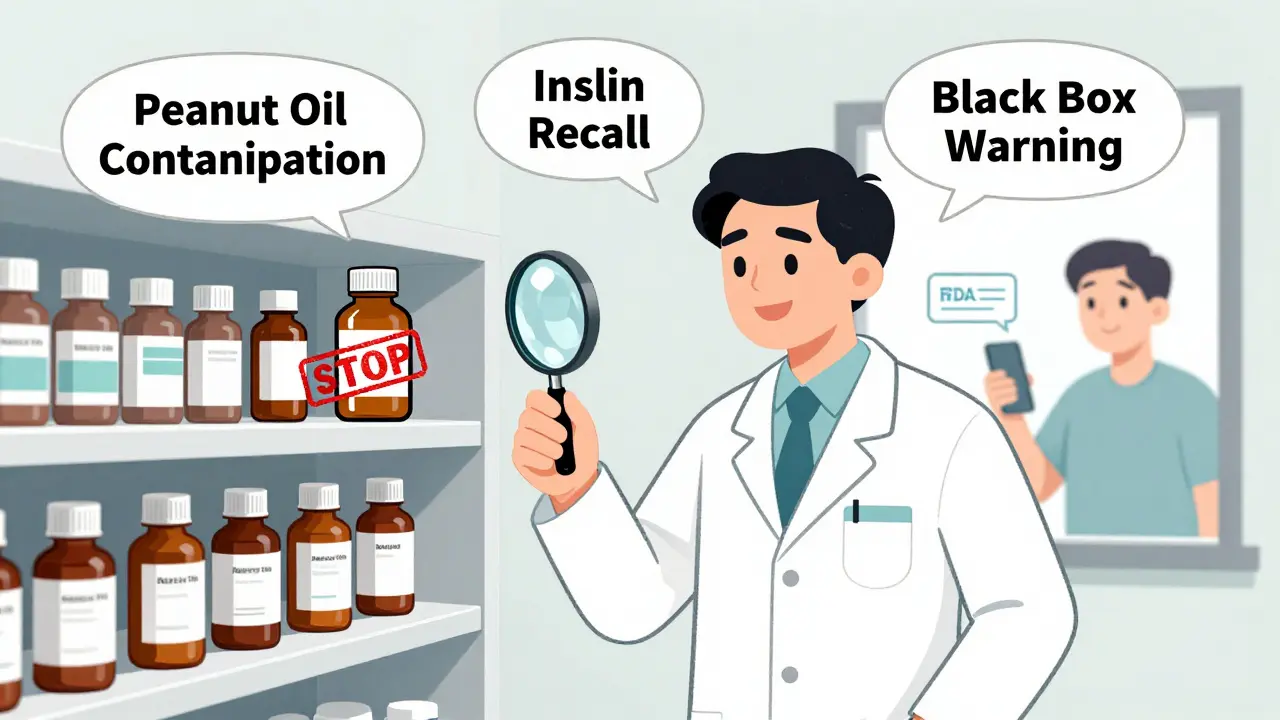
First, they don’t send push notifications. If you’re on the go, you won’t get a beep on your phone. Commercial apps like MedWatcher offer that-but they cost $10 a month. The FDA’s system is free, but you have to check your email.
Second, the alerts don’t explain risk in simple terms. A Drug Safety Communication might say, "There is an increased risk of pancreatitis associated with GLP-1 agonists." It won’t tell you how common that is. For that, you need context. If you’re a patient, look up the FDA’s Drug Safety Communications page and read the "Patient Information" section linked at the bottom of each alert.
Third, they don’t prioritize. A 2023 study found that 63% of subscribers feel overwhelmed by the volume. One hospital pharmacist told a Reddit thread, "I got five alerts last week. Three were about a drug I don’t even stock. I started ignoring them." The FDA knows this. They’re testing machine learning to rank alerts by urgency-and plan to roll out a smarter system by late 2025.
Who Should Subscribe (And Who’s Already Missing Out)
If you take any prescription or OTC medication regularly, you should be signed up. That includes parents of kids on ADHD meds, elderly patients on blood thinners, or anyone with a chronic condition.
But the biggest gap is in consumer adoption. Only 17% of patients subscribe. Meanwhile, 82% of hospitals with 200+ beds do. Why? Because when a batch of antibiotics is contaminated, pharmacists need to pull it off the shelf before a patient gets it. Patients? They’re waiting for the next refill to find out something’s wrong.
Pharmacists are the unsung heroes of this system. A 2022 AMA survey found that 72% of doctors who receive FDA Drug Safety Communications change how they prescribe based on them. One doctor in Ohio stopped prescribing a common diabetes drug after an alert revealed a rare but fatal liver injury. He later told the FDA, "I saved a patient’s life because I checked my email."
And it’s not just professionals. A patient in Texas subscribed to the Enforcement Report and set a keyword for "peanut." When a cough syrup was recalled due to peanut oil contamination, she got the alert before the product even hit her local pharmacy. She called ahead and saved her son from a life-threatening reaction.
What’s Coming in 2025
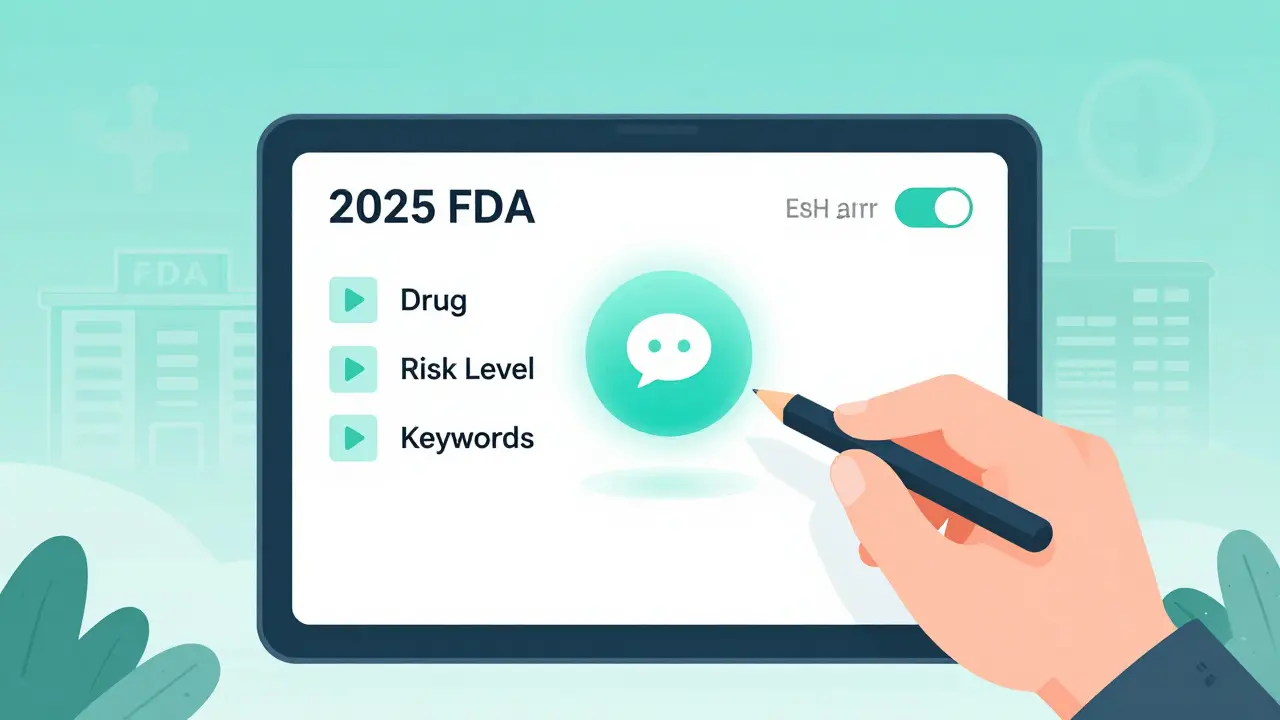
The FDA is making big changes. By mid-2025, they plan to merge all three alert systems into one unified platform. That means one email, one login, one dashboard. You’ll be able to filter by drug, condition, or risk level.
They’re also adding ten keywords per account (up from five), launching a Spanish-language version of all alerts, and releasing a mobile app. The app will include push notifications and a safety score for each alert-so you know which ones need immediate attention.
And they’re working on something even bigger: integrating the alert system with electronic health records. Imagine your EHR automatically flagging a drug you’re about to prescribe because the FDA just issued a safety warning. That’s the next step-and it’s already in testing.
Don’t Wait for a Crisis to Act
Drug safety isn’t about fear. It’s about control. You can’t stop recalls. But you can control whether you’re informed when they happen.
Signing up takes less time than checking your social media feed. The cost? Nothing. The risk of not doing it? Everything.
Set up your three subscriptions today. Pick your keywords. Check your email once a week. You’re not just staying informed-you’re protecting yourself, your family, and maybe even someone else’s life.
Do I have to pay to get FDA drug safety alerts?
No, all FDA drug safety alert subscriptions are completely free. You only need an email address. There are no hidden fees, no premium tiers, and no trials. The system is funded by the U.S. government and designed to be accessible to everyone-patients, caregivers, pharmacists, and providers.
What’s the difference between MedWatch and Drug Safety Communications?
MedWatch covers urgent safety notices, recalls, and adverse event reports across all FDA-regulated products-drugs, devices, and cosmetics. Drug Safety Communications are more detailed, science-focused updates about specific medications or drug classes, often including clinical data and prescribing recommendations. Think of MedWatch as the early warning system, and Drug Safety Communications as the deep-dive analysis.
Can I get alerts in Spanish?
Not yet, but it’s coming. As of January 2026, the FDA is preparing to launch Spanish-language versions of all drug safety alerts, with full rollout expected by Q3 2025. Currently, most alerts are only available in English, which is a known gap since Spanish speakers make up 22% of the U.S. population.
Why am I getting alerts for drugs I don’t take?
That’s because you’re likely subscribed to broad categories like "Drugs" without using keywords. The Enforcement Report system lets you add up to five custom keywords (like "metformin" or "warfarin") to filter alerts. Without keywords, you’ll get everything. Go back to your subscription settings and add your specific medications or allergies to reduce noise.
Do these alerts cover over-the-counter (OTC) drugs?
Yes. The FDA’s alert systems cover all FDA-regulated products, including prescription drugs, over-the-counter medications, biologics, and medical devices. If an OTC pain reliever is recalled for contamination, or if a new warning is added to an antacid label, you’ll get an alert-provided you’ve selected the "Drugs" category and set relevant keywords.
How fast are FDA alerts issued after a recall is confirmed?
On average, FDA alerts are sent within 4.2 hours of a recall being finalized. That’s significantly faster than commercial services, which average over 8 hours. The Enforcement Report system is the fastest for recalls, while Drug Safety Communications may take longer if they require clinical review. The system prioritizes urgent safety threats above all else.
Can I unsubscribe if I get too many alerts?
Yes, you can unsubscribe from any system at any time using the link at the bottom of every alert email. You can also adjust your settings-change from daily to weekly, or add more keywords to narrow the alerts. You don’t have to choose between being informed and being overwhelmed. You can fine-tune the system to fit your needs.
Stephen Craig
January 5, 2026 AT 17:25It’s wild how something so vital is buried under layers of bureaucracy. I’ve been getting these alerts for years, but I only started paying attention after my mom got hit with a recalled blood thinner. Now I check my FDA inbox like it’s my daily horoscope.
Connor Hale
January 7, 2026 AT 07:59Three systems? That’s not a feature, that’s a bug. The FDA should’ve merged these ten years ago. People aren’t IT admins. We just want to know if our medicine is going to kill us.
Roshan Aryal
January 8, 2026 AT 21:01Of course the Americans can’t handle one email list. You need three systems because your government can’t coordinate a fart in a hurricane. Meanwhile, India’s central drug authority sends one SMS per alert and everyone knows what’s going on. This is why your healthcare system is a joke.
Jack Wernet
January 9, 2026 AT 07:08The structure of these alert systems reflects a commendable commitment to tiered information delivery. While the fragmentation may appear inefficient, it allows for nuanced segmentation based on user role and risk profile. A unified platform, as proposed for 2025, may streamline access but risks diluting contextual specificity.
Catherine HARDY
January 10, 2026 AT 14:58Did you know the FDA gets funding from pharmaceutical companies? I’ve read it. They only send alerts when it’s politically safe. The real dangerous drugs? They never show up. I’ve got five alerts in my inbox and zero of them mention the ones that actually kill people. They’re hiding it.
Vicki Yuan
January 11, 2026 AT 12:11Just signed up for all three. Took me 7 minutes. I set keywords for my meds, my kid’s ADHD meds, and my mom’s blood pressure pills. I also created a folder called ‘FDA Life Raft’ and turned on notifications. If you’re not doing this, you’re playing Russian roulette with your health. Do it now.
Uzoamaka Nwankpa
January 11, 2026 AT 14:38I’ve been getting these emails for years. I never opened one. Then my cousin died from a contaminated OTC cough syrup. Now I open every single one. I cry every time. I feel guilty. I feel powerless. But I read them. I have to.
Chris Cantey
January 13, 2026 AT 02:38You think this is about safety? It’s about control. The FDA doesn’t want you to be informed-they want you to be dependent. They make you jump through hoops so you feel grateful for scraps of information. Meanwhile, the real power lies in who decides what’s ‘urgent.’
Abhishek Mondal
January 14, 2026 AT 04:43Let me clarify: The Enforcement Report Subscription Service is not a ‘system’-it is a sub-component of the broader Drug Safety Infrastructure (DSI), which, per 2023 FDA White Paper #F-2023-089, remains fragmented due to legacy interoperability constraints. Furthermore, the keyword limit of five (5) is archaic; modern pharmacovigilance systems permit up to twenty (20). This is not a feature-it is a failure of governance.
Oluwapelumi Yakubu
January 15, 2026 AT 09:20Man, this is beautiful. I’m from Nigeria and I’m telling you-this is the kind of system we need back home. We have people dying from fake insulin and no one tells them. You guys have this? And you’re still complaining? Bless your hearts. Send me the links-I’m sharing this with my whole village.
Akshaya Gandra _ Student - EastCaryMS
January 16, 2026 AT 11:24wait so u just sign up for 3 diffrent emails? i thought it was one? i just signed up for one and now im confused lol
Jacob Milano
January 17, 2026 AT 18:17I’m a nurse and I used to ignore these until I saw a patient get hospitalized because we didn’t know about a batch recall. Now I print them out, put them in a binder, and review them every Monday. It’s not glamorous, but it’s how you keep people alive. Thanks for the reminder.
saurabh singh
January 19, 2026 AT 02:09Bro this is gold. I just shared this with my whole family. My mom is 72 and takes 7 meds. My sister is a pharmacist in Delhi. We’re all signing up. This isn’t just info-it’s a lifeline. Thanks for making it so damn clear. No jargon. Just facts. That’s how you help people.
Dee Humprey
January 19, 2026 AT 05:33I set up all three last week. Made a separate email just for it. Added my meds, my kid’s asthma inhaler, and my dad’s cholesterol pill. Now I get maybe 2-3 alerts a week. I read them while I drink my coffee. It’s not scary-it’s empowering. You’ve got control. Use it.
John Wilmerding
January 19, 2026 AT 10:34It is imperative to underscore that the FDA’s alert mechanisms are predicated upon the principle of public health sovereignty. The tripartite structure is not an oversight, but rather a deliberate architectural design to ensure regulatory fidelity across distinct domains: enforcement, clinical safety, and professional communication. The forthcoming unification, while administratively elegant, must preserve this triage logic to avoid epistemic dilution.