
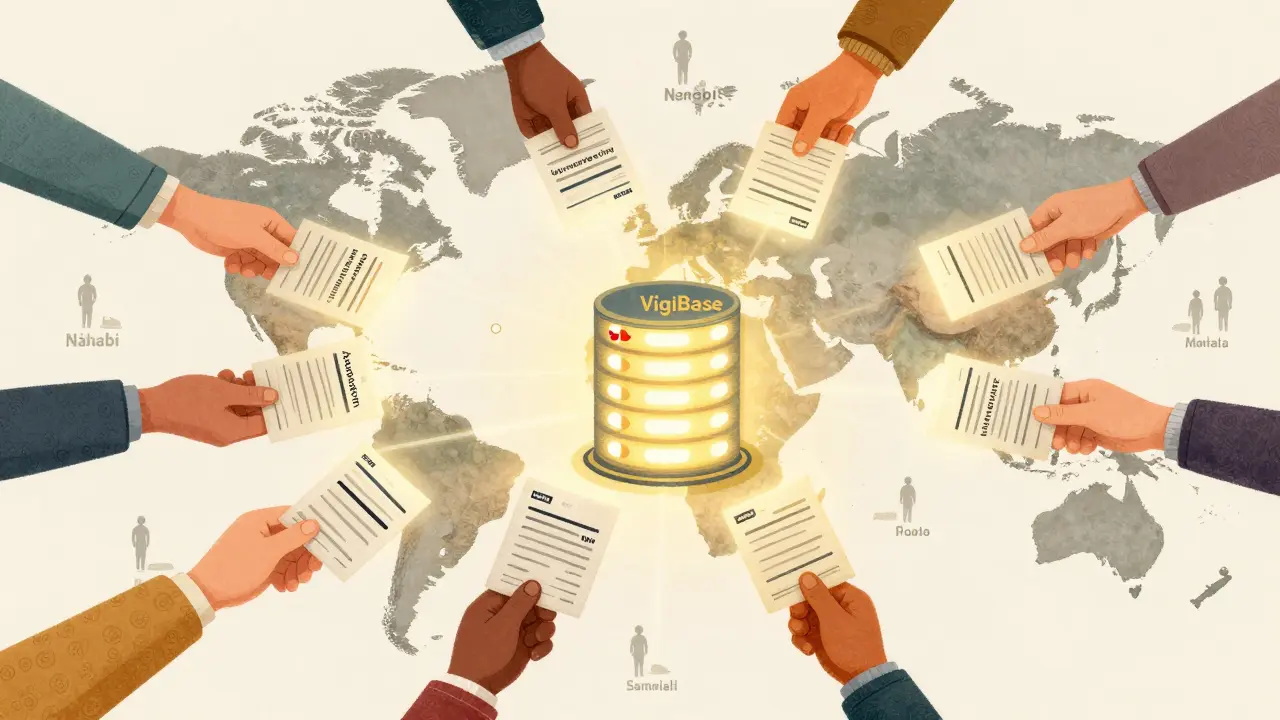
Every time someone takes a new medicine, there’s a hidden safety net working behind the scenes. It doesn’t make headlines. It doesn’t have a logo. But it’s the reason we know when a drug might cause unexpected harm - and why some medicines get pulled or warned about before they hurt thousands. That safety net is the global system for drug safety monitoring. It’s not just one country’s job. It’s a network of 170+ nations sharing data to protect people everywhere.
How the Global System Started
The story begins in 1963. The World Health Assembly, made up of member countries, passed a resolution that changed everything: they demanded a way to track serious side effects after medicines hit the market. Before that, drug safety was mostly tested in labs and small clinical trials. But real-world use? That was a black box. People reacted differently. New problems showed up. The system needed to be global because a drug sold in Japan might cause a rare reaction in Brazil - and no single country would catch it alone. That resolution led to the WHO Programme for International Drug Monitoring (PIDM), launched in 1968. At its center is VigiBase, the world’s largest database of adverse drug reaction reports. Managed by the Uppsala Monitoring Centre (UMC) in Sweden, it now holds over 35 million individual case reports. That’s more than seven times what it had in 2012. Each report is a story: a patient, a medicine, a reaction. And together, they form a map of risk.How Reports Flow Around the World
It’s not magic. It’s structure. Every country with a pharmacovigilance center collects reports from doctors, pharmacists, patients, and hospitals. These reports follow strict rules. The data must be formatted using the E2B(R3) standard - a digital language that lets computers from Sweden to South Africa read the same information. The drug names? They’re matched against WHODrug Global, a dictionary with over 300,000 medicine names. The side effects? Coded using MedDRA, a medical dictionary with 78,000+ terms organized into 27 categories like "nervous system disorders" or "skin and subcutaneous tissue disorders." These reports don’t just sit in a file. They’re uploaded to VigiBase. From there, experts use statistical tools to find patterns. If ten people in three different countries report the same rare liver problem after taking a new antibiotic, that’s a signal. A red flag. That’s when regulators step in. Maybe the drug gets a warning label. Maybe it’s restricted. Maybe it’s withdrawn. The system doesn’t prove cause and effect - it finds clues. Then human experts dig deeper.Regional Systems: WHO vs. EU vs. U.S.
Not all systems are built the same. The WHO PIDM is a voluntary network. Countries choose to join. They send data. They get tools. But they don’t have legal power to force companies to act. That’s where the European Union’s EudraVigilance system differs. In the EU, drug companies are legally required to report adverse events within 15 days of learning about them. The European Medicines Agency’s Pharmacovigilance Risk Assessment Committee (PRAC) reviews signals within 60 days for priority cases. That speed matters. The EU assesses 92% of signals in under 75 days. Globally, the average is 120. The U.S. FDA’s FAERS system handles about 2 million reports a year. It’s powerful. But it’s separate. It doesn’t automatically feed into VigiBase - though the FDA does submit reports manually. That means some signals might be found faster in Europe or the U.S., but missed elsewhere. And that’s a problem when a drug is used globally.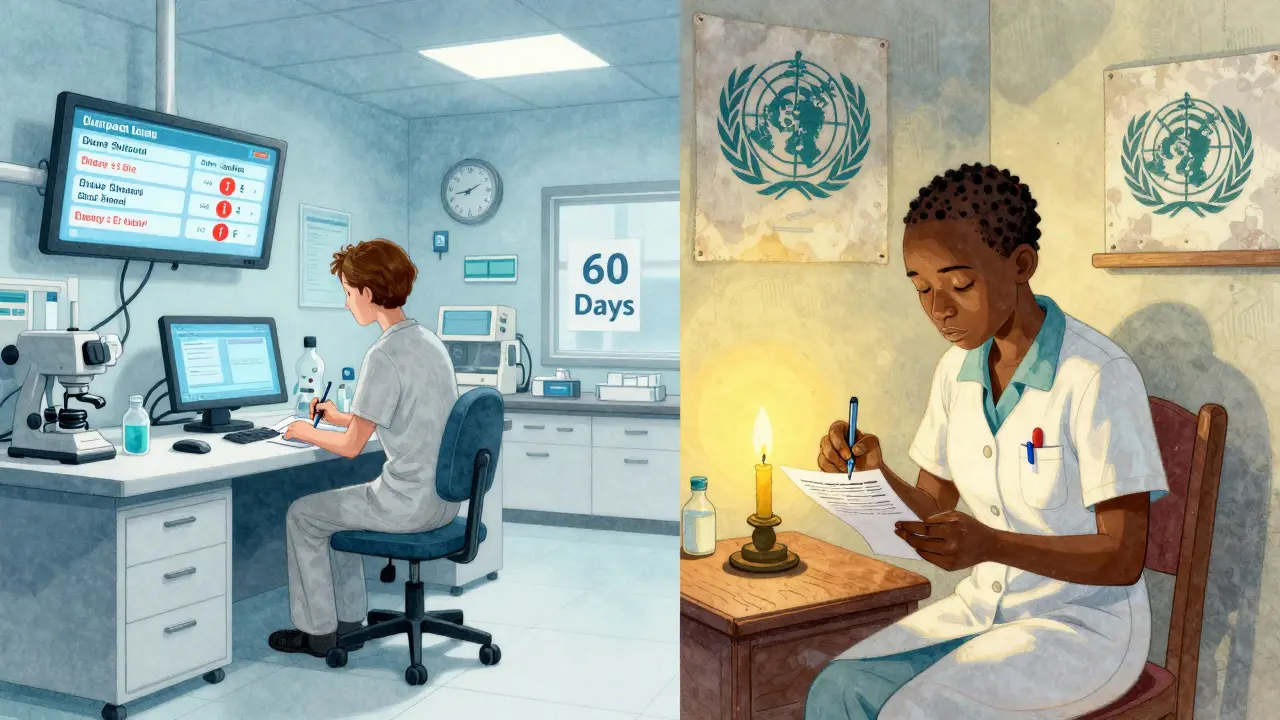
The Big Gap: Who Reports and Who Doesn’t
Here’s the uncomfortable truth: the system works best where resources are high. High-income countries - just 16% of the world’s population - submit 85% of all reports to VigiBase. Sweden reports 1,200 adverse events per 100,000 people each year. Nigeria? Around 2.3. That’s not because Nigerians don’t have side effects. It’s because they lack the systems to report them. A WHO assessment found that only 42% of low- and middle-income countries have fully functional pharmacovigilance systems. In many African nations, the annual budget for drug safety is less than 2 cents per person. In the U.S., it’s over $1.20. That gap means dangerous signals can go unnoticed for years. A 2017 case showed this clearly: after the dengue vaccine Dengvaxia was linked to worse outcomes in children who’d never had dengue before, it was Philippine reports that first flagged the risk. Without that data, the world might have kept giving the vaccine to the wrong people.Technology Is Changing the Game
Old systems relied on paper forms and fax machines. Today, it’s digital. In the UK, the Yellow Card Scheme lets healthcare workers report side effects through a mobile app. Nearly 80% of reports now come electronically, within 48 hours. Ethiopia cut its reporting time from 90 days to 14 after adopting the PViMS system - a free, web-based tool developed by MTaPS. Artificial intelligence is now helping too. UMC’s AI tools scan VigiBase for patterns that humans might miss. One 2023 study showed AI cut false alarms by 28%. That means faster, more accurate signals. The EU is using electronic health records from 150 million patients to find reactions in real time - something spontaneous reporting alone can’t do. That’s boosted detection by 37%.What’s Coming Next
By 2025, the world will adopt ISO IDMP standards - a new global system to identify medicines using 100+ data points: active ingredients, dosages, packaging, manufacturers. Right now, "aspirin" could mean 10 different products across countries. With IDMP, every version will have a unique digital fingerprint. That means better matching of reports across borders. Experts estimate it could improve cross-border data matching by 40%. VigiAccess, the public portal to VigiBase, has had over 12 million visits since 2015. Patients, researchers, and even journalists now use it to explore safety data. Transparency is growing. And more countries are joining. Zanzibar signed on in 2024. Ukraine restarted its national center in 2023 after the war. Yemen joined in 2022. These aren’t just names on a list. They’re people getting access to safety tools they didn’t have before.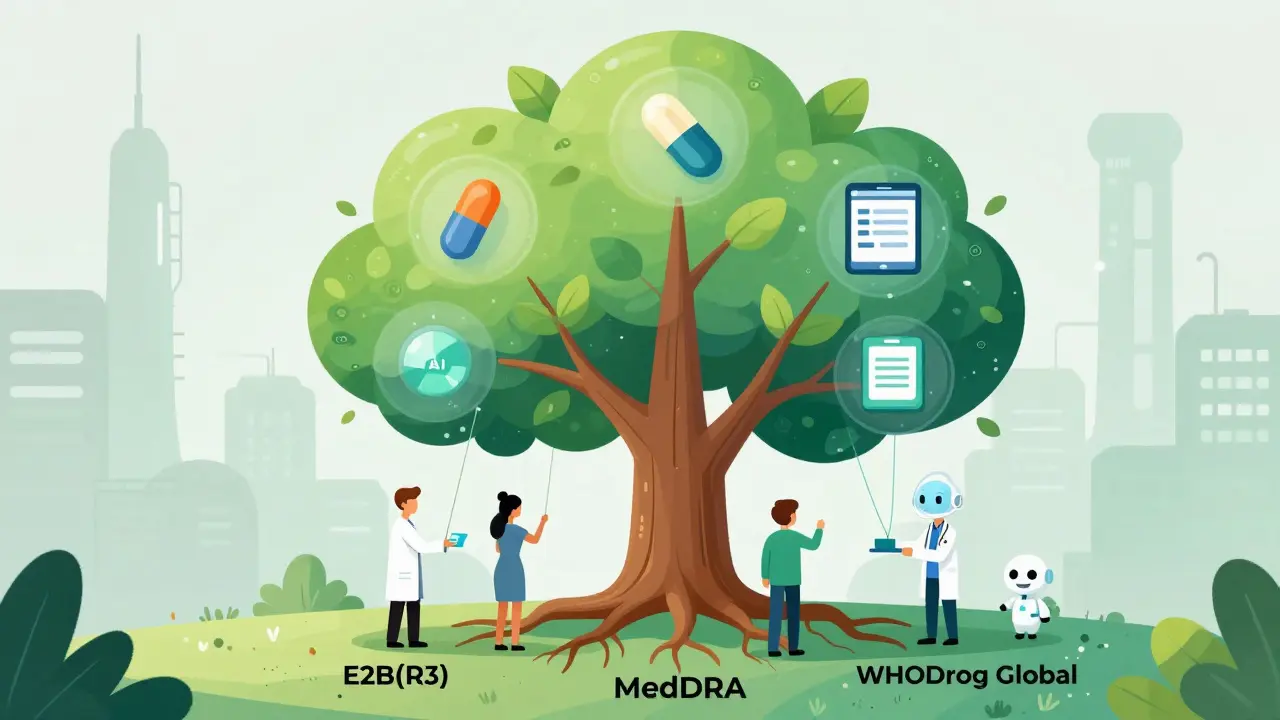
Why It Still Falls Short
Even with all this progress, the system has cracks. One big one: causality. Two experts looking at the same report might disagree on whether the drug caused the reaction. A 2023 study found only 63% agreement between EU and U.S. assessors. Why? Because there’s no global standard for judging cause. Some countries use algorithms. Others rely on doctor intuition. Training is another issue. WHO says pharmacovigilance officers need 40 hours of specialized training. In Southeast Asia, 68% got less than 15. Without proper training, reports are incomplete. Signals get missed. And funding? In 32% of low-income countries, the system survives only because of donor money. When that stops, so does the monitoring.What This Means for You
You don’t need to file a report. But you should know this: if you have a strange reaction to a medicine - especially if it’s new or you’re on multiple drugs - tell your doctor. Ask them to report it. Even if it seems minor. One report might not change anything. But 100? 1,000? That’s how a global warning starts. Pharmaceutical companies spend billions on pharmacovigilance now. The global market hit $5.38 billion in 2022 and is expected to hit $13.17 billion by 2030. That’s because regulators demand it. But the real power lies in the network. The doctors in Nairobi. The nurses in Manila. The patients in São Paulo. Their reports are the heartbeat of the system.Frequently Asked Questions
What is pharmacovigilance?
Pharmacovigilance is the science of detecting, understanding, and preventing adverse effects from medicines. It’s not just about recording side effects - it’s about using that data to make sure drugs stay safe after they’re approved and widely used. The World Health Organization defines it as essential for protecting patient safety and supporting public health.
How does VigiBase work?
VigiBase is the WHO’s global database for adverse drug reaction reports. It collects anonymized data from over 170 countries. Reports are standardized using E2B(R3) format, coded with MedDRA terminology, and matched to drugs using WHODrug Global. Experts use statistical tools to find patterns - signals - that suggest a medicine might be causing unexpected harm. These signals trigger further review by national regulators.
Why do rich countries report more side effects?
It’s not that people in low-income countries have fewer side effects - it’s that they often lack the infrastructure to report them. High-income countries have trained staff, digital systems, funding, and public awareness campaigns. In contrast, many low-income nations have no dedicated pharmacovigilance budgets, limited internet access, or no formal reporting channels. As a result, 85% of global reports come from just 16% of the world’s population.
Can I access drug safety data myself?
Yes. The WHO offers VigiAccess, a free public portal that lets anyone search anonymized data from VigiBase. You can look up a drug and see how many reports exist for different side effects, broken down by country and age group. It’s a powerful tool for patients, researchers, and even journalists who want to understand real-world safety data.
What’s the difference between spontaneous reporting and active surveillance?
Spontaneous reporting relies on healthcare providers or patients to voluntarily report side effects - like filling out a form after noticing a rash. Active surveillance uses automated systems, like electronic health records, to proactively scan for patterns. For example, the EU tracks 150 million patients through their medical records and flags unusual health events linked to specific drugs. Active surveillance catches more signals, faster, and is becoming the gold standard.
Matt Davies
December 19, 2025 AT 03:29Wow. This is one of those rare posts that actually makes you feel like the world isn’t completely falling apart. The fact that a nurse in Nairobi or a pharmacist in Manila can help prevent a global disaster just by clicking a button? That’s quiet heroism right there. I used to think drug safety was all corporate compliance and red tape - turns out it’s people, everywhere, quietly doing the right thing. 🙌
Mike Rengifo
December 20, 2025 AT 15:48Been on a few meds over the years. Never thought about who’s watching for the weird side effects. Kinda comforting to know someone’s got my back - even if I don’t know their name.
Ashley Bliss
December 20, 2025 AT 22:56This system is the last bastion of genuine humanism in a world run by algorithms and profit margins. Every report is a whisper from someone who suffered - and the fact that we listen, even imperfectly, is the only thing keeping us from becoming monsters. We owe these invisible workers everything. The world doesn’t thank them. But we should.
mary lizardo
December 21, 2025 AT 13:06While the premise is commendable, the article exhibits a troubling lack of critical engagement with the structural inequities inherent in the system. The reliance on voluntary reporting from low-income nations, without addressing the epistemic violence of imposing E2B(R3) and MedDRA standards upon culturally disparate healthcare contexts, reveals a neocolonial framework disguised as global cooperation. The Uppsala Monitoring Centre, despite its veneer of neutrality, functions as a de facto epistemic gatekeeper - a technocratic oligarchy masquerading as humanitarianism.
Isabel Rábago
December 21, 2025 AT 14:07It’s not just about funding. It’s about dignity. If a woman in rural India gets a rash after taking a pill, and no one has a form to fill out, or a phone to call, or a doctor who believes her - then the system didn’t fail. It never showed up. We call it a gap. It’s a chasm. And we’re the ones who built the walls around it.
jessica .
December 22, 2025 AT 05:59Wait - so you’re telling me the WHO is collecting ALL our drug reactions? And no one’s asking who’s behind the database? What if this is just a way to track us? I’ve heard the CDC uses this data to build health profiles. And what about the AI? They’re using it to predict who’s gonna get sick before they even take the pill. This isn’t safety. It’s surveillance with a Band-Aid.
Andrew Kelly
December 23, 2025 AT 11:38Yeah, right. ‘Global cooperation.’ Tell that to the FDA and EMA hoarding data like it’s gold. The system’s rigged. The U.S. and EU get first dibs on signals, then the rest of the world gets the scraps. And don’t even get me started on how Big Pharma funds half the ‘independent’ review panels. This isn’t safety - it’s PR with a spreadsheet.
Meenakshi Jaiswal
December 25, 2025 AT 03:17As a pharmacist in Delhi, I can tell you - we’ve been using PViMS since 2021. It’s free, simple, and works on a 2G connection. We’ve reported over 300 cases in two years. One was a blood clot linked to a cheap antihypertensive. Two months later, the manufacturer updated the label. No fanfare. No press. Just a woman in a village who told her aunt, who told the local nurse. That’s the real system. Not the databases. The people.
bhushan telavane
December 26, 2025 AT 14:29Back home in Mumbai, we call this ‘dawa ki suraksha’ - medicine protection. We don’t have fancy software, but we have chai breaks with doctors, and they write names on napkins when something feels off. That napkin? It goes to the district office. Sometimes it becomes a signal. Sometimes it doesn’t. But we keep writing. Because someone has to.
Dev Sawner
December 27, 2025 AT 05:58Statistical signal detection in VigiBase remains fundamentally flawed due to the absence of population denominator data in low-resource settings. The reporting rate disparity between Sweden and Nigeria is not indicative of differential adverse event incidence, but rather a systematic bias in data acquisition methodology. Furthermore, the reliance on MedDRA terminology introduces semantic drift when applied to non-Western clinical phenomenology. The system, as currently constituted, is statistically invalid for global generalizability.
Mahammad Muradov
December 27, 2025 AT 23:00The article romanticizes spontaneous reporting. In reality, most reports from developing nations are either fabricated to secure donor funding or are outright lies from untrained staff under pressure. The WHO’s entire model is built on false assumptions. No one in rural Zambia is filling out a form. They’re just dying. And someone is profitably burying the data.
Anna Sedervay
December 29, 2025 AT 17:27It is, quite frankly, an abomination that the ISO IDMP standards - a monumental leap toward interoperability - are not yet universally mandated. The fact that aspirin remains ambiguously defined across jurisdictions is not merely an oversight; it is a catastrophic failure of global governance. One must ask: if we cannot agree on the identity of a common analgesic, how can we possibly trust the integrity of pharmacovigilance? The answer, I fear, is that we cannot.
Connie Zehner
December 31, 2025 AT 08:30Okay but… what if the AI is wrong? What if it’s learning from biased reports and flagging innocent drugs? I read somewhere that the FDA’s system flagged a diabetes med as causing depression… but it was just because people on that drug were already depressed. What if AI starts telling doctors to stop giving insulin to Black patients because ‘the data says it’s risky’? 😭 I’m not sleeping tonight.
Moses Odumbe
January 2, 2026 AT 01:29Y’all are overthinking this. I took a new painkiller last week and got dizzy. Reported it on the app. Got a thank-you email. 3 days later, they updated the warning label. That’s it. No conspiracy. No colonialism. Just tech doing its job. 🤖✅