

When you think of a generic drug, you probably imagine a little white pill that looks just like the brand-name version but costs a fraction of the price. That’s easy to understand. But what if the drug isn’t a pill at all? What if it’s a living molecule - a protein built inside a cell, shaped by temperature, pH, and a thousand tiny variables you can’t even see? That’s a biosimilar. And copying it isn’t like copying a pill. It’s like trying to rebuild a symphony orchestra without the sheet music, the conductor, or even knowing which instruments were used.
The Big Difference: Biosimilars Aren’t Generics
Generics are made of small, simple chemicals. You mix the same ingredients in the same way, and you get the same molecule every time. It’s chemistry. Predictable. Repeatable. Biosimilars? They’re made in living cells - usually Chinese hamster ovary cells or yeast. These cells are tiny factories. They take in nutrients, breathe oxygen, and spit out complex proteins. That protein is the drug. But no two batches are ever exactly alike. Even under perfect conditions, the cells make slight variations. That’s biology. It’s messy. It’s variable. So when a company says they’ve made a biosimilar to Humira or Enbrel, they’re not saying, "We made the same thing." They’re saying, "We made something so close that it works the same way in your body." And proving that? That’s where the real battle begins.Process Defines the Product - And No One Knows the Recipe
Here’s the kicker: the originator company doesn’t share how they make their biologic. You can’t buy the blueprint. You can’t reverse-engineer it from the final product alone. The molecule might look the same under a microscope, but its real fingerprint - the tiny sugar chains (glycans) stuck to it, the way it folds, the impurities it carries - all of that depends on how it was made. That’s why experts say: process defines the product. Change the temperature by half a degree. Switch the nutrient mix in the bioreactor. Adjust the stirring speed. Suddenly, the glycans change. And those glycans? They control how fast the drug leaves your body, how well it binds to its target, even whether your immune system attacks it. Biosimilar makers have to reverse-engineer this entire process from scratch. It’s like being handed a gourmet meal and told, "Make this again, but you can’t ask the chef, taste it, or see the kitchen." You’ve got to guess the heat, the timing, the seasoning - and then prove to regulators that your version is identical in effect, even if the process is completely different.Glycosylation: The Silent Showstopper
One of the biggest headaches? Glycosylation. That’s the fancy word for the sugar molecules attached to the protein. These sugars aren’t just decoration. They’re functional. They affect stability, half-life, and immune response. A biosimilar might have the exact same amino acid sequence as the original. But if its sugar pattern is off by 5%, it could behave like a completely different drug. Too many sialic acids? The drug lasts too long. Too few? It gets cleared from the blood too fast. Wrong sugar type? The immune system might recognize it as foreign. Getting this right means controlling dozens of variables: the type of cell line, the pH of the culture, the dissolved oxygen level, the feeding strategy, even the air pressure in the room. A single change can ripple through the whole molecule. And regulators demand proof - not just that the sugars are "similar," but that they’re within a narrow, clinically safe range. That’s why labs need mass spectrometers, NMR machines, and teams of scientists who’ve spent years studying glycans. It’s not just expensive. It’s rare.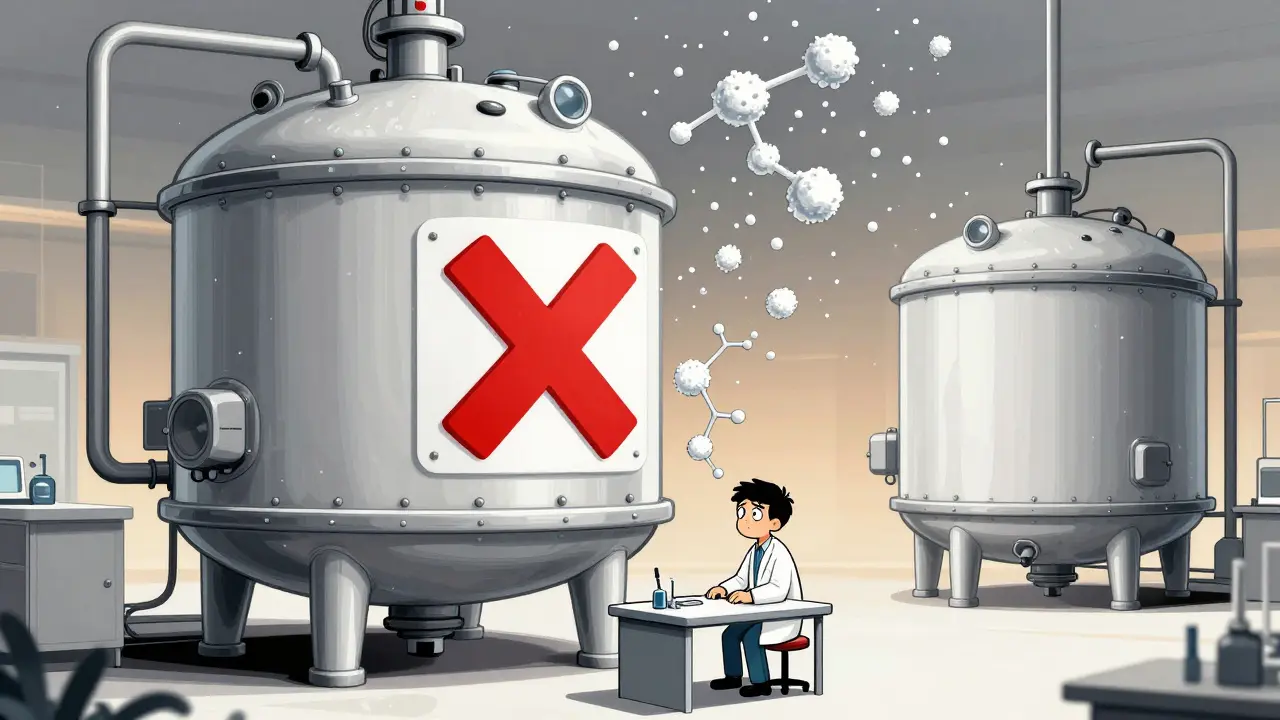
Scale-Up: From Lab to Factory - Where Things Go Wrong
You’ve got a process that works in a 10-liter bioreactor. Great. Now try scaling it to 2,000 liters. Sounds simple? It’s not. In a small tank, you can stir gently, bubble oxygen evenly, and keep the temperature perfect. In a huge tank? The center heats up. The edges get less oxygen. The cells near the walls experience different shear forces. They grow differently. They make different proteins. This isn’t theory. It’s happened. Companies have spent years developing a biosimilar, only to hit a wall when scaling up. The product looked fine in the lab. In the factory? The glycosylation shifted. The purity dropped. The whole batch was scrapped. That’s why manufacturers now use single-use bioreactors. No cleaning. No cross-contamination. No validation nightmares. You just hook up a sterile bag, pump in the cells, and walk away. It’s flexible. It’s faster. And it’s become essential for smaller players trying to enter the market without building a $500 million plant.The Cold Chain: One Slip, and Millions Are Lost
Biologics are fragile. They don’t like heat. They don’t like shaking. They don’t like sitting around. Once the product is made, it has to be filled into vials or syringes, packaged, shipped, stored, and delivered - all while kept between 2°C and 8°C. One broken refrigerator. One delayed shipment. One mishandled container. And the whole batch is ruined. This isn’t just a logistics problem. It’s a financial one. A single batch of a biosimilar can cost $2 million to make. Lose it? That’s a $2 million loss. No margin for error. That’s why companies are investing in real-time temperature sensors, smart packaging, and automated filling lines. The goal? Reduce human handling. Cut down on mistakes. And make sure the drug gets to the patient exactly as it left the bioreactor.Regulatory Maze: Every Country Has Its Own Rules
The FDA in the U.S. doesn’t think the same way as the EMA in Europe or Health Canada. Each agency has its own guidelines, its own expectations for analytical data, its own thresholds for clinical trials. Some require full Phase 3 trials. Others allow bridging studies. Some demand head-to-head comparisons. Others accept pharmacokinetic data alone. And the rules keep changing. In 2023, the FDA updated its guidance on analytical studies, pushing for more sensitive methods to detect subtle differences. That means companies now need better equipment, better data, and better teams - all before they even start clinical testing. Add to that the need for cGMP compliance - current Good Manufacturing Practices - and you’ve got a mountain of paperwork, audits, and inspections. One missed document. One unvalidated process. One inconsistent batch record. And your application gets rejected. No second chances.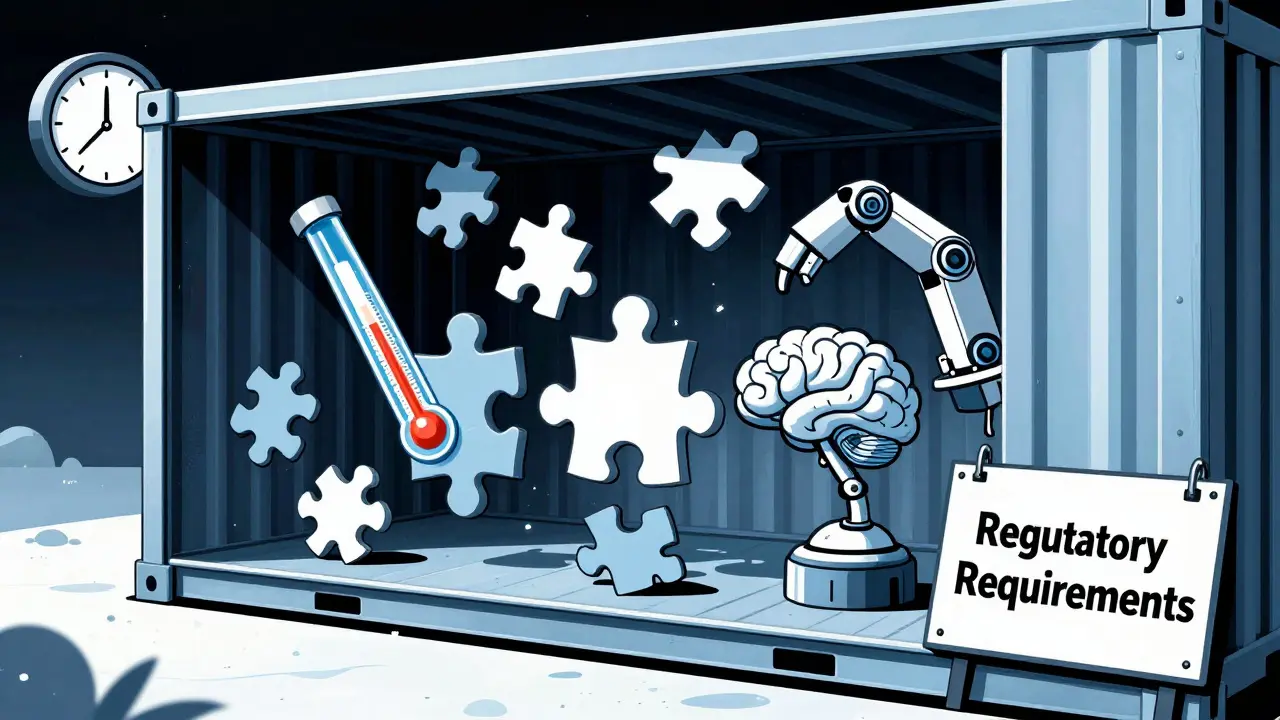
Technology to the Rescue - But at a Cost
The industry isn’t standing still. New tools are emerging to tackle these challenges:- Process Analytical Technology (PAT): Sensors that monitor pH, oxygen, and cell density in real time - letting operators adjust conditions on the fly.
- Artificial Intelligence: Machine learning models that predict how changes in temperature or feed rate will affect glycosylation - cutting years off development time.
- Continuous Manufacturing: Instead of making one batch at a time, some companies are moving to continuous systems where the product flows through the process nonstop. This reduces variability and improves consistency.
- Automation: Robots that handle filling, labeling, and packaging. Less human error. Fewer contamination risks.
The Market Is Booming - But Only for the Few
The global biosimilars market is expected to hit $58 billion by 2030. That’s a 28% annual growth rate. And it’s not hard to see why. Biologics like Humira, Enbrel, and Rituxan are losing patent protection. Insurers and governments want cheaper alternatives. But here’s the irony: the more demand grows, the tighter the bottleneck becomes. There aren’t enough manufacturing facilities with the right tech, the right expertise, and the right regulatory track record to meet the need. Many biosimilars that get approved never reach the market because no one can produce them at scale. The result? A market that’s growing fast - but concentrated in the hands of a few giants. Companies like Samsung Bioepis, Amgen, and Sandoz control most of the supply. Smaller players either get bought out or get stuck in development hell.What’s Next? Simpler Biosimilars Are Just the Beginning
Right now, most approved biosimilars are monoclonal antibodies - relatively straightforward compared to what’s coming. But the next wave? Bispecific antibodies. Antibody-drug conjugates. Fusion proteins. These are even more complex. More steps. More purification. More chances for something to go wrong. Manufacturing these will require even more advanced tech, tighter controls, and deeper expertise. The companies that win will be the ones who treat biosimilar production not as a copy job - but as a scientific challenge on par with developing the original.Copying a biologic isn’t about making a cheaper version. It’s about mastering biology at a level most industries never touch. It’s about controlling the uncontrollable. And that’s why, despite all the hype, there are still only a handful of biosimilars on the market - and why, for now, they’ll always be more expensive and harder to make than your average generic pill.
Why can’t biosimilars be exact copies like generics?
Biosimilars are made from living cells, not chemicals. These cells naturally vary in how they produce proteins - affecting sugar chains, folding, and impurities. Even tiny changes in temperature or nutrients change the final product. Generics are made by mixing identical chemicals, so they’re exact. Biosimilars can’t be - but they must be close enough to work the same way.
What’s the biggest manufacturing hurdle for biosimilars?
Glycosylation - the pattern of sugar molecules attached to the protein - is the most sensitive and hardest to control. It affects how the drug behaves in the body, and it’s easily altered by small changes in the manufacturing process. Matching it to the original requires extreme precision and advanced lab equipment.
Why is scale-up so difficult for biosimilars?
In small bioreactors, conditions are easy to control. In large ones, heat, oxygen, and mixing become uneven. Cells in different parts of the tank grow differently, changing the protein’s structure. What works in a lab often fails in a factory unless the process is carefully redesigned.
Do biosimilars need clinical trials?
Sometimes. Regulators may waive full clinical trials if analytical and pharmacokinetic data prove high similarity. But for complex biosimilars or new indications, full Phase 3 trials are still required. Each country has different rules, making global approval a long process.
Can small companies make biosimilars?
It’s extremely hard. The cost of equipment, regulatory expertise, and analytical labs runs into hundreds of millions. Most small players either partner with big firms or get acquired. Only a few have succeeded independently, and they usually focus on simpler biosimilars or use single-use tech to cut costs.
What’s the future of biosimilar manufacturing?
The future lies in automation, continuous manufacturing, and AI-driven process control. These technologies reduce variability, cut costs, and speed up development. But they also raise the bar - making it harder for companies without deep resources to compete. The winners will be those who treat biosimilars as advanced science, not just cost-saving copies.
Lauren Wall
January 22, 2026 AT 04:58This is why we can't have nice things. Big Pharma just wants to keep prices high by making biosimilars impossible to replicate. It's not about science-it's about profit.
And don't even get me started on how they patent every tiny step of the process.
Ryan Riesterer
January 23, 2026 AT 02:05The core challenge lies in the heterogeneity of post-translational modifications, particularly glycosylation profiles, which are inherently stochastic due to cellular metabolic variance. Process analytical technology (PAT) and high-resolution mass spectrometry are now non-negotiable for comparability assessments.
Without these, clinical equivalence cannot be reliably established.
Jasmine Bryant
January 24, 2026 AT 15:01i read this and was like wait so the sugar bits on the protein are what make it work??
so if you change the temp by like 0.5 degrees the sugar pattern changes??
that’s wild. i thought it was just about the amino acids.
so like… if your bioreactor has a little glitch, the whole drug could be useless?
no wonder it’s so expensive. i had no idea it was this fragile.
also why can’t they just use computers to simulate it all?
is that a thing yet?
someone pls explain
Liberty C
January 25, 2026 AT 20:12Let’s be brutally honest: if you can’t reproduce a molecule with atomic precision, you’re not manufacturing-you’re gambling with human lives.
And the FDA? They’re letting companies slide with ‘similar enough’ because they’re too cozy with the biotech oligarchs.
It’s not innovation. It’s regulatory capture dressed up as science.
And don’t even get me started on how these ‘biosimilars’ are priced at 80% of the original-like we’re supposed to be grateful.
It’s a scam. A beautifully engineered, patent-protected, mass-marketed scam.
shivani acharya
January 27, 2026 AT 06:50Ohhh so this is why the big pharma CEOs are all sipping champagne while people die waiting for insulin.
They don’t want us to have cheap medicine-they want us to be dependent on their magic black box factories.
And guess what? The same people who make these drugs also own the patents on the machines that make them.
They control the cells. The sugar. The temperature. The air pressure.
They even control the data.
And if you try to copy it? They sue you into oblivion.
It’s not science-it’s feudalism with pipettes.
And the worst part? We’re all supposed to be impressed that they ‘managed’ to copy it.
Copy? It’s not copying. It’s theft of biology.
And we’re the ones paying for it.
Next thing you know, they’ll patent your DNA.
They already are.
Just wait.
They’re coming for your mitochondria next.
😂
Brenda King
January 29, 2026 AT 04:38So many people don’t realize how much goes into this
it’s not just about the drug
it’s about the whole system
the cold chain
the robots
the data tracking
the inspectors
the paperwork
the years of failed batches
and still people think it’s just ‘a cheaper pill’
it’s not
it’s like building a jet engine from scratch using only the smoke trail
and then hoping it doesn’t explode midflight
we should be thanking these scientists
not complaining about the price
they’re doing the impossible
and we’re lucky to have any of it at all
❤️
Rob Sims
January 30, 2026 AT 15:18Wow. So after all that, we get a product that’s ‘similar enough’?
Let me guess-the original drug costs $20K a year and the biosimilar costs $18K?
And you call that a win?
Meanwhile, the guy who invented the original got a $200M bonus.
And now you want me to clap?
Pathetic.
This isn’t competition. It’s a rigged game where the house always wins.
And we’re the suckers buying the tickets.
Kenji Gaerlan
January 31, 2026 AT 15:59so like… if the sugar thing is so important why dont they just make it the same?
is it that hard to copy a few sugar bits?
or is this just a fancy excuse to keep prices high?
also i heard biosimilars are mostly made in china now
is that true?
or is that just another conspiracy
idk man
just saying
it all sounds like a lot of bs to me
Akriti Jain
February 1, 2026 AT 02:22They’re lying about the glycosylation.
They can copy it.
They just don’t want to.
Why?
Because if they could make perfect copies, then everyone would.
And then the big companies would lose their monopoly.
So they pretend it’s impossible.
They hire scientists to say it’s too complex.
They spend millions on patents for ‘processes’ that are just random steps.
And then they charge $20K for a drug that costs $200 to make.
And we believe them.
Because we’re too lazy to ask questions.
Or maybe we’re scared.
What if they’re right?
What if we really can’t copy it?
Then we’re doomed.
And they win.
Again.
😭
Mike P
February 2, 2026 AT 13:50Let me get this straight-you’re telling me a bunch of Chinese hamster cells are the reason we can’t have affordable medicine?
And we’re supposed to be impressed that a company spent $500M to make a protein that’s ‘close enough’?
Bro.
That’s not science.
That’s corporate theater.
Meanwhile, in India, they’re making generics that cost 10% of the price and they don’t even have half the tech.
So why can’t we?
Because we’re too busy patenting air.
And calling it innovation.
Pathetic.
And don’t even get me started on how the FDA lets this slide.
They’re in the pocket.
Every. Single. One.
Sarvesh CK
February 4, 2026 AT 12:03The complexity of biosimilar manufacturing reveals a profound truth: biology resists reductionism. Unlike synthetic chemistry, where molecules are assembled with deterministic precision, living systems operate through emergent, nonlinear dynamics-each batch a unique expression of cellular physiology shaped by micro-environmental fluctuations.
What we perceive as ‘imperfection’ is, in fact, the signature of life itself.
Regulatory frameworks rooted in chemical equivalence are fundamentally inadequate for biological entities.
Perhaps the real challenge is not to replicate, but to reframe our understanding of therapeutic similarity-not as identity, but as functional resonance.
And if we accept this, we may find not only better science, but also more humane policy.
After all, medicine should serve life, not control it.
Hilary Miller
February 5, 2026 AT 01:03Just flew back from Mumbai last week-saw a biosimilar clinic in a slum that’s saving lives for $50 a dose.
They use open-source protocols, solar-powered cold storage, and local lab techs trained in 3 months.
It’s not perfect.
But it works.
And it’s not in a $200M facility.
Maybe the future isn’t in giant bioreactors.
Maybe it’s in humility.
And collaboration.
Not patents.