
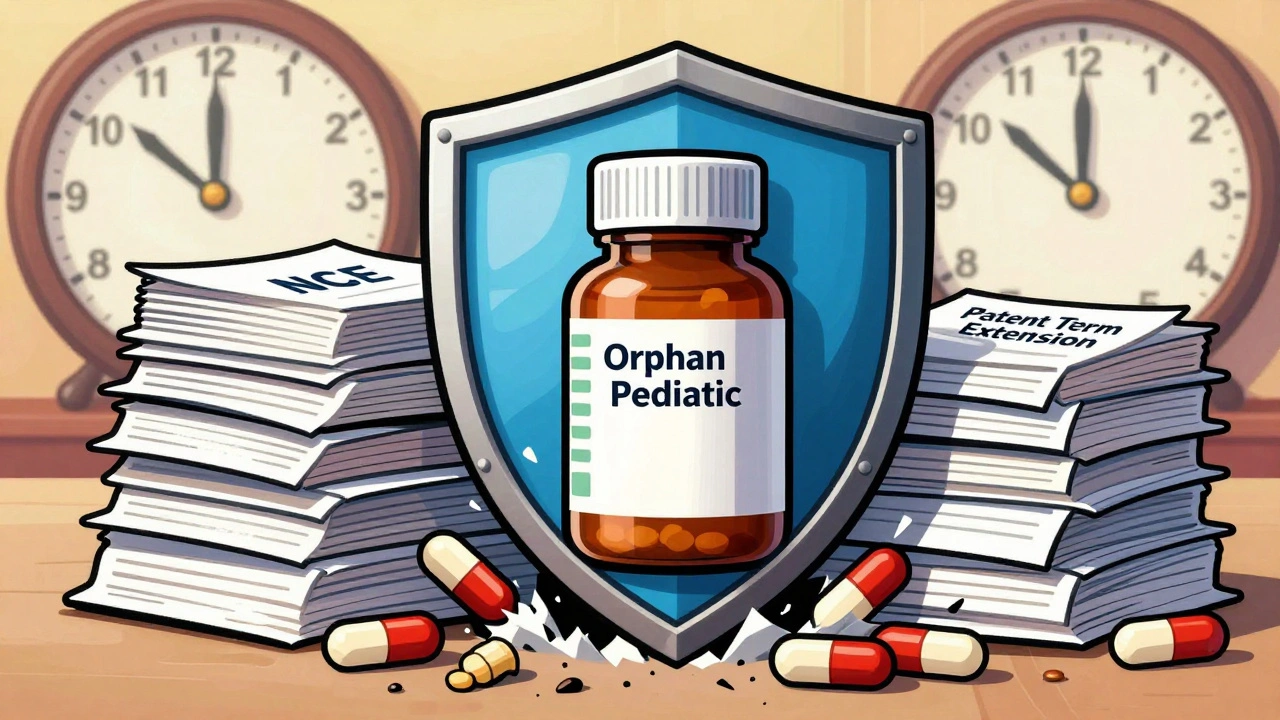
When a new drug hits the market, most people assume it’s protected by a patent that lasts 20 years. But that’s only the beginning. In reality, many blockbuster drugs stay off-limits to generics for 15 to 20 years-sometimes longer-thanks to a web of legal and regulatory tools that have nothing to do with the original patent. These are called market exclusivity extensions, and they’re the real reason why prices stay high long after the patent expires.
Patents Aren’t the Whole Story
The 20-year patent clock starts ticking the moment a drug’s formula is filed, often years before it even reaches patients. By the time the FDA approves it, five or six years might already be gone. That leaves little time to recoup the $2.3 billion average cost of development. To fix this, the U.S. created the Hatch-Waxman Act in 1984, which allowed for Patent Term Extension (PTE). This lets companies add back up to five years of patent life to make up for FDA review delays. But here’s the catch: even after that extension, the total market monopoly can’t exceed 14 years after FDA approval. So if a drug gets approved 10 years after the patent was filed, the maximum protection is 14 years total-not 25.But companies didn’t stop there. They found other ways to keep generics out. These aren’t patents. They’re regulatory exclusivities-special protections granted by the FDA that run parallel to, and often longer than, patents. And unlike patents, they don’t require inventiveness. Just paperwork.
The Five Big Exclusivity Tools in the U.S.
The FDA offers five main types of market exclusivity that stack on top of patents:- New Chemical Entity (NCE) exclusivity: 5 years of market protection for a drug with a completely new active ingredient. No generics can even apply during this time.
- Orphan Drug exclusivity: 7 years for drugs treating rare diseases affecting fewer than 200,000 Americans. Even if another company develops the same drug for the same condition, they can’t sell it for 7 years.
- New Clinical Investigation exclusivity: 3 years for a new use, dosage, or formulation of an existing drug. But here’s the trick: the FDA now demands real clinical benefit, not just a tweak.
- Pediatric exclusivity: A 6-month bonus added to any existing exclusivity period if the company completes FDA-requested pediatric studies. This isn’t a standalone protection-it piggybacks on everything else.
- Patent challenge exclusivity: 180 days for the first generic company to successfully challenge a patent. This isn’t for the brand-name company-it’s a reward for the challenger.
Here’s where it gets strategic. A drug can qualify for multiple exclusivities at once. A new orphan drug with a pediatric study? That’s 7 years + 6 months. Add a new indication? Another 3 years. The result? A drug might have 10, 12, even 15 years of layered protection-all without a single new patent.
How Europe Does It Differently
The EU doesn’t use patent term extensions the same way. Instead, it relies on Supplemental Protection Certificates (SPCs). These can extend protection up to 15 years after drug approval-slightly longer than the U.S. cap. But the real difference is in how exclusivity is structured.Europe uses an 8+2+1 system: 8 years of data exclusivity, 2 years of market exclusivity, and 1 extra year if pediatric studies are done. Unlike the U.S., where exclusivities can stack like Lego blocks, Europe keeps them more tightly controlled. Orphan drugs get 10 years of protection, extended to 12 with pediatric data. There’s also a separate system called PUMA-Pediatric-Use Marketing Authorization-for drugs developed specifically for children, even if they’re not patentable. That gives 8+2 years of protection.
The U.S. system is more flexible but also more exploitable. The EU’s structure makes it harder to pile on endless layers. That’s why U.S. drugs often have longer effective monopolies.

The Patent Thicket Strategy
Beyond regulatory exclusivity, companies build what’s called a patent thicket. This isn’t one patent. It’s dozens-sometimes over 40-covering tiny changes: a new pill coating, a different dosing schedule, a slightly altered chemical salt form. These are called secondary patents. They don’t protect the drug’s core function-they protect how it’s delivered, packaged, or used.Take tazarotene, a skin cream. Its original patent covered the active ingredient. But the manufacturer filed 48 more patents covering things like packaging, timing of application, and combinations with other creams. Each one delayed generic entry by a few months. When the core patent expired, generics couldn’t enter because another patent was still active. The FDA couldn’t approve them-not because the drug was unsafe, but because of legal technicalities.
This is what experts call evergreening. It’s legal, but it’s not innovation. It’s legal engineering. A 2023 Yale study found that 91% of drugs with patent extensions still had market control long after those extensions expired-thanks to these secondary patents.
Product Hopping and Other Tactics
Another common tactic is product hopping. Just before a patent expires, the brand-name company launches a slightly modified version-say, a pill that dissolves under the tongue instead of being swallowed. They market it as “improved,” then stop making the original. Generics can’t copy the new version because it’s still under patent. Patients are forced to switch, and insurers keep paying the high price.Teva Pharmaceuticals reported in 2022 that this tactic delayed generic entry for 17% of their target drugs. The Federal Trade Commission has called this anticompetitive. In 2023, they filed legal briefs arguing that product hopping violates U.S. antitrust laws. But courts move slowly, and companies keep doing it.
Why This Matters for Patients and Payers
The cost isn’t abstract. In 2022, just four drugs-bimatoprost, celecoxib, glatiramer, and imatinib-cost the U.S. healthcare system an extra $3.5 billion over two years because generics were blocked by exclusivity extensions. These aren’t niche drugs. They’re used by hundreds of thousands of people.Branded drugs make up only 10% of prescriptions but 78% of spending in the U.S. That’s not because they’re better. It’s because they’re the only option. For rare diseases, exclusivity is essential. Orphan drug programs have led to treatments for conditions that once had none. But for common conditions like high blood pressure or arthritis, these extensions are pure profit protection.

Who’s Behind the Scenes?
Big pharma doesn’t leave this to chance. Top companies like Bristol Myers Squibb, Novartis, and Vertex have teams of 15 to 25 people dedicated to exclusivity strategy. These aren’t sales reps. They’re lawyers, regulatory experts, and data analysts who map out every possible extension months before a drug even launches.They file patents at the perfect time-often after Phase II trials, so the 20-year clock doesn’t expire before the drug hits shelves. They plan pediatric studies years in advance to lock in the 6-month bonus. They target orphan status early, even if the disease isn’t ultra-rare, because the payoff is huge.
For startups, exclusivity isn’t optional. A 2023 BIO survey found that 68% of biotech firms say market exclusivity is critical to securing venture capital. Investors won’t fund a drug unless they can see a clear path to 10+ years of monopoly revenue.
Is the System Broken?
The original intent of these rules was good: encourage innovation for hard-to-treat diseases. But today, the system is being used to delay competition on drugs that treat common conditions. The FDA has started pushing back. In April 2023, it tightened rules for 3-year exclusivity, requiring proof of real clinical benefit-not just a new pill shape.The EU is also reviewing its SPC system to stop minor modifications from getting extra years. But change moves slowly. Meanwhile, companies keep stacking protections. Evaluate Pharma predicts that by 2028, the average drug will enjoy 16.3 years of market exclusivity-up from 12.7 in 2018.
There’s a growing consensus among health economists: the system needs recalibration. Not to kill innovation, but to stop it from being weaponized. The goal should be to reward breakthroughs, not tweaks. To protect patients with rare diseases, not to protect profits on everyday pills.
What’s Next?
The tension between access and innovation isn’t going away. More lawsuits are coming. More regulatory crackdowns. More pressure from insurers and patient groups. But as long as a single year of monopoly can mean billions in revenue, companies will keep pushing the limits.For now, the real story isn’t about patents. It’s about how legal loopholes, regulatory quirks, and strategic timing have turned market exclusivity into a multi-layered shield-one that keeps generics out long after the science says they should be allowed in.
What’s the difference between a patent and market exclusivity?
A patent protects the invention of a drug’s chemical structure and lasts 20 years from filing. Market exclusivity is granted by the FDA and protects a drug from generic competition based on regulatory data, not invention. It runs separately from patents and can last 5, 7, or even 12 years depending on the type. You can have exclusivity without a patent, and vice versa.
Can a drug have more than one type of exclusivity at the same time?
Yes. A drug can have New Chemical Entity exclusivity (5 years), pediatric exclusivity (6 months added), and orphan drug exclusivity (7 years) all at once. The protections stack, meaning the clock doesn’t reset-it adds on. So a drug might get 5 + 0.5 + 7 = 12.5 years of total exclusivity without any patents.
Why do companies file so many secondary patents?
Secondary patents cover minor changes like dosage forms, delivery methods, or combinations with other drugs. They don’t make the drug better-they just create legal barriers. Once the main patent expires, generics still can’t enter because another patent is active. This is called a patent thicket. Tazarotene had 48 secondary patents, delaying generics for years.
Does pediatric exclusivity really add value to patients?
Yes, but only when the studies are meaningful. Pediatric exclusivity requires companies to test drugs on children, which was rare before the 1990s. Now, many drugs have dosing guidelines for kids because of this rule. But some companies do minimal studies just to get the 6-month bonus. The FDA is cracking down on this.
Are orphan drug exclusivities being abused?
Some are. Orphan status was meant for diseases affecting fewer than 200,000 people. But now, some drugs for common conditions like high cholesterol or diabetes have been granted orphan status because they’re used in a small subset of patients. The FDA is aware and has started reviewing these cases more closely.
How long do exclusivity extensions really last on average?
The average drug now gets 8.2 years of exclusivity beyond its core patent. Some, like glatiramer, gained 13 months. Others, like celecoxib, got 7 months. But when you add patent extensions, orphan status, pediatric bonuses, and secondary patents, the total effective exclusivity often reaches 15-20 years.
Katie Harrison
December 8, 2025 AT 14:04Interesting breakdown-especially the part about orphan drug exclusivity being stretched to common conditions. I’ve seen this happen with insulin analogs in Canada; the same molecule gets rebranded as ‘for pediatric use’ just to lock in another 7 years. It’s regulatory arbitrage dressed as innovation.
Steve Sullivan
December 9, 2025 AT 14:02bro the patent thicket thing is wild. 48 patents on a skin cream??? like imagine if you got 48 copyrights on a single spoon because it’s ‘slightly curved’ or ‘has a matte finish’ 😂 we’re not protecting innovation-we’re protecting spreadsheets.
ian septian
December 10, 2025 AT 21:28This is why generics are so slow to arrive. Not because of science. Because lawyers.
Chris Marel
December 11, 2025 AT 20:06I’m from Nigeria, and we can’t even get generics for basic meds because the pricing stays inflated by these loopholes. It’s not just an American problem-it’s a global injustice.
Evelyn Pastrana
December 13, 2025 AT 04:25So let me get this straight… we reward companies for doing the bare minimum (like testing on kids)… then let them charge $10,000 a pill for 15 years? 🤡
Arun Kumar Raut
December 13, 2025 AT 12:45Good point about the EU system being tighter. Maybe we should copy that instead of letting pharma write the rules. Innovation shouldn’t mean monopoly forever.
precious amzy
December 14, 2025 AT 13:55The moral hazard inherent in this system is not merely economic-it is ontological. We have conflated proprietary control with societal progress, thereby reducing the pharmaceutical enterprise to a neofeudal rent-extraction apparatus. The FDA, in its current form, functions not as a guardian of public health, but as a custodian of corporate privilege.
Carina M
December 16, 2025 AT 04:47It is unconscionable that profit motives are permitted to override the fundamental human right to access life-saving medication. These so-called ‘exclusivities’ are not legal instruments-they are moral failures dressed in legalese.
William Umstattd
December 17, 2025 AT 06:58These companies aren’t innovating-they’re gaming the system. And the FDA lets them. It’s not just unethical-it’s criminal. Someone needs to go to jail for this.
Asset Finance Komrade
December 18, 2025 AT 10:36As a contrarian, I must ask: what if the system works exactly as designed? If we want innovation, we must reward it with exclusivity. The alternative is a world where no one invests in R&D because the first mover gets wiped out by generics on day one. Maybe the problem isn’t the length of exclusivity-it’s that we expect miracles on a budget.
Elliot Barrett
December 20, 2025 AT 02:56Yeah, but the 6-month pediatric bonus? That’s just a tax on parents. Companies do the bare minimum study and cash in. No real benefit. Just a loophole.