
MAOI Food Safety Calculator
Check if specific foods and drinks are safe to consume while taking MAOIs. The tool identifies tyramine content and risk levels for dietary restrictions.
Select foods or enter your own item. Results will show tyramine content (in mg per 100g) and whether the item is safe with MAOIs.
Results
Select or enter a food item to see safety information.
Important Safety Information
For MAOI users:
- Never consume items with tyramine content over 10 mg per 100g while taking MAOIs
- When in doubt, avoid the food or drink
- Always check with your doctor about specific dietary restrictions
- At the lowest dose of Emsam (6 mg/24hr), you can safely consume many foods that would be dangerous at higher doses
When most people think of antidepressants, they picture SSRIs like Prozac or Zoloft-pills with mild side effects and no big dietary rules. But there’s another class of antidepressants, older and far more complex: Monoamine Oxidase Inhibitors, or MAOIs. These aren’t your first-line treatment. In fact, they’re prescribed in less than 1% of antidepressant cases in the U.S. But for the 1 in 5 people who’ve tried five or more antidepressants and still feel stuck, MAOIs can be the only thing that works.
How MAOIs Work (And Why They’re Different)
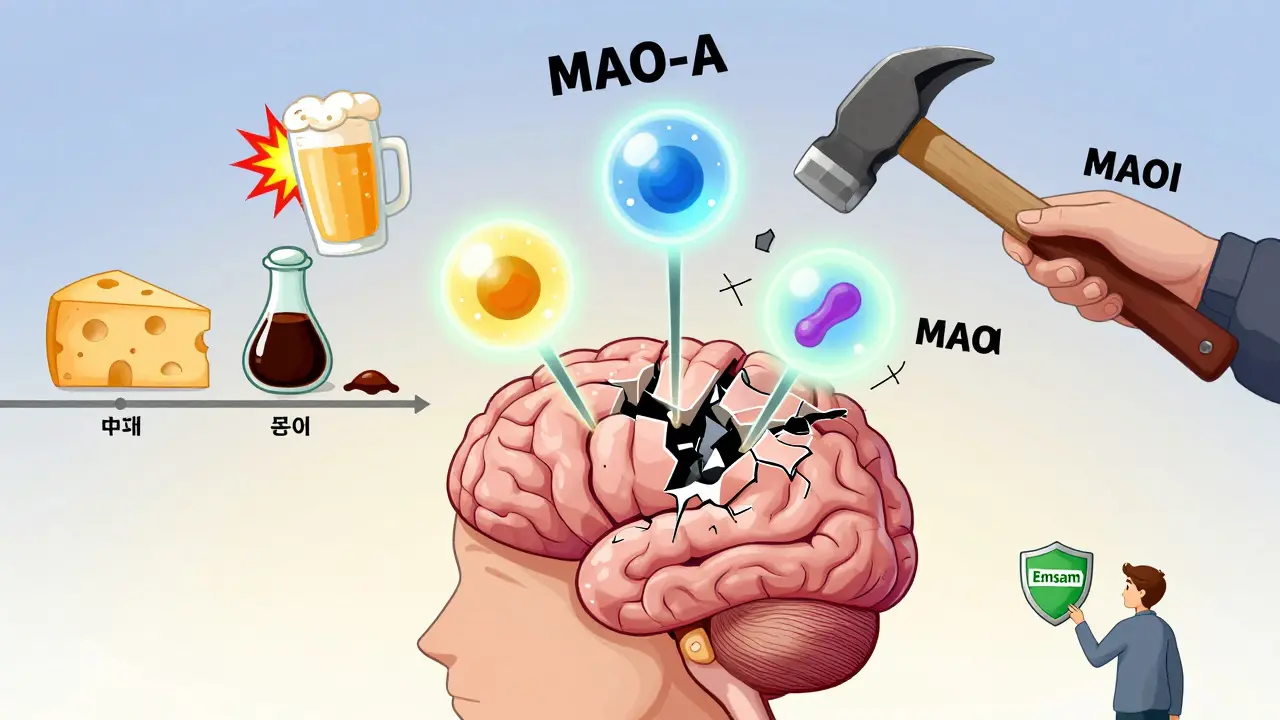
Most antidepressants boost serotonin by blocking its reabsorption. MAOIs do something more radical: they stop your body from breaking down serotonin, norepinephrine, and dopamine at all. They block the enzyme monoamine oxidase, which normally cleans up these mood chemicals after they’ve done their job. With MAOIs, these neurotransmitters stick around longer-flooding the brain with more of what’s needed to lift depression.
There are two types of this enzyme: MAO-A and MAO-B. MAO-A is the big player for depression. It breaks down serotonin and norepinephrine. That’s why drugs like phenelzine and tranylcypromine target MAO-A. MAO-B, on the other hand, mostly handles dopamine and trace amines-so it’s more relevant for Parkinson’s. The newer selegiline patch (Emsam) works this way: low doses only block MAO-B, so no diet changes. Higher doses? They hit MAO-A too-and then the restrictions kick in.
Older MAOIs like Nardil and Parnate are irreversible. That means they bind to the enzyme permanently. Your body has to make new enzymes, which takes two weeks. That’s why switching from an SSRI to an MAOI isn’t just a matter of stopping one and starting the other. You need a 2- to 5-week washout period. Mess that up? You could trigger serotonin syndrome-a dangerous spike in body temperature, confusion, seizures, or even death.
The Tyramine Trap: Why Your Cheese Could Be Dangerous
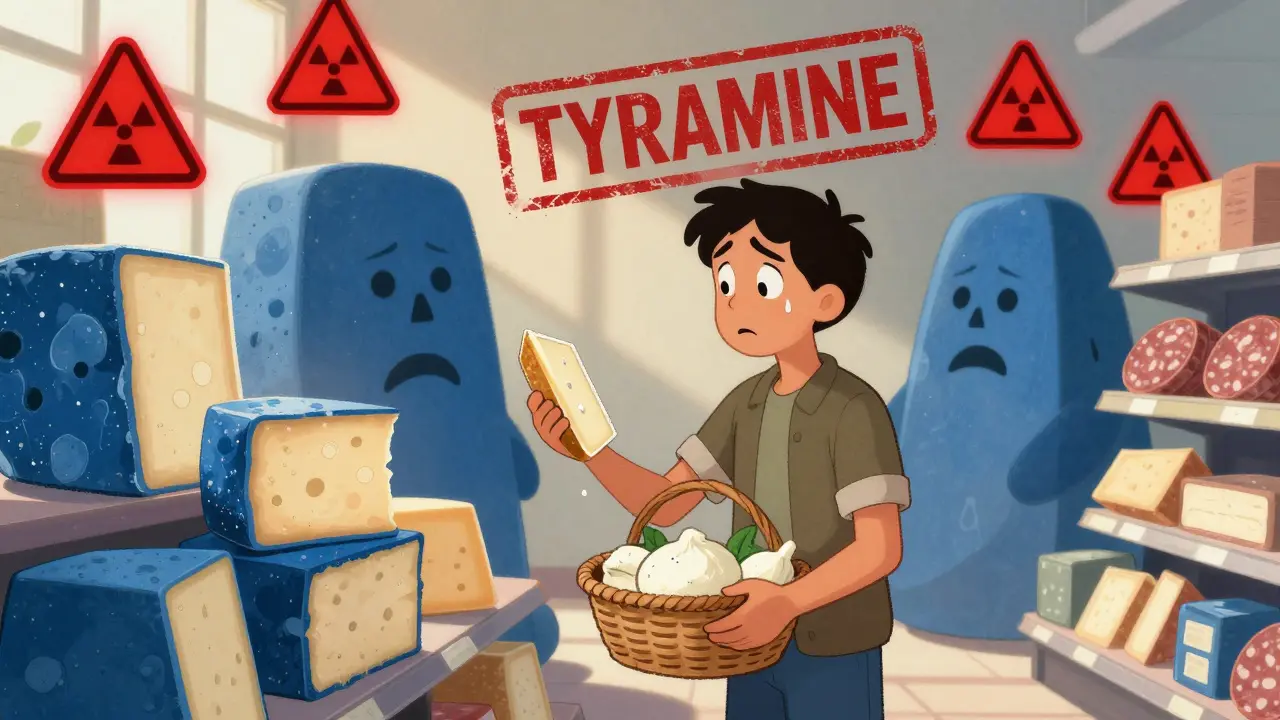
The most infamous rule with MAOIs? No aged cheese. No soy sauce. No tap beer. No cured meats. Why? Tyramine.
Tyramine is a natural compound found in foods that have been aged, fermented, or stored too long. It’s in blue cheese (up to 100 mg per 100g), salami (up to 50 mg), red wine, and even leftover stir-fry from two days ago. Normally, your gut breaks down tyramine with MAO-A before it enters your bloodstream. But when MAO-A is blocked by an MAOI, tyramine slips through. It then triggers your body to dump a flood of norepinephrine-causing your blood pressure to skyrocket.
Systolic pressure can jump over 200 mmHg. That’s a hypertensive crisis. Symptoms? Blinding headache, chest pain, nausea, blurred vision. In extreme cases, it leads to stroke or heart attack. The FDA requires a black box warning on every MAOI prescription for this reason.
But here’s the twist: the risk isn’t as high as people think. Studies show fewer than 1 in 10,000 MAOI users have a hypertensive crisis per year-if they follow the rules. The real problem? People don’t know what’s risky. A 2022 study found 28% of MAOI users had at least one episode in their first year-mostly from eating leftovers, drinking craft beer, or grabbing a quick snack at the airport.
What’s safe? Fresh cheeses like cottage cheese or ricotta (under 2 mg tyramine per 100g). Fresh meats. Untapped beer. Refrigerated, unfermented soy products. Cooked meals made the same day. If it’s been sitting out for more than 48 hours, skip it.
Drug Interactions: The Hidden Minefield
MAOIs don’t just clash with food. They can explode when mixed with common medications.
- SSRIs and SNRIs: Mixing these with MAOIs-even days after stopping-can trigger serotonin syndrome. The risk jumps to 15-20% if the washout isn’t long enough.
- Decongestants: Pseudoephedrine (Sudafed) and phenylephrine (in many cold meds) can spike blood pressure. Even one tablet can be dangerous.
- Opioids: Meperidine (Demerol) is a known killer when combined with MAOIs. Fentanyl and tramadol? Also risky.
- Herbal supplements: St. John’s Wort, 5-HTP, and even certain energy drinks can push serotonin levels too high.
Doctors often miss this. A 2021 study in the Journal of Clinical Psychopharmacology found that 37% of MAOI patients were prescribed at least one unsafe drug by a non-psychiatrist. That’s why carrying a printed list of forbidden meds-and showing it to every new doctor-isn’t just smart. It’s life-saving.
The Newer, Safer Option: The Emsam Patch
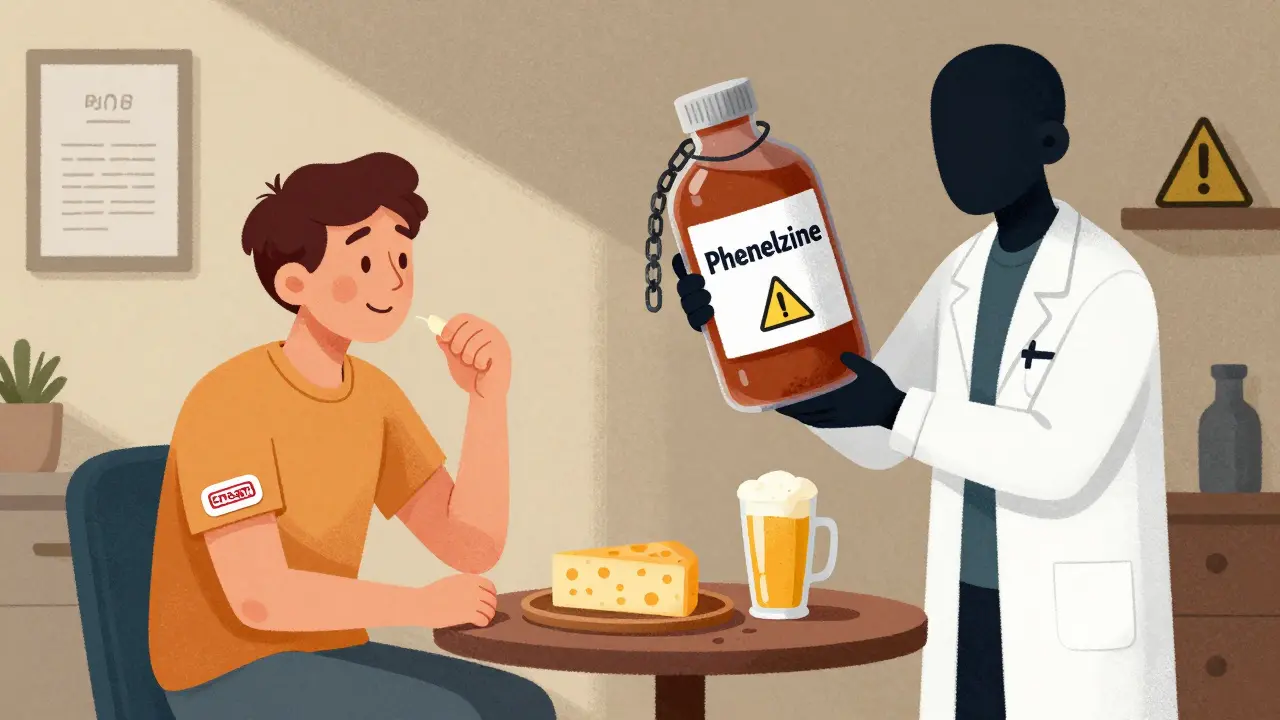
If the idea of avoiding cheese for life sounds unbearable, there’s a better way: the selegiline patch (Emsam).
Unlike oral MAOIs, Emsam delivers the drug through the skin. At the lowest dose (6 mg/24hr), it barely touches MAO-A in the gut. That means no dietary restrictions. You can eat your sushi, your blue cheese, your craft IPA. The FDA approved this in 2006-and it’s still the only MAOI with that freedom.
At higher doses (9 mg and 12 mg), you need to follow the same rules as oral MAOIs. But most patients stay on the low dose. The catch? Cost. Emsam runs $850-$1,200 a month. Generic phenelzine? $30. Insurance often won’t cover Emsam unless you’ve tried everything else.
Still, for people who travel, eat out often, or just hate food paranoia, Emsam changes everything. One user on Reddit wrote: “I’ve been on Emsam for 3 years. I had a cheese platter at my sister’s wedding. I didn’t die. I cried. It was the first time I felt normal in 15 years.”
Who Actually Benefits?
MAOIs aren’t for everyone. But for certain types of depression, they’re the most effective tool we have.
Atypical depression-characterized by oversleeping, overeating, heavy limbs, and mood reactivity (feeling better when something good happens)-responds better to MAOIs than SSRIs. A 2023 meta-analysis in The Lancet Psychiatry found MAOIs had a number needed to treat (NNT) of 4.2. That means for every 4 people treated, one achieves remission. For SSRIs? The NNT is 7.8. That’s almost twice as many people needed to treat for one to get better.
They also work for treatment-resistant depression. A 2021 meta-analysis in the American Journal of Psychiatry showed 50-60% of people who failed 3+ antidepressants improved on MAOIs. Reddit threads are full of stories like: “I tried 7 meds. Nothing. Parnate gave me back my energy in 3 weeks. I haven’t cried in 2 years.”
But here’s the hard truth: only 7% of general psychiatrists prescribe MAOIs regularly. It’s mostly specialists-those who see patients who’ve given up. That’s because managing MAOIs takes time. You need diet counseling, medication reviews, and constant follow-up. Most clinics don’t have the bandwidth.
The Real Cost: Lifestyle and Mental Load
The biggest side effect of MAOIs isn’t dizziness or dry mouth. It’s the mental burden.
You become a detective. You check expiration dates. You ask servers how food was prepared. You carry emergency phentolamine (an alpha-blocker that can reverse a hypertensive crisis) in your purse. You avoid dating because explaining “no aged cheese” on a first date feels ridiculous. You panic when your leftovers sit in the fridge too long.
A 2022 survey by the Depression and Bipolar Support Alliance found 63% of MAOI users said food anxiety was their biggest daily stressor. But 65% still stuck with it-because the alternative was being numb.
Support groups like the MAOI Information Project have 5,000 members sharing tips: “Freeze meat within 24 hours,” “Use fresh garlic, not garlic powder,” “Avoid kombucha unless it’s unpasteurized and you’ve tested it.” These aren’t myths. They’re survival tactics.
What’s Next? The Future of MAOIs
Researchers aren’t giving up on MAOIs. In fact, they’re trying to fix them.
A new compound called AZD7325, tested in early 2023, reduced tyramine sensitivity by 70% compared to old MAOIs. It’s still in trials, but if it works, it could mean no diet restrictions at all. The National Institute of Mental Health is also funding studies on MAOIs for bipolar depression-with early results showing 55% remission rates.
Meanwhile, the Emsam patch is gaining traction. More insurers are covering it. More patients are asking for it. And as awareness grows, so does the number of psychiatrists willing to prescribe.
But for now, MAOIs remain a tool for the desperate. The ones who’ve lost years to depression. The ones who’ve tried everything. For them, the cheese, the labels, the fear-it’s all worth it. Because for the first time in a long time, they feel alive.
Can you drink alcohol on MAOIs?
Moderate alcohol is usually okay, but avoid red wine, tap beer, and any fermented drinks. They contain tyramine and can trigger high blood pressure. Clear spirits like vodka or gin in small amounts are lower risk-but never mix with medications or take when you’re tired or stressed. Always check with your doctor.
Are MAOIs addictive?
No, MAOIs are not addictive. They don’t create cravings or euphoria like opioids or benzodiazepines. But stopping them suddenly can cause withdrawal symptoms-dizziness, nausea, anxiety, or flu-like feelings. Always taper off under medical supervision. Never quit cold turkey.
How long does it take for MAOIs to work?
Most people notice changes in 2 to 4 weeks, but full effects can take 6 to 8 weeks. Unlike SSRIs, which often cause initial worsening, MAOIs tend to improve sleep and energy first. If you don’t feel better after 8 weeks, talk to your doctor-this isn’t a trial-and-error medication. It’s a precision tool.
Can you take MAOIs if you have high blood pressure?
It’s risky. MAOIs can cause sudden spikes in blood pressure, especially with tyramine exposure. If you have uncontrolled hypertension, you’re usually not a candidate. But if your blood pressure is stable and well-managed with medication, MAOIs may still be an option-with close monitoring. Always disclose your full medical history.
Is there a safer MAOI than others?
Yes. Moclobemide (Aurorix) is a reversible MAO-A inhibitor (RIMA) with fewer dietary restrictions and less risk of interaction. It’s not available in the U.S., but approved in Europe and Canada. The Emsam patch at 6 mg/24hr is the safest option in the U.S.-no diet changes needed. Oral MAOIs like phenelzine and tranylcypromine carry the highest risk.
If you’re considering MAOIs, talk to a psychiatrist who specializes in treatment-resistant depression. Don’t rely on general practitioners. This isn’t a medication you start on a whim. It’s a commitment. But for the right person, it’s not just a drug-it’s a second chance.
Laura Gabel
March 18, 2026 AT 08:13Andrew Mamone
March 18, 2026 AT 10:18MALYN RICABLANCA
March 20, 2026 AT 04:30Sanjana Rajan
March 22, 2026 AT 04:02SNEHA GUPTA
March 22, 2026 AT 08:37Kathy Underhill
March 23, 2026 AT 20:01Kyle Young
March 24, 2026 AT 23:13gemeika hernandez
March 26, 2026 AT 02:51