
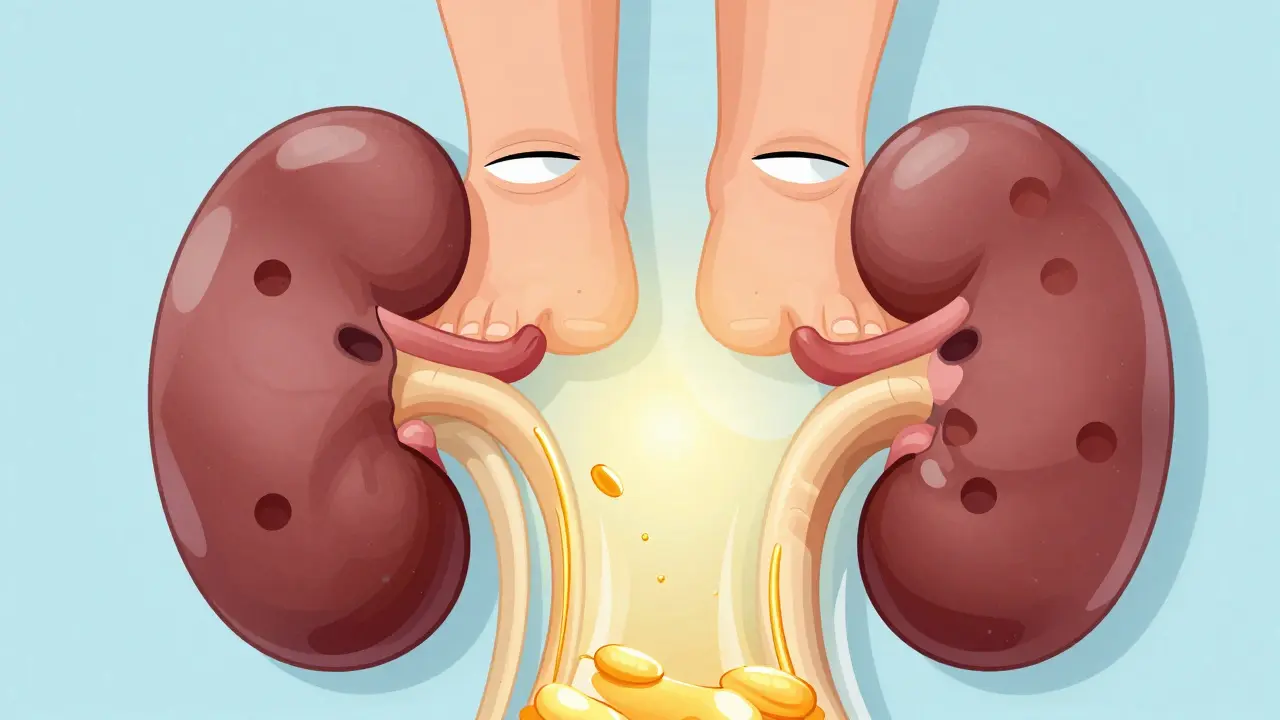
When your kidneys stop doing their job, your body starts to leak. Not blood, not pus, but something far more subtle: protein. This is the hidden signal of nephrotic syndrome - a condition that doesn’t always scream for attention, but quietly changes your life through swelling, foamy urine, and unexplained weight gain. It’s not one disease. It’s your kidneys crying out because the filters are broken.
What’s Really Happening in Your Kidneys?
Your kidneys have tiny filters called glomeruli. Think of them like fine mesh sieves. Normally, they let water and waste out, but hold onto important stuff like albumin - the protein that keeps fluid from leaking into your tissues. In nephrotic syndrome, that mesh gets holes. Big ones. So albumin slips into your urine, sometimes more than 3.5 grams a day. That’s like losing a full teaspoon of protein every single hour. This isn’t just about losing protein. It’s a chain reaction. When albumin drops below 3.0 g/dL, your blood can’t hold onto water anymore. Fluid spills into your ankles, your eyes, your belly. That’s the edema - the swelling that makes people think they’ve gained weight, or that they’re just "puffy." But it’s not fat. It’s fluid. And it can be severe: some adults get fluid in their lungs, making it hard to breathe. Kids wake up with swollen eyelids that look like they’ve been crying all night. At the same time, your liver tries to make up for the lost protein by cranking out more lipids. Cholesterol and triglycerides skyrocket - often over 300 mg/dL. That’s not just a lab number. It’s a ticking time bomb for heart disease down the road.Why Does This Happen? It Depends on Your Age
Nephrotic syndrome doesn’t pick its victims randomly. It has favorite targets based on age. In kids under 6? Almost always minimal change disease. It’s the most common cause - 80 to 90% of cases. The name sounds harmless, but it’s not. Under the microscope, the kidney looks normal. Yet, it’s leaking like a sieve. And here’s the good news: 80 to 90% of these kids respond to steroids within 4 weeks. Their proteinuria vanishes. Their swelling goes down. They bounce back. But in adults? The story changes. About 40% have focal segmental glomerulosclerosis (FSGS). That’s when parts of the filter scar over. Another 30% have membranous nephropathy, where immune proteins build up like gunk on the filter. And for adults over 65? Diabetes is the #1 culprit - 20 to 30% of cases. High blood sugar slowly damages the glomeruli. It’s slow. Silent. Often caught too late. Less common, but just as serious, are the genetic forms. Congenital nephrotic syndrome, caused by a mutation in the NPHS1 gene, shows up in babies under 3 months old. They’re born with proteinuria over 10 grams a day. These cases don’t respond to steroids. They need different tools - and fast.How Do You Know It’s Nephrotic - Not Just Swelling?
Many people think swollen ankles mean they’re dehydrated or standing too long. But nephrotic syndrome has a signature. Look for these three together:- Proteinuria over 3.5 grams per day (confirmed by a 24-hour urine collection)
- Low serum albumin (under 3.0 g/dL)
- Edema - especially around the eyes, legs, or abdomen
What’s the First Line of Treatment?
For kids with minimal change disease? Prednisone is the go-to. Dose? 60 mg per square meter of body surface (max 80 mg/day). Give it for 4 to 6 weeks. Most kids start feeling better in days. Swelling drops. Urine clears. Then you taper slowly - over 2 to 5 months. Don’t rush it. Stopping too fast? Relapse is almost guaranteed. Adults get the same drug, but often for longer - 8 to 16 weeks. Response? Only 60 to 70% get full remission. And half of them will relapse. That’s why doctors don’t just stop there. Here’s the game-changer: ACE inhibitors or ARBs. These blood pressure pills - like lisinopril or losartan - aren’t just for hypertension. They directly reduce protein leakage. Studies show they cut proteinuria by 30 to 50%. That’s huge. Every patient, no matter the cause, should be on one - if their blood pressure allows it. Target? Below 130/80 mmHg.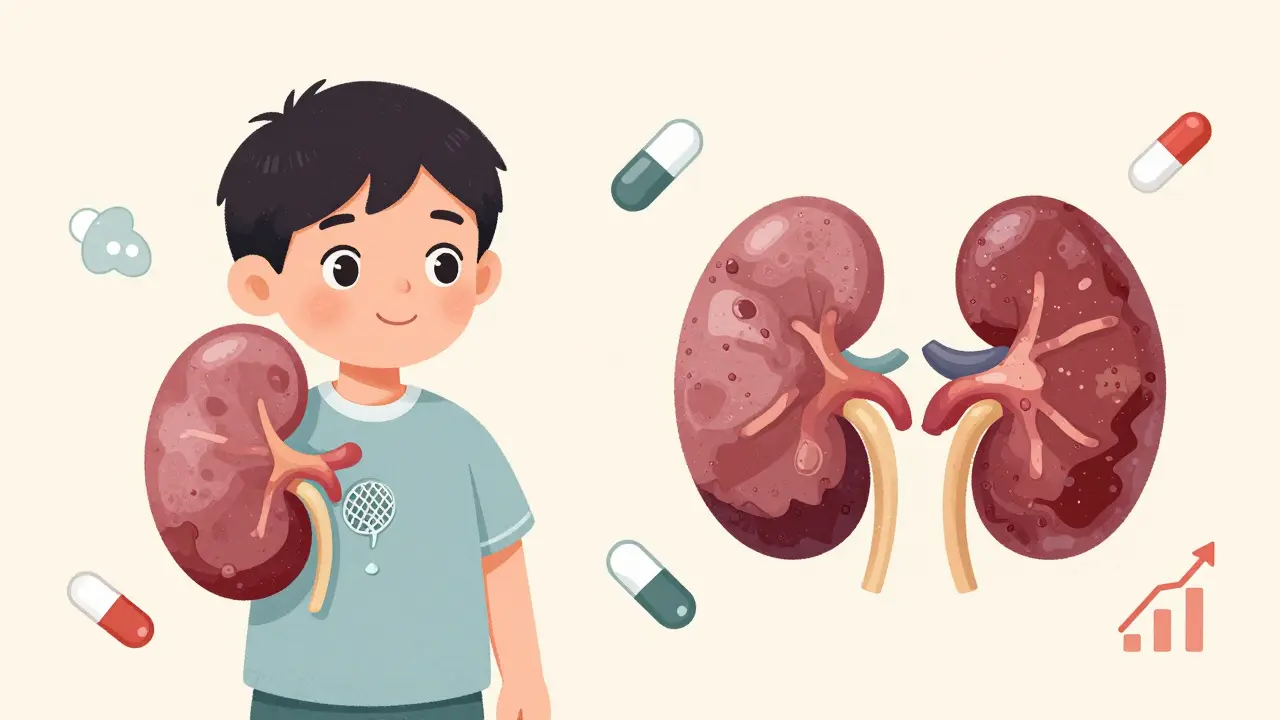
The Hidden Danger No One Talks About
Nephrotic syndrome doesn’t just leak protein. It makes your blood clot. When albumin drops below 2.0 g/dL, your body loses natural anticoagulants. Your blood thickens. The risk of clots - in your legs, lungs, or even the vein that drains your kidney - jumps 2 to 4 times. Renal vein thrombosis isn’t rare. It happens in 10 to 40% of adults with severe nephrotic syndrome. That’s why doctors watch for sudden pain in the flank, shortness of breath, or swelling that doesn’t improve. If you’re in that high-risk zone, anticoagulants like warfarin or low-molecular-weight heparin may be needed. It’s not optional. It’s life-saving.Diet: What You Eat Matters More Than You Think
You might think eating more protein helps. It doesn’t. In fact, too much protein - over 1.2 g/kg/day - can make your kidneys work harder and leak more. The sweet spot? 0.8 to 1.0 grams per kilogram of body weight. So if you weigh 70 kg, aim for 56 to 70 grams of protein daily. That’s about 2 eggs, 100g chicken, and a cup of lentils. Enough to keep you strong, not enough to overload your kidneys. And sodium? Cut it. Under 2,000 mg per day. That means no processed food, no canned soup, no chips, no soy sauce. Simple as that. People who stick to this see 30 to 50% less swelling in just 72 hours. It’s not magic. It’s physics. Less salt = less water retention.What Happens When Steroids Don’t Work?
About 10 to 15% of kids and 30 to 40% of adults don’t respond to steroids. That’s steroid-resistant nephrotic syndrome. It’s scary. But it’s not the end. Calcineurin inhibitors like tacrolimus or cyclosporine are next. These drugs calm the immune system differently. They help 50 to 70% of steroid-resistant patients. But they come with trade-offs: high blood pressure, kidney toxicity, tremors, and increased infection risk. For some, especially those with FSGS, rituximab - a drug used for lymphoma - is now being used off-label. It targets the immune cells that attack the kidney. Studies show it can induce remission in 50% of cases where other drugs failed. But it costs $1,200 to $2,500 per month. Insurance doesn’t always cover it.The New Hope: Drugs That Target the Root Cause
Science is catching up. Two new drugs are changing the game. Sparsentan - approved in 2023 - blocks two pathways that cause kidney damage. In the PROTECT trial, it cut proteinuria by 47.6% over 36 weeks. That’s nearly 3 times better than the old standard. It’s now being used for FSGS and other resistant forms. Budesonide (Tarpeyo) - a slow-release steroid - was approved for IgA nephropathy in 2023. It’s now being tested in FSGS. Early results show 31 to 59% reduction in proteinuria. It’s targeted. Fewer side effects. More hope. And research is moving faster. The NEPTUNE study found three distinct molecular types of FSGS. One responds to immunosuppressants. Another doesn’t. Soon, we’ll be able to test a patient’s kidney tissue and know exactly which drug to use. Precision medicine is here.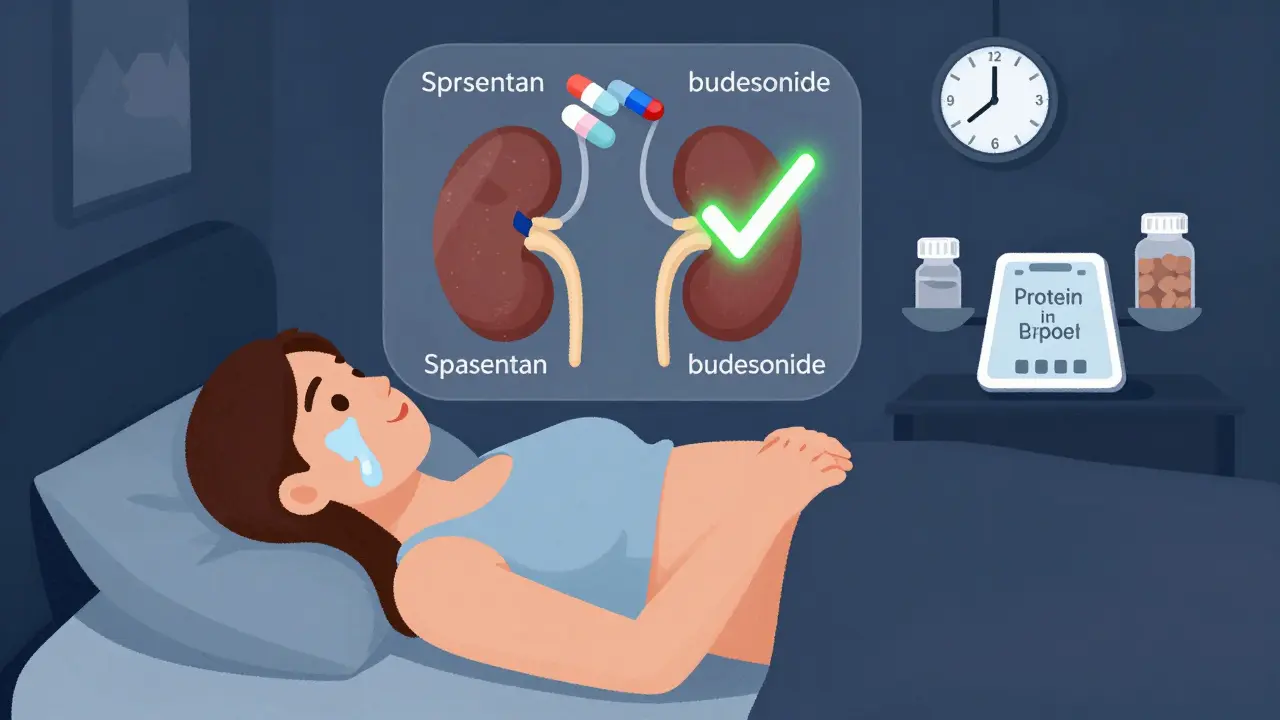
What About Long-Term Outlook?
Your prognosis depends entirely on what caused it.- Minimal change disease: 95% kidney survival at 10 years. Most kids outgrow it.
- Membranous nephropathy: 60 to 80% survive 10 years. Some go into remission without treatment.
- FSGS: 50 to 70% survival. But if proteinuria stays above 1 gram/day after treatment? Risk of kidney failure jumps 4.2 times.
- Diabetes-related: Only 40 to 50% make it 10 years. This is the toughest.
What Should You Do If You Suspect It?
If you or your child have:- Swelling that doesn’t go away
- Foamy urine for more than a few days
- Unexplained weight gain (5+ pounds in a week)
- High blood pressure with no history
What to Expect During Treatment
Steroids change more than your kidneys. They change your body - and your mind. Parents report kids gaining 10 to 20% of their body weight from increased appetite. Moon face. Belly fat. Mood swings. Insomnia. These aren’t side effects. They’re normal. Talk to your doctor. Don’t stop the meds because of how you look. The goal is kidney health, not appearance. And yes - vaccines matter. Live vaccines (like MMR or chickenpox) are off-limits during steroid treatment. But flu shots? Yes. Pneumococcal? Yes. Stay up to date. Infection is the #1 trigger for relapse.Final Thoughts
Nephrotic syndrome isn’t a death sentence. It’s a signal. A broken filter. A warning. And now, more than ever, we have tools to fix it. Steroids still work for most kids. ACE inhibitors protect everyone. New drugs like sparsentan are changing outcomes for adults who thought they had no options. But the real power lies in early detection. In understanding that swelling isn’t just weight gain. In knowing that foamy urine isn’t normal. In refusing to ignore the signs. Your kidneys don’t shout. They whisper. Listen before it’s too late.Can nephrotic syndrome be cured?
In children with minimal change disease, yes - many outgrow it completely by adolescence. In adults, "cure" is less common. But remission - meaning no protein in the urine - is achievable in over 60% of cases with the right treatment. The goal isn’t always a cure. It’s stopping the damage before the kidneys fail.
Is nephrotic syndrome hereditary?
Most cases aren’t. But about 1% of cases, especially in babies under 3 months, are caused by genetic mutations like NPHS1. If a child has nephrotic syndrome before age 1, or if there’s a family history, genetic testing is now recommended. It can prevent unnecessary steroid treatments that won’t work.
Can you live a normal life with nephrotic syndrome?
Absolutely - if you get the right treatment and stick to it. Many kids return to school, sports, and normal routines after remission. Adults can work, travel, and raise families. The key is managing proteinuria, blood pressure, and infection risk. Regular follow-ups and lifestyle changes make all the difference.
Why does swelling get worse at night?
During the day, gravity pulls fluid down into your legs and feet. At night, when you lie flat, that fluid redistributes. In nephrotic syndrome, your body can’t hold onto fluid properly, so it pools in the abdomen and around the eyes. That’s why kids wake up with swollen eyelids - it’s the easiest place for fluid to collect.
What’s the difference between nephrotic and nephritic syndrome?
Nephrotic syndrome is about massive protein loss, low albumin, and swelling. Nephritic syndrome is about inflammation - blood in the urine, high blood pressure, and reduced kidney function. You’ll see red blood cell casts in the urine with nephritic, but not with nephrotic. They’re completely different conditions with different causes and treatments.
Can diet alone fix nephrotic syndrome?
No. Diet helps manage symptoms - especially swelling and cholesterol - but it doesn’t fix the broken filter. Medications like steroids, ACE inhibitors, or newer drugs are needed to stop the protein leakage. Diet is support, not cure.
Is nephrotic syndrome more dangerous for children or adults?
It’s more common in children, but adults face higher long-term risks. Kids often respond to simple steroids. Adults are more likely to have chronic causes like FSGS or diabetes that don’t respond as well. Plus, adults are more likely to develop clots or heart disease from high cholesterol. Both need urgent care - but adults have fewer easy solutions.
tatiana verdesoto
March 3, 2026 AT 03:52Just wanted to say this post made me feel seen. My daughter had minimal change disease at 4, and yeah - the moon face, the weight gain, the mood swings… we thought she was turning into a different kid. But when the proteinuria cleared after 6 weeks of steroids? Pure magic. She’s 16 now, runs cross-country, and never even needed a biopsy. This stuff works if you give it time.
Also - low sodium? Game changer. We switched to home-cooked meals, no salt shaker, and her swelling dropped in 3 days. No magic pills, just physics.
Thanks for writing this.
Jessica Chaloux
March 4, 2026 AT 10:26OMG I cried reading this 😭 My uncle just got diagnosed and I had NO idea it was this serious. I thought it was just "kidney issues". Now I get why he’s so tired and why his ankles look like balloons. Thank you for explaining it like a human.
Mariah Carle
March 4, 2026 AT 13:36It’s fascinating how the body’s attempt to compensate - the liver overproducing lipids - becomes its own trap. We’re not just losing protein. We’re triggering a metabolic cascade that turns our own biology against us. It’s like the body’s emergency protocol has a bug. Evolution didn’t plan for modern diets, modern toxins, modern stress. This isn’t disease. It’s a system failure. And yet… we have tools to patch it. Isn’t that beautiful? And terrifying?
RacRac Rachel
March 5, 2026 AT 11:54You did an incredible job breaking this down. Every point matters. Especially the part about ACE inhibitors - so many people think they’re just for blood pressure. They’re kidney protectors. Period. And the sodium advice? Crystal clear. No processed food. No exceptions. I’ve seen patients who cut salt and saw 50% less swelling in 72 hours. It’s not hype. It’s physiology.
Also - yes, vaccines. Flu shot, pneumococcal, everything. Infection is the #1 trigger for relapse. Don’t skip them. Ever.
Thank you for the clarity. This is what medicine should look like.
Jane Ryan Ryder
March 6, 2026 AT 00:15Wow. A whole essay about protein leaking out of kidneys. And you expect us to be impressed? In the 2020s? We have CRISPR. We have AI diagnostics. And we’re still giving kids steroids like it’s 1978? Pathetic. Next you’ll tell me penicillin is a miracle drug.
Callum Duffy
March 7, 2026 AT 02:58An exceptionally well-structured and clinically accurate overview. The distinction between minimal change disease and FSGS is particularly well-articulated. I would only add, for international readers, that access to newer agents such as sparsentan remains highly variable outside of high-income nations. The cost barrier is not trivial - and should be acknowledged as a systemic inequity, not merely a pharmacoeconomic footnote.
Levi Viloria
March 8, 2026 AT 06:01My dad had membranous nephropathy. Took 3 years, 3 relapses, and a kidney biopsy to get to the right diagnosis. He’s been in remission for 8 years now on losartan and a low-salt diet. The steroid side effects? Brutal. But the alternative? Worse.
One thing I wish more people knew: it’s not about "fixing" the kidney. It’s about managing the leak. You can live a full life with a leak - if you’re smart about it.
Thanks for the reminder.
Richard Elric5111
March 8, 2026 AT 16:45The metaphysical implications of proteinuria are profound. The kidney, as an organ of filtration, is not merely a physiological entity - it is a boundary. When albumin escapes, it is not merely a biochemical anomaly. It is a symbolic rupture - the body’s attempt to maintain homeostasis collapsing under the weight of systemic imbalance. One might argue that nephrotic syndrome is not a disease of the glomerulus, but of the self’s inability to contain its essence. The swelling? A physical manifestation of existential leakage. The foamy urine - a literal effervescence of identity. We treat the symptom. But do we ever treat the soul’s filtration failure?
Dean Jones
March 10, 2026 AT 07:08Let’s be real. Steroids are a band-aid on a gunshot wound. We’re still treating nephrotic syndrome like it’s a 1980s problem. The fact that we’re still using prednisone as first-line for kids - while we have targeted therapies like sparsentan and budesonide - is a scandal. And don’t get me started on the cost of rituximab. $2,500 a month? For a drug that’s been used for lymphoma since 2006? This isn’t medicine. This is corporate exploitation wrapped in a white coat.
And the biopsy? Still the gold standard? In 2024? We have single-cell RNA sequencing. We have AI models that can predict FSGS subtypes from urine proteomics. We’re using scalpels and microscopes when we could be using data. We’re treating patients like lab rats instead of people. And the worst part? Most doctors don’t even know about the NEPTUNE study. They’re still reading textbooks from 2010.
This isn’t progress. It’s inertia. And it’s killing people slowly.
Stop calling it "nephrotic syndrome." Call it what it is: a systemic failure of medical innovation. And stop pretending steroids are the answer.
Zacharia Reda
March 10, 2026 AT 19:24Okay but like… how do you even tell if it’s nephrotic vs nephritic? I used to think "swelling = kidney problem" until I got my dad’s urine dipstick results back and realized his was full of RBCs - not protein. This post helped me finally get the difference. Also - the part about clots? I had no idea. My uncle had a pulmonary embolism during his flare. No one told us it was connected. This should be on every med school syllabus.
Jeff Card
March 12, 2026 AT 04:20My sister had congenital nephrotic syndrome. NPHS1 mutation. Steroids did nothing. We started dialysis when she was 5 months old. Transplanted at 2. She’s 12 now, no protein in her urine, plays soccer, hates broccoli. This post? It’s the story of her life. Thank you for not sugarcoating it. We needed to see this.
Sharon Lammas
March 13, 2026 AT 18:56There’s something quiet about this illness. It doesn’t scream. It just… changes things. The way your child walks slower. The way your partner stops asking if you’re okay. The way you stop wearing shorts. I didn’t know it was proteinuria until the foam wouldn’t go away after I flushed. It took me 3 months to get tested. I wish I’d known sooner.
marjorie arsenault
March 14, 2026 AT 03:32You’re not alone. Seriously. I’ve been through this with two kids. The weight gain? The mood swings? The way they cry over nothing? It’s the steroids. Not them. You’re doing great. Keep going. The remission is coming. And when it does? It’s worth every second of this.
Deborah Dennis
March 15, 2026 AT 15:02Wow. A 3,000-word essay on "leaky kidneys." And you think this is news? I’ve been on a low-sodium diet since 2012. I’ve had ACE inhibitors since 2015. I’ve had 3 relapses. This isn’t a breakthrough. It’s a textbook. And you’re not even mentioning the real issue: insurance won’t cover sparsentan unless you fail 3 other drugs first. So yeah. Great info. Now go fix the system.
Donna Zurick
March 16, 2026 AT 06:11YES. The sodium part. I cut out soy sauce and my swelling vanished in 72 hours. I didn’t even need more meds. Just no processed food. Seriously - if you’re swollen, stop eating anything with a label. You’ll thank me later. Also - get the flu shot. Always.