
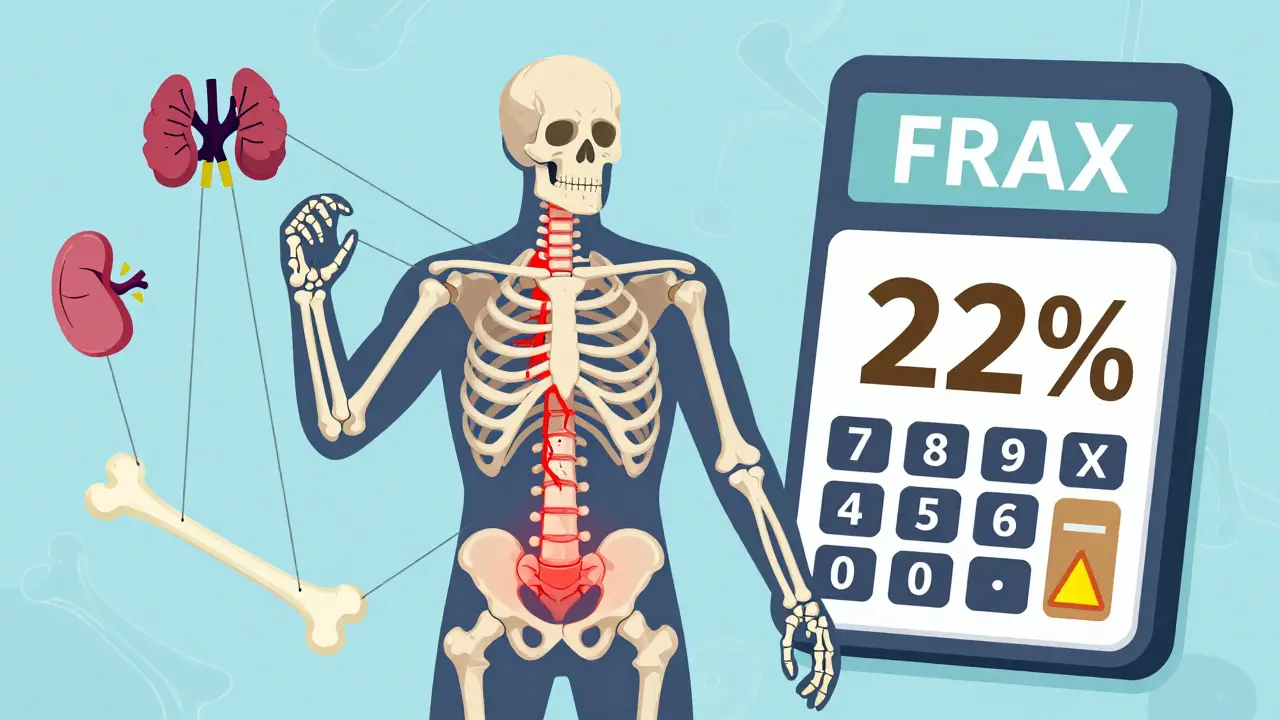
When your hormones are out of balance, your bones pay the price. Conditions like type 1 diabetes, untreated thyroid disease, or low testosterone don’t just affect energy or mood-they quietly weaken your skeleton. This isn’t just about aging. It’s about how endocrine disorders hijack the natural process of bone renewal, turning what should be a slow, manageable decline into a rapid, dangerous loss of strength. The good news? We now have tools to catch this before it leads to a broken hip or spine. Two of the most important? FRAX and bisphosphonates.
Why Endocrine Disorders Break Bones
Your bones aren’t static. They’re constantly being broken down and rebuilt by two types of cells: osteoclasts that dissolve old bone, and osteoblasts that build new bone. Hormones control this balance. When something goes wrong with your thyroid, pancreas, ovaries, or testes, that balance shatters. Take type 1 diabetes. People with this condition have a 6 to 7 times higher risk of breaking a bone-even when their bone density scans look normal. Why? High blood sugar damages bone quality at a microscopic level. It makes bone brittle, less flexible, and more likely to snap under stress. The same thing happens in untreated hyperthyroidism. Too much thyroid hormone speeds up bone turnover so much that bone is broken down faster than it can be replaced. Hypogonadism-whether from menopause before 45, low testosterone, or prostate cancer treatment-leads to bone loss of 2% to 4% per year. That’s faster than most people lose bone after age 65. These aren’t rare edge cases. The National Institutes of Health lists over half a dozen endocrine conditions that directly increase fracture risk. And here’s the catch: a standard bone density scan (DEXA) often misses the danger. That’s why you need more than just a T-score.FRAX: The Calculator That Sees Beyond Bone Density
FRAX isn’t a machine. It’s a free, web-based tool developed by the University of Sheffield that calculates your 10-year risk of breaking a major bone-like your hip, spine, shoulder, or wrist. It doesn’t rely on bone density alone. It uses nine key factors: your age, sex, weight, height, whether you’ve had a prior fracture, if your parents broke a hip, if you smoke, if you drink more than three alcoholic drinks a day, if you take steroid pills, and if you have rheumatoid arthritis. For endocrine disease patients, FRAX includes your condition as a risk factor. But here’s the problem: it doesn’t fully account for how badly some conditions wreck bone quality. In type 1 diabetes, FRAX underestimates fracture risk by about 30%. That means a person with diabetes might be told they’re “low risk” when they’re actually in the danger zone. That’s why doctors now use FRAX with a second tool: the Trabecular Bone Score (TBS). TBS looks at the texture of your bone on the DEXA scan-something regular scans don’t measure. A rough, patchy texture means your bone’s internal structure is crumbling, even if the density number looks okay. TBS helps fix FRAX’s blind spots in diabetes, hyperparathyroidism, and other endocrine disorders. The treatment trigger is clear: if your 10-year risk of a major fracture is 20% or higher, or your hip fracture risk is 3% or higher, you need treatment-even if your T-score is only -2.0. That’s the rule from the Bone Health and Osteoporosis Foundation. And it applies whether you have osteoporosis, osteopenia, or an endocrine disease.
Bisphosphonates: The First-Line Shield
When your fracture risk hits those thresholds, bisphosphonates are the go-to treatment. These drugs-like alendronate (Fosamax), risedronate (Actonel), and zoledronic acid (Reclast)-stick to bone surfaces and tell osteoclasts to stand down. They slow down bone breakdown, letting the builders catch up. The numbers speak for themselves. In people with osteoporosis, bisphosphonates reduce spine fractures by 40% to 70% and hip fractures by 40% to 50%. That’s not a small benefit. It’s life-changing. For someone with type 1 diabetes, that same reduction applies-even though their bones are fragile for different reasons. Treatment usually starts with an oral pill taken once a week or once a month. For those who can’t tolerate pills or have very high risk, there’s an annual IV infusion of zoledronic acid. Most people take it for 3 to 5 years. After that, your doctor reassesses your risk using FRAX and TBS. If your risk has dropped, you might stop. If it’s still high, you continue. Bisphosphonates aren’t perfect. Some people get stomach upset. Rarely, they can cause jawbone problems or unusual thigh fractures after years of use. But for most people with endocrine-related osteoporosis, the benefits far outweigh the risks. The American Academy of Family Physicians and the Endocrine Society both agree: bisphosphonates are the best first step.Who Gets Tested and When
Not everyone needs a bone scan. The U.S. Preventive Services Task Force says all women 65 and older should get screened. For younger women and men over 50, screening is recommended if they have any risk factor-like a history of fracture, low body weight, smoking, steroid use, or an endocrine disorder. Here’s the clinical pathway most doctors follow:- Start with FRAX. Plug in your age, sex, weight, height, smoking status, alcohol use, steroid use, and whether you have diabetes, thyroid disease, or low sex hormones.
- If your FRAX score is above 9.3% for major fractures (or if you’ve already broken a bone), get a DEXA scan.
- Combine the DEXA result with FRAX and add TBS if available.
- If your 10-year fracture risk is 20% or higher for major fractures or 3% or higher for hip fractures, start bisphosphonates.
- For complex cases-like kidney disease or multiple endocrine problems-consult an endocrinologist.

Where the System Still Falls Short
Despite all the progress, gaps remain. FRAX doesn’t yet fully adjust for type 1 diabetes. Studies show that if you build a version of FRAX just for diabetics, it predicts fractures 25% better. The Bone Health and Osteoporosis Foundation is working on this right now. Also, not every clinic uses TBS. It’s still not standard in every hospital or doctor’s office. If you have an endocrine disorder and your doctor only looks at your T-score, you might be missing a big part of the picture. And then there’s the issue of access. Not everyone gets screened. Many patients with thyroid disease or type 1 diabetes never get a bone scan because their endocrinologist is focused on glucose or hormone levels-not bones. The message is clear: bone health can’t be an afterthought in endocrine care. If you have a hormonal condition, your bones need attention too.What Comes Next
By 2025, experts predict 85% of endocrinologists will use FRAX with endocrine-specific adjustments. That’s a big shift. AI tools are being trained to combine FRAX, TBS, blood markers, and even gait patterns to predict fracture risk better than ever. New drugs are in development that don’t just slow bone loss-they actually rebuild bone. But for now, the tools we have work. If you have diabetes, thyroid disease, early menopause, or low testosterone, don’t wait for a fracture to happen. Ask your doctor for a FRAX assessment. Get a DEXA scan if your risk is elevated. And if your fracture risk is high, bisphosphonates are the most proven way to protect your bones. Your bones don’t just carry you-they keep you independent. In endocrine disease, protecting them isn’t optional. It’s essential.Is FRAX accurate for people with type 1 diabetes?
FRAX underestimates fracture risk in type 1 diabetes by about 30% because it doesn’t fully capture how high blood sugar damages bone quality. While FRAX still provides useful risk estimates, doctors should use it alongside the Trabecular Bone Score (TBS) and clinical judgment. New diabetes-specific versions of FRAX are being tested and could improve accuracy by up to 25%.
Do bisphosphonates work for endocrine-related osteoporosis?
Yes. Bisphosphonates reduce fracture risk by 40% to 70% in people with endocrine disorders, just like in the general population. They’re the first-line treatment recommended by the American Academy of Family Physicians, the Endocrine Society, and the Bone Health and Osteoporosis Foundation-even for those with normal bone density but high fracture risk due to diabetes or thyroid disease.
Can I skip a bone density scan if I have an endocrine disease?
No-not if you’re over 50 or have other risk factors. While FRAX helps identify who needs testing, a DEXA scan is still required to confirm bone density and calculate your T-score. Skipping the scan means you’re missing critical data. The NIH guidelines say routine scanning without risk assessment isn’t recommended, but if you have an endocrine disorder, you’re already in the high-risk group that needs it.
How long should I take bisphosphonates?
Most people take oral bisphosphonates for 3 to 5 years and annual IV zoledronic acid for 3 years. After that, your doctor will reassess your fracture risk using FRAX and TBS. If your risk has dropped, you may stop. If it’s still high, you may continue. Long-term use beyond 5-10 years increases rare risks like atypical fractures, so regular reevaluation is key.
What if my T-score is -1.8 but I have type 1 diabetes?
Even with a T-score of -1.8 (osteopenia), you may still need treatment if your FRAX score shows a 10-year fracture risk of 20% or higher for major fractures or 3% or higher for hip fractures. In type 1 diabetes, bone quality is often poor even when density looks okay. That’s why FRAX and TBS matter more than T-score alone in endocrine disease.
Can lifestyle changes alone prevent fractures in endocrine disease?
Lifestyle changes-like getting enough calcium and vitamin D, stopping smoking, reducing alcohol, and doing weight-bearing exercise-are essential. But they’re not enough on their own if your fracture risk is high. For people with endocrine disorders and elevated FRAX scores, medication like bisphosphonates is needed to significantly lower fracture risk. Lifestyle supports treatment-it doesn’t replace it.
swati Thounaojam
January 8, 2026 AT 21:06frax is fine but my doc never mentioned tbs even tho i have type 1
christy lianto
January 10, 2026 AT 12:46finally someone gets it. my endo was all about my A1c and ignored my bones until i broke my wrist riding a bike. 30% underestimation? yeah that’s the exact number my rheumatologist said. TBS saved me. don’t let your doctor skip it.
Annette Robinson
January 11, 2026 AT 19:35I’ve been advocating for this for years. Bone health isn’t a side note-it’s central to endocrine care. If you’re managing thyroid, diabetes, or hormone levels, your skeleton is part of the treatment plan. FRAX + TBS isn’t optional. It’s standard of care. And bisphosphonates? They’re not scary-they’re lifesavers.
Manish Kumar
January 12, 2026 AT 15:17you know, in the grand tapestry of human biology, bone is the silent witness to the chaos of hormones. we think of diabetes as a sugar problem, thyroid as a metabolism issue, but really, they’re all just whispers of systemic imbalance-and the skeleton, that ancient scaffold of our existence, bears the weight of it all. bisphosphonates? they’re not drugs-they’re temporary truces with entropy. we’re trying to slow time in bone tissue. isn’t that poetic? or just tragic? either way, we’re lucky to have tools. the real tragedy is that most people never even know they’re at risk until they fall.
Dave Old-Wolf
January 13, 2026 AT 20:14so if i’m 48 with type 1 and my T-score is -1.8 but FRAX says 22% risk, i should just take the pill? no scan needed? i’m confused. my doc said i’m ‘borderline’ but didn’t push for anything. is that normal?
Prakash Sharma
January 14, 2026 AT 04:29why do we need american tools for indian patients? FRAX was built on white, western populations. our bone density, body types, diets-everything’s different. we’re just being used as data points for a system that doesn’t care about us. if you’re diabetic in India, you’re lucky to get insulin, let alone a TBS scan.
Donny Airlangga
January 15, 2026 AT 08:26my mom had a hip fracture at 62 after 15 years of hypothyroidism. they never checked her bones. she’s in a wheelchair now. this post saved me from making the same mistake with my dad. thank you.
Molly Silvernale
January 15, 2026 AT 23:44bone… is memory… written in calcium… and when the hormones lie… the skeleton remembers… every spike… every crash… every missed dose… and fractures… are just the punctuation… to a silent story… of metabolic betrayal…
Kristina Felixita
January 17, 2026 AT 19:45omg yes!! i got my dxa after my endo finally listened (thank u god) and tbs showed my bone structure was crumbling even though my t-score was -1.9… bisphosphonates were scary but i did it… 2 years in… no fractures… my yoga instructor said i’m standing taller… love u science
Joanna Brancewicz
January 19, 2026 AT 16:05FRAX underestimates T1D fracture risk by 30%-per AACE 2023 guidelines. TBS is the missing variable. Bisphosphonates remain first-line per Endocrine Society 2024. No exceptions.
Evan Smith
January 20, 2026 AT 04:25so let me get this straight… you’re telling me my 40-year-old diabetic buddy who thinks he’s fine because he ‘eats healthy’ needs a drug that stops bone breakdown… just because his sugar messed up his skeleton? wow. guess i’ll be sending him this link. thanks for making me feel less like a weirdo for asking for a scan.
Lois Li
January 21, 2026 AT 19:56i’ve been a nurse for 20 years and i’ve seen too many patients dismissed because their bone density looked okay. but if you have an endocrine disorder, your bones aren’t just thin-they’re structurally broken. FRAX and TBS together are the only way to see the real damage. don’t let anyone tell you otherwise. you deserve to be protected.
Ken Porter
January 22, 2026 AT 02:11why are we paying for fancy scans when we could just give everyone calcium? this is overmedicalization. if you’re not falling out of bed, you’re fine. stop scaring people with numbers.