
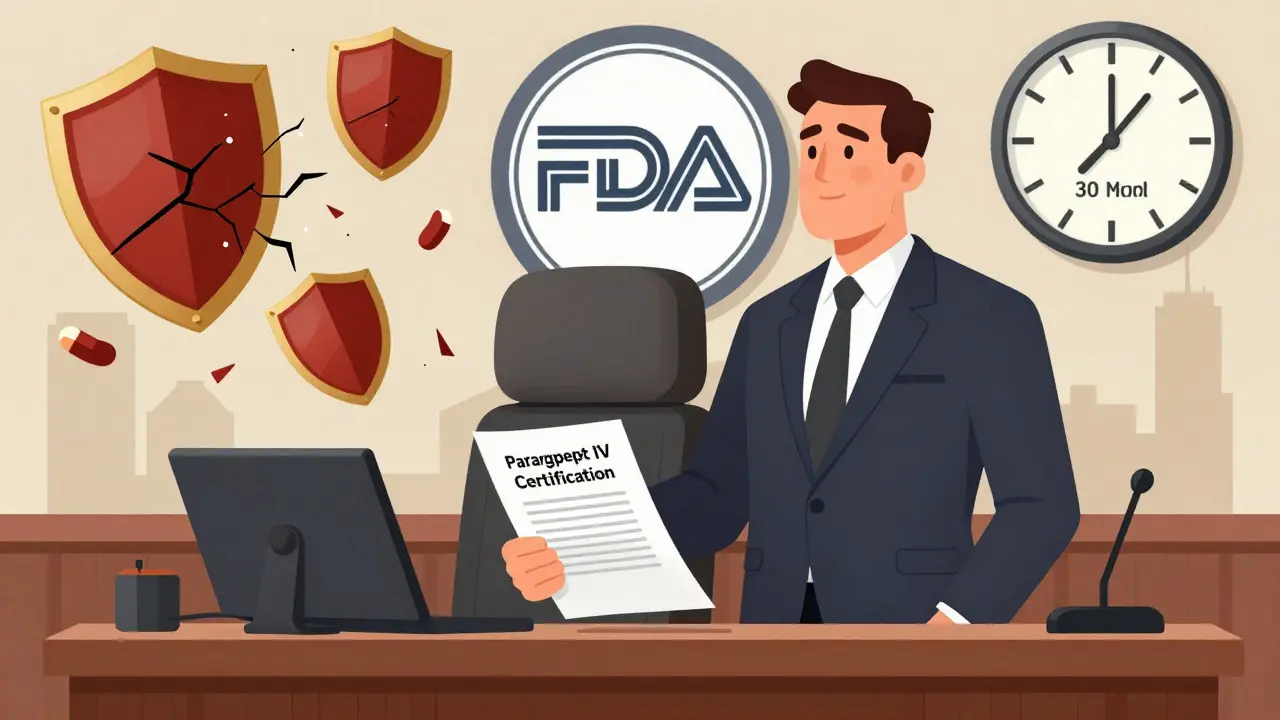
When a brand-name drug hits the market, its manufacturer gets years of exclusive sales-often over a decade-protected by patents. But there’s a legal loophole built into U.S. drug law that lets generic companies challenge those patents before they even make the drug. That loophole is called a Paragraph IV certification. It’s not a secret trick. It’s a formal, court-backed process created by the Hatch-Waxman Act of 1984. And it’s the main reason why 90% of prescription drugs in the U.S. are now generics.
What Exactly Is a Paragraph IV Certification?
A Paragraph IV certification is a legal statement filed by a generic drug company when it submits an Abbreviated New Drug Application (ANDA) to the FDA. In that statement, the generic maker says one of three things: the brand’s patent is invalid, it won’t be infringed by their version of the drug, or it’s unenforceable. This isn’t just a claim. It’s a legal trigger. By filing it, the generic company is essentially saying: “We’re coming, and we’re ready to fight you in court.”
Here’s the twist: under 35 U.S.C. § 271(e)(2), submitting an ANDA with a Paragraph IV certification is treated as an “artificial act of infringement.” That means the brand-name company doesn’t have to wait until the generic drug is sold to sue. They can sue right away-even if no generic pill has been made yet. It’s a legal fiction designed to avoid chaos. Without this rule, generic companies would have to launch “at-risk,” risking millions in damages if they lost. The brand companies, meanwhile, wouldn’t be able to stop them until after the damage was done.
How the Process Works: The 20-45-30 Rule
The timeline is strict. Once the FDA accepts the ANDA, the generic company has exactly 20 days to send a notice letter to the brand-name drugmaker and the patent holder. This letter isn’t a courtesy. It’s a formal legal notice that includes the full legal and factual basis for why they believe the patent doesn’t hold up.
The brand company then has 45 days to file a patent infringement lawsuit. If they do, the FDA automatically puts a 30-month stay on approving the generic drug. That’s the clock ticking. The generic company can’t sell its version until the stay ends-unless the court rules in their favor earlier.
But here’s where things get messy. That 30-month clock isn’t fixed. If the brand company delays filing, the clock can be extended. If the generic company files an amendment after the initial submission, the FDA can restart the clock. In practice, many stays last 36 months or longer. And while the law says the FDA can’t approve the drug during the stay, it doesn’t stop the generic company from manufacturing it. Some do-“at-risk” launches-and gamble that they’ll win in court.
Why the 180-Day Exclusivity Matters
The biggest incentive for generic companies to take this risk? The 180-day exclusivity period. The first company to successfully file a Paragraph IV certification gets to be the only generic on the market for six months after approval. No competition. That’s huge. For a blockbuster drug like Humira, which brings in $20 billion a year, 180 days of solo sales can mean over $10 billion in revenue.
That’s why companies like Teva, Mylan, and Sandoz spend millions preparing these filings. In 2024, Teva filed 147 Paragraph IV certifications. That’s not luck. It’s strategy. They’re targeting drugs with weak patents, high sales, and low barriers to bioequivalence. The payoff? A single successful challenge can fund years of R&D.
How Brand Companies Fight Back
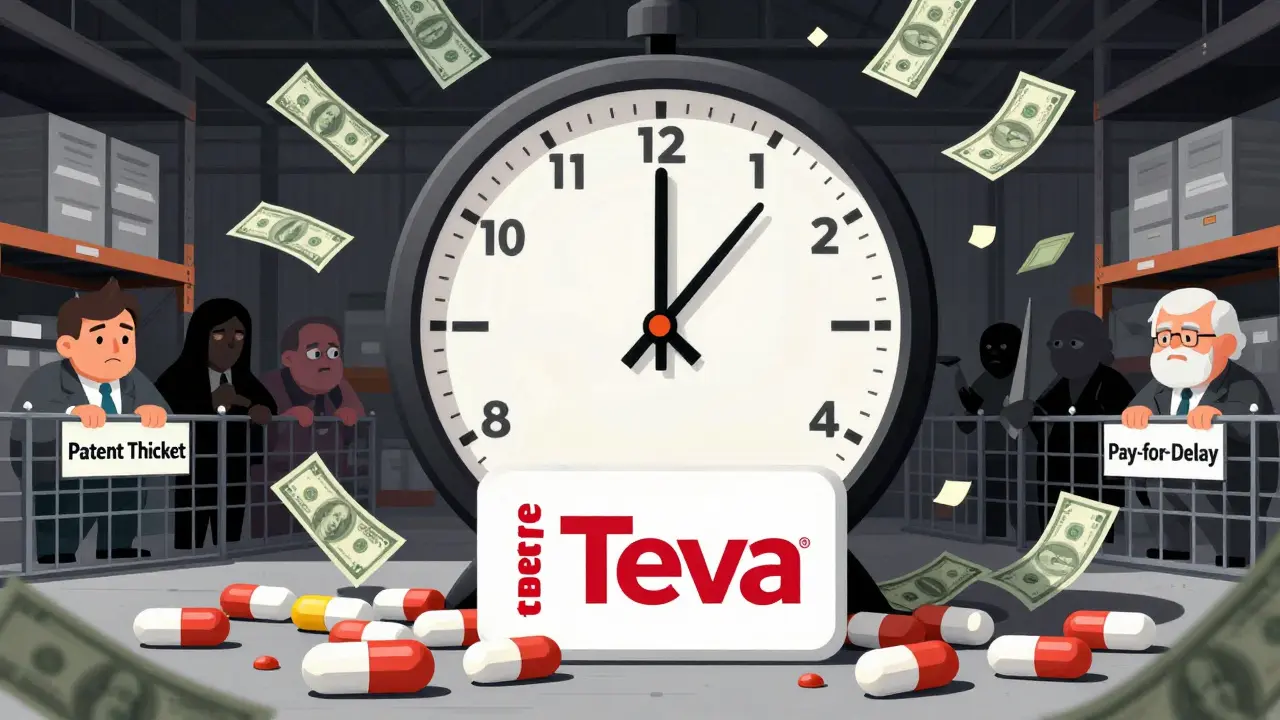
Brand-name drugmakers didn’t sit back and let this system eat their profits. They responded by building patent thickets. In 2005, the average drug had 7.2 patents listed in the FDA’s Orange Book. By 2024, that number jumped to 17.3. That’s not coincidence. Each patent listed means another Paragraph IV challenge the generic company has to fight.
Some brands even change the drug slightly-add a new coating, tweak the dosage, switch from a tablet to a capsule-to get a new patent. This is called “product-hopping.” In 2024, 31% of Paragraph IV targets were drugs where the brand had done this right before generic entry. The goal? To reset the clock and delay competition.
Another tactic? Pay-for-delay settlements. In 2024, 68% of Paragraph IV lawsuits ended in settlements. And in nearly 70% of those, the brand paid the generic company to delay launch. The average payment? $187 million. The FTC has filed 17 lawsuits since 2023 against these deals, calling them anti-competitive. But they’re still happening. Why? Because for the brand, paying $200 million to delay a generic for a year is cheaper than losing $2 billion in sales.
Section viii Carve-Outs: The Silent Strategy
Not every Paragraph IV challenge is about taking the whole drug. Some generics use something called a Section viii carve-out. If a drug has multiple approved uses, but only one is patented, the generic can file for approval of the non-patented uses only. For example, if a drug treats both depression and migraines, and only the migraine use is patented, the generic can sell it for depression only.
This is called a “skinny label.” And it’s growing. According to West Health Institute, 37% of Paragraph IV filings in 2023 used this approach. It’s smarter, cheaper, and faster. No need to fight a patent. Just avoid it. And because the FDA allows it, the brand can’t stop it-even if they don’t like it.
Who’s Winning? The Numbers Don’t Lie
Since 1984, Paragraph IV challenges have saved U.S. consumers $2.2 trillion. In 2024 alone, they saved $192 billion. That’s not theoretical. It’s real money in people’s pockets.
Success rates are climbing. From 2003 to 2019, generic companies won about 41% of their challenges. From 2020 to 2025, that number jumped to 58%. Why? Two reasons. First, the Supreme Court has narrowed what counts as a patentable invention-making it harder for brands to defend weak patents. Second, generic companies are getting better. They’re using AI-powered patent analytics tools that cost up to $500,000 a year. They’re building teams of patent lawyers, pharmacists, and regulatory experts. They’re not guessing anymore. They’re calculating.
The biggest targets? Drugs like Humira (28 challenges), Trulicity (24), and Eliquis (21). The biggest winners? Teva, Mylan, Sandoz, and Hikma. Together, they filed over 400 Paragraph IV certifications in 2024.
The Cost of Playing the Game
But it’s not cheap. The average Paragraph IV challenge costs $12.3 million in legal fees. Cases take nearly 29 months to resolve. And if you lose? You’re out millions. Even if you win, you’re out millions-because you spent them fighting.
And the delays? They’re brutal. A 30-month stay that stretches to 36 months means $8.7 million in extra holding costs per drug. That’s why some companies launch “at-risk.” In 2024, 22% of generic challengers did it. The average pre-launch revenue? $83 million. The average risk of damages if they lost? $217 million. That’s not a gamble. That’s a business decision.
What’s Next? The FDA and FTC Are Watching
In October 2022, the FDA updated its rules to close loopholes in how companies can amend Paragraph IV certifications. Now, if a generic company changes the drug’s strength or crystalline structure after filing, they have to prove it’s still the same drug. No more sneaky tweaks.
In 2026, the FDA plans to require brand companies to justify every patent they list in the Orange Book. That could cut patent thickets by 30-40%. If that happens, generic companies will have fewer patents to fight-and more drugs to enter faster.
The FTC is also stepping up. Their 2025 plan targets pay-for-delay deals with more lawsuits. If they succeed, generic drugs could hit the market 4-6 months sooner on average. That’s billions more in savings for patients.
One thing’s clear: Paragraph IV certifications aren’t going away. They’re evolving. And as long as brand drugs cost thousands of dollars a year, generic companies will keep using this tool to break the monopoly.
Babe Addict
December 27, 2025 AT 17:37Paragraph IV? More like Paragraph I-need-to-make-a-bucket-load-of-cash. These generic companies aren’t fighting patents-they’re playing chess with billion-dollar pieces. And let’s be real, 90% generics? That’s not innovation, that’s regulatory arbitrage wrapped in a lab coat. The system’s rigged to let them exploit loopholes while the pharma giants bleed out. Honestly, if I owned a drug patent, I’d just start patenting the color of the pill.
Satyakki Bhattacharjee
December 27, 2025 AT 19:27This is not medicine. This is business war. People are suffering. Drugs should be for healing, not for lawyers to fight over. The rich get richer, the poor get nothing. Why do we allow this? In India, we know the value of life-not of patents.
Kishor Raibole
December 28, 2025 AT 10:28It is, with all due respect, a most curious and profoundly unsettling phenomenon that the legal architecture of pharmaceutical innovation has been subverted into a mechanistic battlefield of corporate opportunism. The Hatch-Waxman Act, originally conceived as a delicate equilibrium between innovation and accessibility, has devolved into a high-stakes poker game wherein the house always wins-except when the house is the generic manufacturer, in which case, the house still wins, but with a different nameplate. One cannot help but observe that the moral calculus of this system has been entirely outsourced to the balance sheet.
Liz MENDOZA
December 29, 2025 AT 19:42I just want to say thank you for explaining this so clearly. I’ve had family members who couldn’t afford their meds, and hearing how this system actually works-especially the 180-day exclusivity-makes me realize how much is at stake. It’s not just about big pharma vs. generics. It’s about whether someone can afford to take their insulin next month. I hope more people understand this.
Miriam Piro
December 31, 2025 AT 17:09Okay, but have you ever stopped to think that the FDA and Big Pharma are in cahoots? The 30-month stay? The patent thickets? The ‘pay-for-delay’ settlements? That’s not capitalism-that’s a cartel. They’re using the courts to keep prices high while pretending it’s ‘legal.’ And don’t get me started on AI patent analytics-those tools are trained on data from pharma insiders. It’s all orchestrated. The real winners? The shadowy lobbyists in D.C. who wrote Hatch-Waxman in the first place. They knew exactly what they were doing. You think this is about access? Nah. It’s about control. And they’re not done yet. Wait till you see the next ‘innovation’-they’re already working on blockchain patents for insulin.
Kylie Robson
January 2, 2026 AT 09:06Let’s unpack the bioequivalence thresholds here-because the 2020–2025 win rate surge isn’t just about better litigation strategy; it’s directly correlated with the FDA’s 2021 guidance on ANDA submission standards for complex generics. The SCOTUS rulings in *KSR v. Teleflex* and *Mayo v. Prometheus* fundamentally altered the non-obviousness bar, which disproportionately impacted secondary pharmaceutical patents-especially those covering crystalline forms, polymorphs, and metabolic pathways. The generic firms aren’t lucky-they’re leveraging decades of jurisprudential erosion of patent scope. Also, the $500K AI tools? They’re using transformer models trained on PTAB decisions and prior art databases. This isn’t gaming the system-it’s systemic optimization.
Will Neitzer
January 2, 2026 AT 21:34While the economic implications of Paragraph IV certifications are undeniably significant, one must not overlook the ethical dimension inherent in the pursuit of market entry through legal challenge. The systematic erosion of patent rights, even when justified by public interest, risks undermining the foundational incentive structure upon which pharmaceutical innovation depends. The cost of drug development exceeds $2.6 billion per approved agent, and without the assurance of exclusivity, the pipeline for novel therapeutics-particularly for rare diseases-will wither. We must, therefore, seek not to dismantle the system, but to refine it-with greater transparency, judicial efficiency, and a recalibrated balance between access and incentive.
Olivia Goolsby
January 4, 2026 AT 00:21Okay, so let me get this straight-so the government lets companies file a legal document saying ‘your patent is fake’… and then the patent holder has to spend millions to prove it’s real… while the generic company can start MAKING the drug during the 30-month ‘stay’?! And they call this ‘fair competition’?! And you know what’s worse? The FDA doesn’t even require them to disclose their manufacturing process until after they’ve already made it?! This isn’t a loophole-it’s a backdoor heist. And the ‘180-day exclusivity’? That’s not a reward-it’s a bribe to the first thief. And the ‘pay-for-delay’ deals? That’s not a settlement-that’s bribery with a subpoena. The FTC is too weak. The FDA is asleep. And the people? They’re just paying the bill. This system is a pyramid scheme with a white coat.
Gerald Tardif
January 4, 2026 AT 09:24Look-I get why this feels like a war. But here’s the thing: without Paragraph IV, insulin would still cost $400 a vial. People are dying because they can’t afford meds. The generics aren’t evil-they’re the only thing standing between a family and bankruptcy. Yeah, the legal fees are insane. Yeah, the patent thickets are shady. But if you’ve ever had to choose between rent and your asthma inhaler, you’d cheer for the guy filing that certification. This isn’t about winning. It’s about surviving. And honestly? The system’s broken. But at least someone’s trying to fix it-with lawsuits, not silence.
Monika Naumann
January 6, 2026 AT 00:59It is regrettable that the United States, a nation founded upon principles of justice and equity, has permitted the commodification of human health to such an extent that the right to life is contingent upon the financial acumen of multinational corporations. The practice of filing Paragraph IV certifications, while legally permissible, constitutes a moral abdication of national responsibility. In India, we have long recognized that medicine is not a commodity but a fundamental human right. The exploitation of legal technicalities to delay access to essential medicines-however profitable-must be condemned by all civilized societies. Let us not mistake corporate strategy for public service.
Babe Addict
January 6, 2026 AT 06:13Wait, so you’re telling me the first generic to file gets 180 days of monopoly? That’s not competition-that’s a cartel with a spreadsheet. So now the guy who sued first gets to be the only one selling… while everyone else waits? That’s like giving the first thief the exclusive right to rob the bank for six months. Who wrote this law? A mob boss with a law degree?