
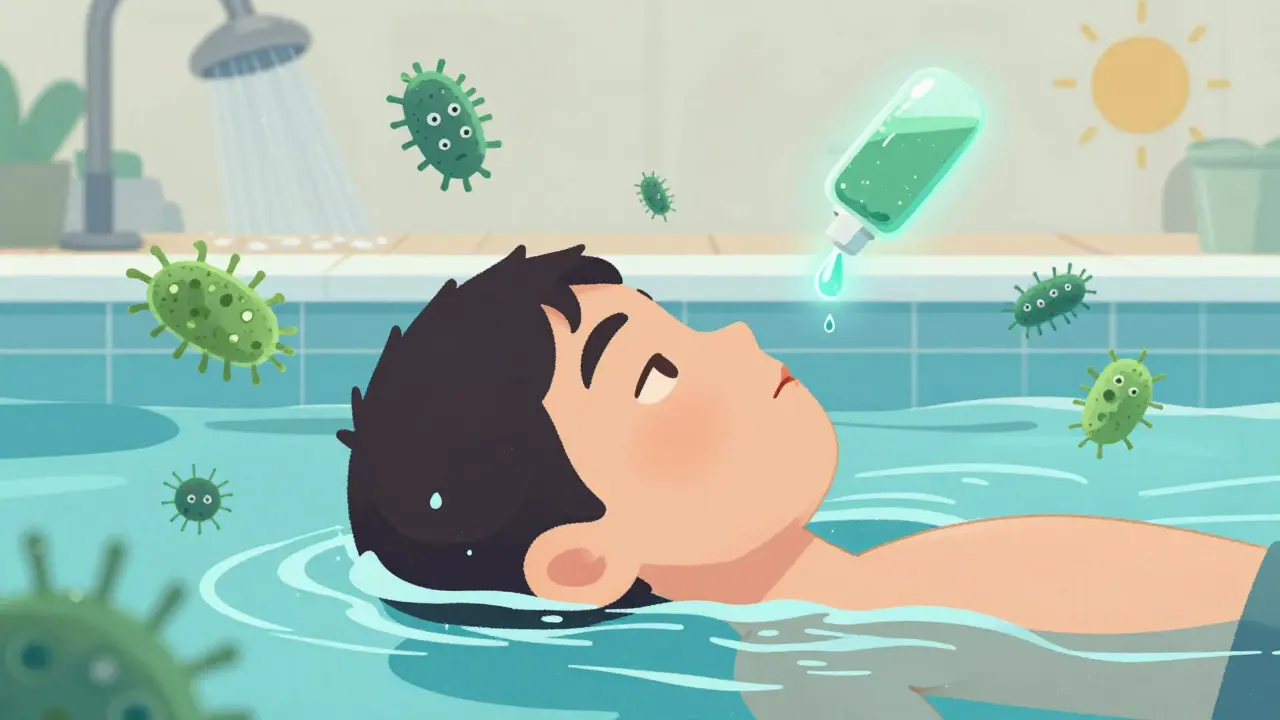
Swimmer’s ear isn’t just a nuisance for competitive swimmers-it’s a common, painful infection that can strike anyone who gets water trapped in their ear canal. You don’t need to be an athlete to get it. A quick dip in the pool, a shower that lingers too long, or even sweating after a workout can set the stage. The problem? Moisture creates a perfect breeding ground for bacteria, especially Pseudomonas aeruginosa and Staphylococcus aureus. This infection, medically called otitis externa, affects over 2.4 million people in the U.S. every year, with the worst spike happening between June and August. And here’s the kicker: 87% of recurring cases happen because people keep poking or prodding their ears-even after being told not to.
What Swimmer’s Ear Actually Feels Like
If you’ve ever had swimmer’s ear, you know it’s not just an itch. The pain is sharp, deep, and gets worse when you tug on your earlobe or press on the little bump in front of your ear (the tragus). That’s the classic sign. About 97% of people with this infection feel this kind of pain, and it can be so intense it wakes you up at night. You might also notice drainage-starting clear, then turning thick and yellow-green within a day or two. Your hearing might get muffled, too. It’s not full hearing loss, but it’s enough to make conversations feel distant-around 20 to 30 decibels quieter than normal.
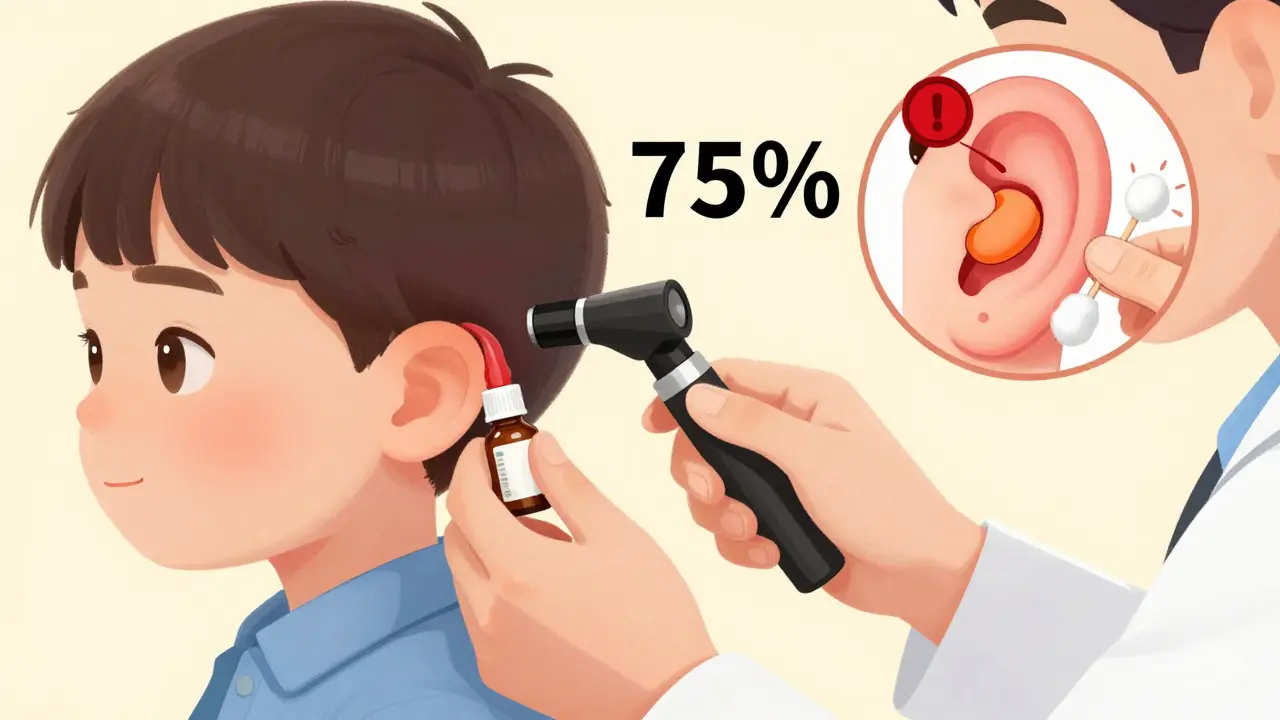
Doctors can see it too. The ear canal becomes swollen and red, narrowing by up to 75%. That’s why even putting in earbuds can feel impossible. It’s not just an ear infection-it’s an inflamed tunnel that’s literally closing in on itself. The worst part? Many people mistake it for a middle ear infection. But if you press on the tragus and it hurts, it’s almost certainly otitis externa. That simple test catches it correctly 94% of the time.
Who’s Most at Risk?
You might think only swimmers get it. But the data shows something else. Kids between 7 and 12 make up 43% of cases. Teens and young adults aged 15 to 25? Another 31%. Men are diagnosed more often than women-58% of cases. Why? Because they’re more likely to swim regularly, use cotton swabs, or ignore early symptoms.
But it’s not just about swimming. If you clean your ears with cotton swabs, you’re 65% more likely to get an infection. Those little swabs scrape the skin, push wax deeper, and create tiny cuts where bacteria can sneak in. People with eczema or psoriasis on their scalp or ears are also at higher risk-about 28% of chronic cases involve one of these skin conditions.
And frequency matters. Swimming more than four days a week? Your risk jumps 7.2 times. Even one extra swim per week can tip the balance. It’s not the water itself-it’s how long it stays trapped.
How to Prevent Swimmer’s Ear Before It Starts
The best treatment? Not getting it in the first place. And the science backs up simple, cheap tricks.
- Use alcohol-vinegar drops after swimming. Mix 70% isopropyl alcohol with 30% white vinegar. Put a few drops in each ear, let it sit for 30 seconds, then tilt your head to drain. This solution kills bacteria and dries out moisture. Studies show it cuts infection rates by 72% in regular swimmers.
- Wear custom earplugs. Over-the-counter foam plugs block only 42% of water. Silicone, custom-molded plugs? They block 68%. They cost $45 to $120, but for frequent swimmers, they pay for themselves in avoided doctor visits.
- Never insert anything into your ear canal. No cotton swabs, no bobby pins, no fingers. Your ear cleans itself. Pushing things in just moves wax around and creates micro-tears.
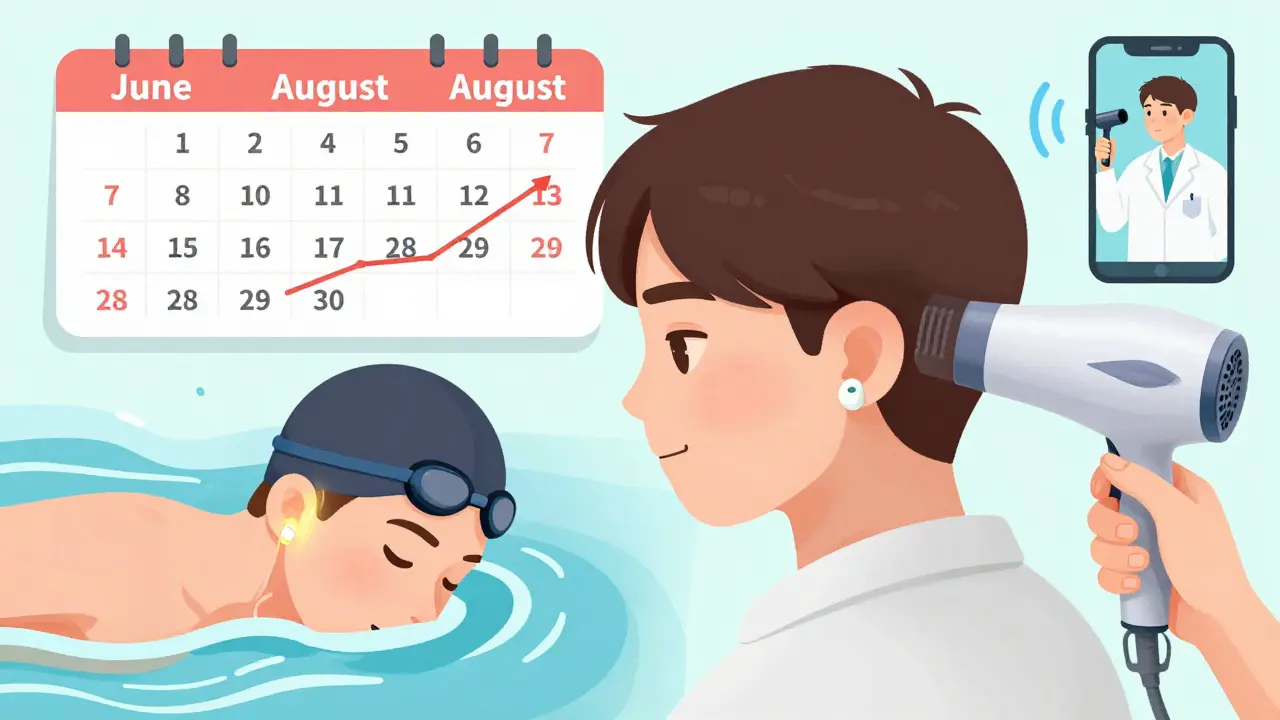
- Dry your ears fast. After swimming or showering, tilt your head and gently pull your earlobe to help water drain. Use a hairdryer on the coolest, lowest setting-hold it 12 inches away for 30 seconds. One Reddit user went four years without a recurrence after starting this habit.
- Limit water exposure. Staying underwater for more than two minutes after swimming increases risk by 37%. Get out, dry off, and move on.
How It’s Treated-And What Actually Works
If you do get swimmer’s ear, don’t wait. The infection can worsen fast. First-line treatment? Prescription ear drops. Not oral antibiotics. Not home remedies. Drops that go straight into the canal.
The gold standard is ciprofloxacin 0.3% and hydrocortisone 1% (brand name Cipro HC). You use 10 drops in each ear, twice a day, for seven days. Studies show 92.4% of people are cured within a week. The hydrocortisone reduces swelling, and the antibiotic kills the bacteria.
For the rare 2% of cases caused by fungus, doctors use clotrimazole 1% solution. You use 5 drops twice daily for 14 days. It works well, but you need to stick with it.
Here’s the catch: you must keep your ears dry during treatment. If you swim, shower, or even get your ear wet, your cure rate drops by 40%. One study found 63% of people who got their ear wet during treatment failed to recover. That’s why doctors tell you to avoid showers. But you don’t have to suffer. Use a cotton ball coated in petroleum jelly to plug your ear while showering. It’s not perfect-but it’s better than nothing.
How to Use Ear Drops Right
Even the best drops won’t work if you don’t use them correctly. Most people mess this up.
- Warm the bottle in your hand for a minute. Cold drops can make you dizzy.
- For adults: pull your earlobe up and back. For kids under 12: pull down and back. This straightens the ear canal so the drops reach the infection.
- Put in the full number of drops. Use a 1 mL calibrated dropper-no guessing.
- Stay on your side for 5 minutes after. This lets the medicine soak in. Without this, the drops drain out in 90 seconds. With it? They stay for over 4 minutes.
- Don’t rinse your ear afterward. Let it drain naturally.
Studies show people who follow these steps improve delivery of medicine by 83%. First-timers get it right only 38% of the time. Experienced users? 92%. Practice makes perfect.
Pain Management That Actually Helps
Swimmer’s ear hurts. A lot. About 68% of patients have moderate to severe pain. Over-the-counter painkillers help, but you need the right dose.
- Mild pain (32% of cases): Acetaminophen (Tylenol) at 15 mg per kg of body weight every 6 hours.
- Severe pain (68% of cases): Oxycodone at 0.15 mg per kg every 4 to 6 hours. This is prescription-only and should be used short-term.
Don’t rely on ibuprofen alone. It doesn’t work as well for this type of deep, canal-based pain. And never put anything hot, like a heating pad, against your ear. That can burn already inflamed skin.
What to Avoid at All Costs
There’s a long list of things people do that make it worse:
- Using cotton swabs-even once. It’s the #1 cause of preventable cases.
- Trying to “drain” the ear with a Q-tip or tweezers. You’re not helping-you’re risking a deeper infection.
- Swimming while infected. Water delays healing and can spread the infection.
- Ignoring symptoms for days. The longer you wait, the more swollen the canal gets-and the harder it is to treat.
- Using leftover antibiotics from another infection. They might not be the right type, and you risk antibiotic resistance.
When to See a Doctor
You can try home care for a day or two if symptoms are mild. But if:
- The pain gets worse after 24 hours,
- You have a fever,
- Your hearing gets noticeably worse,
- Or the drainage smells foul or turns bloody,
-you need to see a doctor immediately. In rare cases, the infection can spread to the bone (osteomyelitis), especially in diabetics or people with weakened immune systems. That’s a medical emergency.
What’s New in Treatment
Science is moving fast. In early 2023, the FDA approved a new device called the hydrogel ear wick. It’s a tiny, soft sponge inserted into the ear canal that slowly releases antibiotics over 72 hours. It’s especially helpful when the canal is so swollen that drops can’t reach the infection. In trials, it kept antibiotic levels 300% higher than regular drops.
Another exciting development? A new treatment using Staphylococcus hominis lysate. This isn’t an antibiotic. It’s a substance made from harmless bacteria that live on healthy skin. It helps your body fight off the bad bacteria without wiping out your good ones. Early results show it could cut recurrence rates from 14% to under 7%.
And telehealth is changing access. With smartphone otoscopes like TytoCare, you can send clear images of your ear to a specialist. It’s 89% as accurate as an in-person exam. That means faster diagnosis, fewer trips to the ER, and lower costs.
Why Prevention Beats Treatment Every Time
Swimmer’s ear costs the U.S. healthcare system over $500 million a year. Most of that is avoidable. The most effective prevention? Simple, consistent habits. Dry your ears. Don’t poke them. Use alcohol-vinegar drops. Wear good plugs. And if you’re a swimmer, make this part of your routine-like brushing your teeth.
It’s not about being perfect. It’s about being consistent. One person who followed these steps for six months cut their ear infections from 5 a year to zero. That’s not luck. That’s science.
Danielle Arnold
March 24, 2026 AT 14:31So let me get this straight-I’m supposed to drip vinegar into my ear like it’s a cocktail and call it prevention? Thanks, I’ll just keep using Q-tips and pretending I’m a human vacuum.
Also, 87% of recurring cases are from poking? That’s not a statistic, that’s a cry for help from a generation that thinks their ears are DIY projects.
James Moreau
March 26, 2026 AT 11:10I’ve been using the alcohol-vinegar mix since last summer after my third infection. It’s not glamorous, but it works. I keep a small dropper bottle in my swim bag now-right next to my towel and sunscreen.
Also, custom earplugs were a game-changer. I used to think they were overpriced, but after one trip to the ENT, I realized they paid for themselves in one visit. Worth every penny.
Jesse Hall
March 27, 2026 AT 20:38Y’all this is legit!! 🙌 I used to get swimmer’s ear every time I jumped in the lake. Tried everything-heat lamps, garlic oil (yes, really), even praying to the water gods.
Then I started the vinegar-alcohol thing + drying with a hairdryer on cool. Zero infections this year. I’m basically a new person. Thanks for the science-backed wisdom, OP! 🏊♂️💧
Sean Bechtelheimer
March 28, 2026 AT 16:02Wait… so the FDA approved a ‘hydrogel ear wick’? Hmm. Who’s funding this? Who owns the patent? Did Big Pharma slip this in while we were all distracted by TikTok?
And that ‘Staphylococcus hominis lysate’? Sounds like a lab experiment gone rogue. I’m not putting ‘harmless bacteria’ in my ear unless I see the full clinical trial data. 🤔
Seth Eugenne
March 30, 2026 AT 03:20Just wanted to say-this post is incredibly helpful. I’ve been dealing with chronic ear issues since I was a kid, and this is the first time I’ve seen a clear, non-alarmist breakdown of what actually works.
Especially the part about not using heat. I used to put a warm washcloth on my ear and thought I was helping. Turns out I was just making inflammation worse. Thanks for the clarity.
Jefferson Moratin
March 31, 2026 AT 18:09The linguistic precision of this post is admirable. The use of quantified empirical claims-94% diagnostic accuracy via tragus pressure, 72% reduction in infection rates with alcohol-vinegar solution-is not merely persuasive; it is epistemologically grounded.
One might argue that the cultural normalization of otic intrusion (via cotton swabs) reflects a broader societal failure to recognize autonomic biological processes. The ear, as a self-cleaning system, is anthropologically misunderstood as a vessel requiring external intervention.
Thus, prevention is not merely medical-it is philosophical.
Caroline Dennis
April 2, 2026 AT 05:10OTITIS EXTERNA: bacterial biofilm colonization in the external auditory canal, primarily P. aeruginosa and S. aureus. Key risk factor: mechanical disruption of cerumen barrier.
Prophylaxis: 70:30 IPA:acetic acid solution reduces pH, desiccates canal, and inhibits microbial adhesion. Efficacy: 72% reduction in cohort studies.
DO NOT INSERT DEVICES. EVER. The ear has a self-cleaning mechanism. Q-tips = iatrogenic trauma.
Adherence to protocol = zero recurrences. Simple. Evidence-based. Non-negotiable.
Zola Parker
April 4, 2026 AT 04:24But what if the real cause is… chemtrails? 🤔
I read somewhere that the government added chlorine to public pools to make people get ear infections so they’d buy more antibiotics. And those ‘custom earplugs’? They’re just surveillance devices. They record your dreams.
Also, hydrocortisone? That’s a steroid. They’re trying to make us docile. I stopped using the drops. My ear’s fine. I just hum louder now. 🎵
florence matthews
April 5, 2026 AT 02:01I’m from Thailand and we’ve been using warm coconut oil drops for ear infections for generations. Not sure if it’s science, but it’s comfort.
Maybe the real lesson here is that different cultures have different ways of healing-and maybe we don’t have to choose just one.
Keep the vinegar, sure. But also, sometimes a little love and warmth (literally) helps too. 🌿
Kenneth Jones
April 6, 2026 AT 21:02Mihir Patel
April 7, 2026 AT 21:48OMG I JUST GOT SWIMMER’S EAR AGAIN 😭
I swear I didn’t use q-tip this time!! I just took a shower and then I felt this PAIN like a knife in my ear!!
Now I’m crying and googling ‘how to stop ear infection fast’ and I found this post and I’m so grateful!!
I’m trying the vinegar drops right now!! Pray for me!! 🙏💧
Kevin Y.
April 9, 2026 AT 06:10Thank you for sharing such a comprehensive and well-researched overview. As a healthcare professional, I appreciate the clarity and evidence-based recommendations presented here.
I’ve recommended the alcohol-vinegar solution to countless patients, and the adherence rate improves dramatically when we explain the ‘why’ behind it-especially the 72% reduction statistic.
Also, the hairdryer tip? Brilliant. Simple. Effective. I’m adding it to my patient handouts today.
Well done.
Raphael Schwartz
April 11, 2026 AT 04:54