
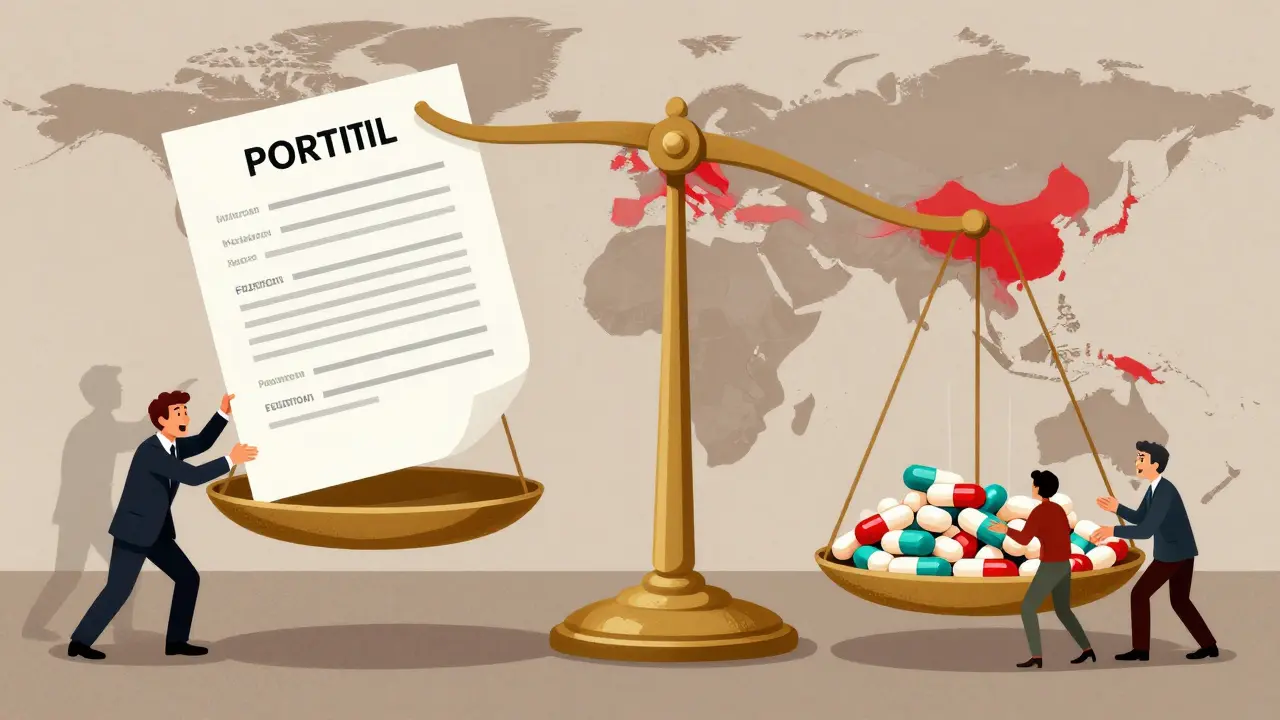
How the TRIPS Agreement Changed Who Gets Life-Saving Medicine
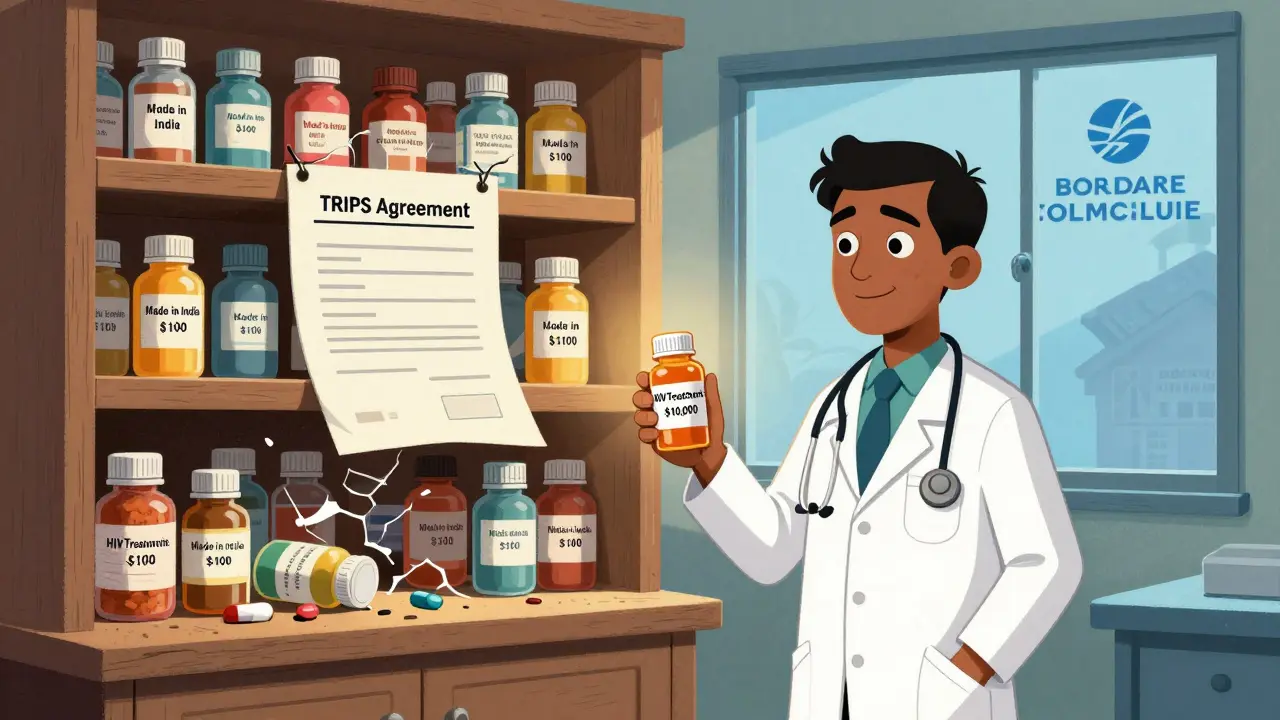
Before 1995, a person in Kenya or Bolivia could buy a generic version of an HIV drug for less than $100 a year. Today, that same drug might cost over $10,000 if it’s still under patent. The difference? The TRIPS Agreement.
The TRIPS Agreement is a binding international treaty under the World Trade Organization that sets minimum standards for intellectual property protection, including 20-year patents on pharmaceuticals. It came into force on January 1, 1995, after being negotiated as part of the Uruguay Round of global trade talks. Its goal was to create uniform rules for patents, trademarks, and copyrights across 164 member countries. But for medicines, the outcome was far from neutral.
Before TRIPS, countries like India, Brazil, and Thailand didn’t grant product patents for drugs. They could copy chemical formulas and make generics - cheap, effective versions of branded medicines. India became the pharmacy of the developing world, producing antiretrovirals at 5% to 10% of the price charged by U.S. or European companies. When HIV hit sub-Saharan Africa, these generics saved millions. After TRIPS, that changed. Suddenly, producing a generic version of a patented drug became illegal. Countries had to rewrite their laws. And the cost of treatment skyrocketed.
What TRIPS Actually Requires - And What It Blocks
TRIPS doesn’t just say "patents are good." It spells out exact rules. Under Article 33, every member must give pharmaceutical patents 20 years of protection from the date of filing. That’s not from when the drug hits the market - from when the company files the paperwork, often years before testing even finishes. That means a drug can be priced at a monopoly rate for over two decades.
Article 27 says inventions must be patentable if they’re new, involve an inventive step, and are industrially applicable. That sounds fair - until you realize it excludes natural substances but includes synthetic versions of them. So if a plant compound cures malaria, you can’t patent the plant. But if a lab tweaks it slightly, you can patent the new version and charge 100 times more.
Article 31 lets countries issue compulsory licenses - meaning the government can authorize a local company to make a generic version without the patent holder’s permission. Sounds like a safety valve, right? But here’s the catch: Article 31(f) says the generic medicine can only be made "predominantly for the supply of the domestic market." So if you’re a small African country with no drug factories, you can’t import generics from India. You’re stuck.
That’s why the 2005 Protocol Amendment (Article 31bis) was added. It was supposed to fix this. It lets countries without manufacturing capacity import generics made under compulsory license in another country. Sounds perfect. But it’s a legal maze. The importing country must notify the WTO. The exporting country must issue a license with exact product details. Both must prove they’ve tried to get a voluntary license first. The whole process takes years. And only one country has ever used it successfully: Rwanda, in 2008, importing HIV meds from Canada. It took four years. Médecins Sans Frontières called it "unworkable."
Why No One Uses the Flexibilities - Even When They’re Legal
Here’s the hard truth: countries know they have the legal right to use TRIPS flexibilities. But they don’t use them.
A 2017 study of 105 low- and middle-income countries found that 83% had never issued a single compulsory license. Why? Fear. Pressure. Retaliation.
When Thailand issued compulsory licenses for HIV and heart drugs in 2006, the U.S. removed its trade preferences, costing Thailand $57 million a year in lost exports. Brazil faced similar pressure after licensing efavirenz in 2007 - it was put on the U.S. "Priority Watch List" for two years. South Africa’s 1997 attempt to allow generics triggered a lawsuit from 39 pharmaceutical companies. The case was dropped only after global protests.
It’s not just about money. It’s about power. The U.S. Trade Representative’s office has repeatedly used trade threats to block countries from using TRIPS flexibilities. Between 2007 and 2015, the UN High-Level Panel documented 423 instances where countries were threatened with sanctions, reduced aid, or trade penalties just for considering compulsory licensing.
Even when countries try to follow the rules, they’re often under-resourced. A 2019 Duke University study found that 92% of low-income countries had fewer than two full-time staff members handling intellectual property and medicine policy. Many lack even basic legal frameworks. Of 48 least-developed countries, 67 still didn’t have laws to issue compulsory licenses - even though they were given until 2033 to comply with TRIPS for pharmaceuticals.
Voluntary Licensing: A Band-Aid on a Broken System
Pharmaceutical companies don’t like compulsory licenses. So they created the Medicines Patent Pool - a voluntary system where companies agree to let generic makers produce their drugs in exchange for royalties.
It sounds cooperative. But the numbers tell a different story. As of 2022, the Medicines Patent Pool covered only 44 patented medicines out of thousands. Most are for HIV. Very few for hepatitis, cancer, or diabetes. And 73% of those licenses are restricted to sub-Saharan Africa - even though those diseases affect people everywhere.
Compare that to the pre-TRIPS era. Between 1996 and 2001, Brazil exported generic antiretrovirals to 127 countries. Treatment coverage hit 85% domestically. Costs were one-tenth of branded drugs. Today, the same drugs cost 10 times more - and only 28% of prescriptions in low-income countries are generics, compared to 89% in the U.S.
Voluntary licensing is a tool, but it’s not a solution. It depends on corporate goodwill. And companies only license drugs that are profitable enough to share - not the ones that are most needed.
TRIPS-Plus: The Hidden Rules That Make Things Worse
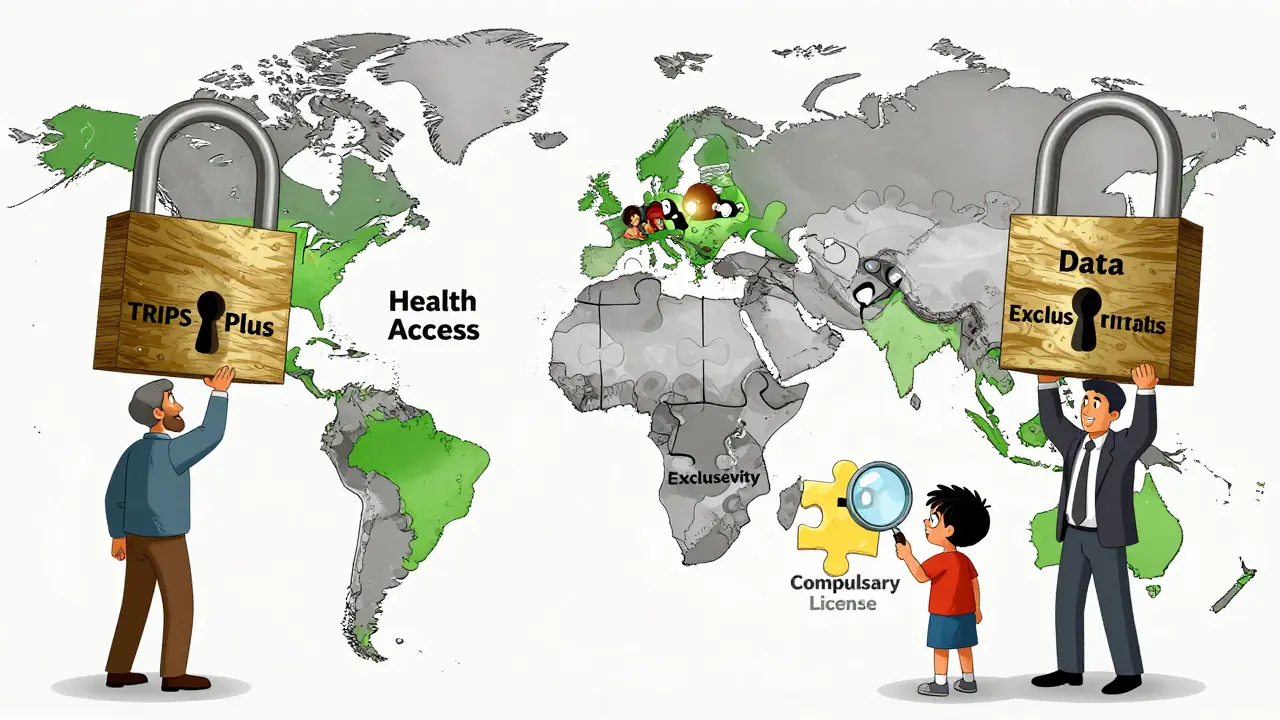
Even if a country follows TRIPS, it’s not safe. Most trade deals now include "TRIPS-plus" clauses - extra patent rules that go beyond what the WTO requires.
The U.S.-Jordan Free Trade Agreement, signed in 2011, extended patent terms beyond 20 years. It also blocked generic drug approval until the patent expired - even if the patent was invalid. That’s called "data exclusivity." It means even if a generic company proves a drug is safe and effective, they can’t sell it until the originator’s data expires - often five to seven extra years.
WTO data shows 141 of 164 member states have adopted TRIPS-plus provisions through bilateral deals. That adds an average of 4.7 extra years of monopoly pricing. Health Action International estimates this costs low-income countries $2.3 billion a year in lost savings from generic competition.
And it’s spreading. As of 2023, 58 low- and middle-income countries are in active trade negotiations with the U.S., EU, or others - and most are being pressured to accept TRIPS-plus terms in exchange for market access.
What’s Changing - And What’s Still Broken
The pandemic forced a reckoning. In October 2020, India and South Africa proposed a TRIPS waiver for COVID-19 vaccines and treatments. After two years of global pressure, the WTO approved a limited waiver in June 2022 - but only for vaccines. Diagnostics and treatments were left out.
That’s not enough. The WHO’s 2023 Global Strategy on Digital Health now includes TRIPS flexibilities as a key tool for enabling local production of digital medical tools - a sign the debate is expanding beyond pills to include diagnostics, vaccines, and even AI-driven health tech.
The UN High-Level Meeting on Pandemic Prevention in September 2024 called for "reform of the TRIPS Agreement to ensure timely access to health technologies during health emergencies." That’s a direct challenge to the status quo.
But reform is slow. The current system still favors corporate profits over public health. Even with the waiver, only a handful of countries have the capacity to produce mRNA vaccines. Most still rely on donations - not rights.
And the numbers are grim. The WHO estimates 2 billion people still lack regular access to essential medicines. In low-income countries, patent barriers are responsible for 80% of that gap. The global pharmaceutical market hit $1.42 trillion in 2022 - but 68% of that revenue came from patented drugs that make up just 12% of prescriptions.
TRIPS was supposed to be a global standard. Instead, it became a barrier. A legal wall between life-saving medicine and the people who need it most.
Can the System Be Fixed?
Yes - but not without pressure.
The tools exist. Compulsory licensing works when used. India’s generic production still supplies 80% of the world’s HIV drugs. South Africa’s treatment program now covers over 5 million people - thanks to generics. The problem isn’t the law. It’s the fear, the lobbying, the trade threats, and the lack of political will.
Real change needs three things:
- Legal clarity: Countries need help drafting and enforcing compulsory licensing laws - not threats.
- Political courage: Leaders must stop letting trade deals dictate public health policy.
- Global solidarity: High-income countries must stop blocking access and start supporting local production in low-income regions.
The TRIPS Agreement isn’t sacred. It was written by negotiators - not patients. And it can be changed. The question isn’t whether it can be fixed. It’s whether the world will choose to fix it before another million people die because a patent stood in the way.
Can a country legally produce generic drugs under TRIPS?
Yes. TRIPS allows compulsory licensing under Article 31, letting governments authorize local production of generic drugs without the patent holder’s consent - if certain conditions are met, like paying fair compensation and primarily serving the domestic market. The 2005 Protocol Amendment also allows importing generics from other countries under specific conditions. But these rights are rarely used due to political pressure and complex procedures.
Why hasn’t the Article 31bis system worked better?
The Article 31bis system is technically functional but practically unworkable. It requires over 78 steps across two countries, takes an average of 3.8 years to complete, and demands precise legal documentation. Only one case has succeeded - Rwanda importing HIV drugs from Canada in 2008. Civil society groups like Médecins Sans Frontières called it too slow and bureaucratic for emergencies. Most countries lack the staff or legal capacity to navigate it.
What’s the difference between TRIPS and TRIPS-plus?
TRIPS sets the minimum global standard for patent protection - 20 years for pharmaceuticals. TRIPS-plus refers to stricter rules added through bilateral trade deals, like extending patent terms beyond 20 years, blocking generic approval during patent life (data exclusivity), or limiting compulsory licensing. These are not required by the WTO but are often forced on developing countries in exchange for market access.
Do generic drugs cost less because they’re lower quality?
No. Generic drugs contain the same active ingredients as branded drugs and must meet the same safety and efficacy standards set by regulatory agencies like the WHO or FDA. The price difference comes from not paying for research, marketing, or patent protection. In many cases, Indian and Thai generics have been used successfully in UN programs and have saved millions of lives.
Why do pharmaceutical companies oppose compulsory licensing?
They argue it undermines innovation by reducing profits needed to fund new drug development. But critics point out that most major drugs are developed with public funding, and the industry spends far more on marketing than R&D. The real concern is maintaining high prices and monopoly control - not innovation. The same companies that oppose generics often license their drugs voluntarily when it’s profitable - like through the Medicines Patent Pool.
Is the TRIPS waiver for COVID vaccines enough?
No. The 2022 WTO waiver only covers vaccines, not treatments, diagnostics, or future pandemic tools. It also has complex conditions and doesn’t transfer technology or know-how - which is critical for local production. Most low-income countries still lack the capacity to produce mRNA vaccines, even with the waiver. Experts say it’s a symbolic step, not a structural fix.
erica yabut
January 4, 2026 AT 05:16Let’s be real-TRIPS isn’t just a treaty; it’s a neoliberal death sentence wrapped in legalese. Pharmaceutical CEOs don’t sleep at night worrying about African mothers-they’re counting how many zeroes they can tack onto a pill’s price tag. The fact that we call this ‘intellectual property’ instead of ‘life-or-death monopoly’ says everything about the moral bankruptcy of the system. And don’t get me started on ‘voluntary licensing’-it’s corporate virtue signaling dressed up as compassion. The only thing more obscene than the patents? The silence of the so-called ‘ethical’ nations that enabled them.
Angela Goree
January 4, 2026 AT 08:22Enough with the whining! America invented these drugs! We paid for the R&D! Why should India get to steal our innovations and sell them for pennies? If you want cheap medicine, go to China-but don’t punish the companies that risked billions to save lives! TRIPS protects innovation-and if you can’t afford it, that’s not our problem. We don’t hand out free cars because you can’t afford a Tesla!
Shanahan Crowell
January 5, 2026 AT 09:19Look-I get the outrage. But let’s not pretend this is just about greed. The system is broken, yes-but the answer isn’t to tear down patents, it’s to fix the architecture. We need global funding pools for R&D, public-private partnerships, and real tech transfer-not just compulsory licenses that gather dust because no one has the infrastructure to use them. We’re not fighting corporations; we’re fighting systemic neglect. And that’s fixable-if we stop pointing fingers and start building bridges.
Kerry Howarth
January 5, 2026 AT 13:04TRIPS allows generics. The problem isn't the law. It's the fear.
Tiffany Channell
January 6, 2026 AT 14:44Let’s quantify the hypocrisy. The U.S. spends $500 billion annually on healthcare. Yet it blocks access to $20-a-month generics in Africa while selling $100,000-a-year cancer drugs to its own citizens. This isn’t about innovation-it’s about profit maximization disguised as patriotism. The real crime? The fact that we’ve normalized this as ‘free market.’ You don’t have a free market when access to life is auctioned off to the highest bidder.
Brittany Wallace
January 7, 2026 AT 12:05There’s a quiet truth here that no one wants to say out loud: we’ve turned medicine into a commodity, not a right. And in doing so, we’ve forgotten that every patent on a life-saving drug is a promise broken-to a mother in Malawi, to a child in Haiti, to a farmer in Bolivia who just wants to live long enough to see his grandchildren. The TRIPS Agreement didn’t create this injustice-it just codified it. And now we’re all complicit, because we didn’t speak up when it mattered. Maybe the real question isn’t how to fix TRIPS-but how to remember our shared humanity before it’s too late.
Michael Burgess
January 9, 2026 AT 00:35Big Pharma’s lobbying budget > the entire health budget of 12 African nations combined. 😔 The Medicines Patent Pool? Cute. But it’s like handing out band-aids during a hurricane. Meanwhile, India’s generic industry produces 60% of the world’s vaccines and 40% of its generics-without a single patent on the original formulas. And yet, we call them ‘pirates’? We need to stop romanticizing innovation and start celebrating access. The real heroes aren’t the CEOs in suits-they’re the chemists in Pune who work for $10 a day to keep millions alive.
Liam Tanner
January 10, 2026 AT 22:55It’s not about whether TRIPS is right or wrong. It’s about whether we’re willing to face the consequences of what we’ve built. The system works fine for the 20% of the world that can pay. For the rest? It’s a maze of legal traps and silent threats. Maybe the answer isn’t to abolish patents, but to decouple R&D funding from drug pricing. Public funding for research, public ownership of outcomes. Simple. Effective. Human.
Palesa Makuru
January 12, 2026 AT 12:15Let me tell you something about South Africa-we’ve been fighting this for 25 years. The U.S. threatened us with trade sanctions. The EU called us ‘rogue.’ The pharmaceutical giants sued us. And yet-we kept going. We didn’t win because we were right. We won because we refused to be silent. If you think this is just about law, you’re missing the point. This is about dignity. And dignity doesn’t ask permission. It takes what it needs.
Hank Pannell
January 12, 2026 AT 15:29Structural analysis: TRIPS operates as a neocolonial regulatory apparatus-reproducing global asymmetries under the guise of legal universalism. The 20-year patent term is a temporal artifact of industrial capitalism, not a biological imperative. The ‘inventive step’ requirement, as interpreted, effectively criminalizes bio-diversity. And the 31bis protocol? A bureaucratic mirage designed to appear functional while remaining functionally inert. The real barrier isn’t legal-it’s epistemic: the hegemony of Western IP frameworks as the sole legitimate mode of knowledge governance. Decolonizing health requires dismantling the epistemic monopoly, not just tweaking clauses.
Lori Jackson
January 13, 2026 AT 06:37People who complain about TRIPS are the same ones who want free healthcare, free education, free everything-then blame the ‘system’ when they don’t get it. If you’re so concerned about access, why don’t you work for a nonprofit? Why don’t you fund research? Why do you demand others pay for your moral outrage? This isn’t justice-it’s performative outrage. And it’s exhausting.
Wren Hamley
January 15, 2026 AT 04:27Wait-so if a drug costs $10,000 and the generic is $100, who’s really paying for R&D? The patient? The taxpayer? The NIH funded 70% of the foundational science behind most blockbuster drugs. Big Pharma just bought the patent, slapped on a brand name, and charged 100x. The real innovation? Marketing. The real hero? The Indian factory worker who packs 500 pills a day for $2. We need to stop pretending this is about science. It’s about who gets to profit from human suffering.