

Your thyroid is a small, butterfly-shaped gland at the base of your neck, but it acts as the body’s master switch. It controls how fast your heart beats, how you digest food, and even how you feel emotionally. When this system goes off track, life feels like it’s moving in slow motion or racing out of control. To figure out what is happening, doctors rely on two main blood tests: TSH (Thyroid-Stimulating Hormone) and T4 (Thyroxine). Understanding these numbers is not just about reading a lab report; it is about unlocking the key to your energy levels, weight stability, and overall well-being.
Most people walk into a clinic feeling tired, gaining weight without trying, or dealing with hair loss. The doctor orders a "thyroid panel." You get the results back, see a number next to TSH, and wonder if it’s normal. But here is the catch: a "normal" range on paper doesn’t always mean you are healthy. This guide breaks down exactly what TSH and T4 mean, why they work together, and how doctors decide on the right medication dose for you.
The Dynamic Duo: How TSH and T4 Work Together
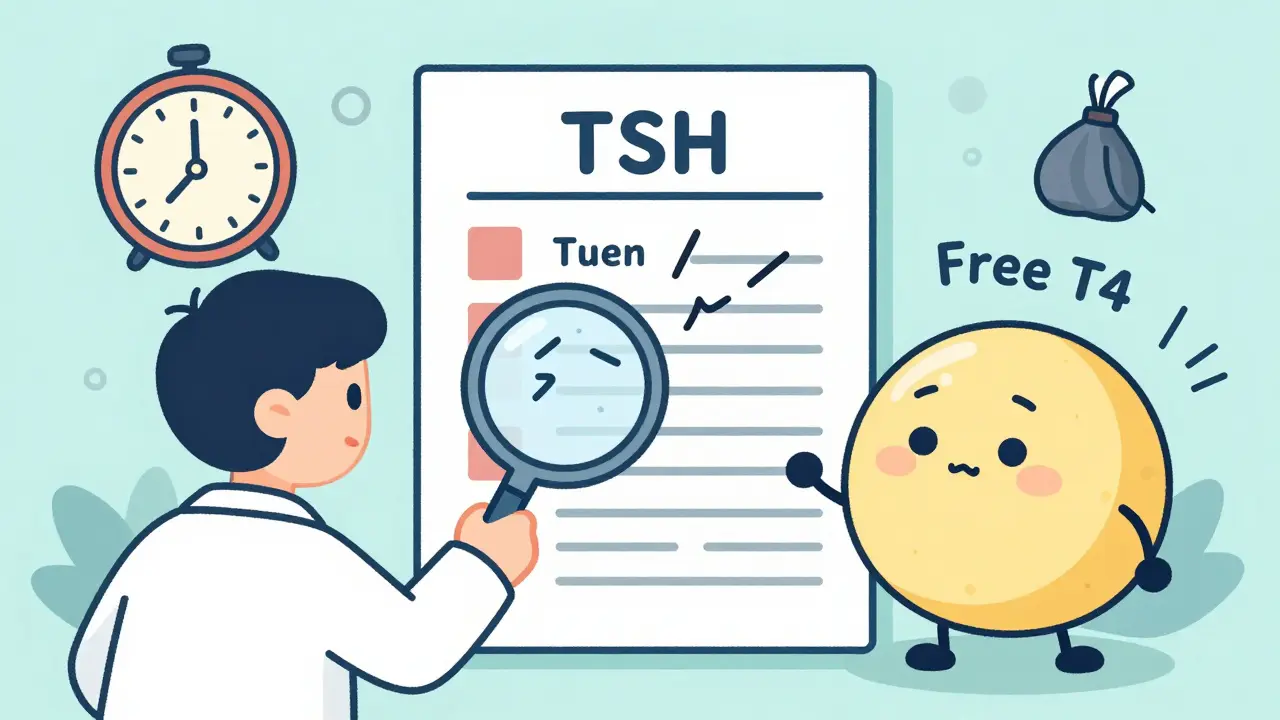
To understand your results, you have to look at the conversation between two parts of your brain and body. First, there is the pituitary gland in your brain. It produces TSH (Thyroid-Stimulating Hormone). Think of TSH as the manager sending emails to the factory floor. If the factory (your thyroid gland) isn’t producing enough product, the manager sends more urgent emails (higher TSH). If the factory is overproducing, the manager stops sending emails (lower TSH).
The product being made is T4 (Thyroxine). Specifically, doctors usually measure "Free T4," which is the active hormone floating freely in your blood, ready to do its job. Total T4 includes hormones bound to proteins, which aren’t immediately usable by your cells. In most clinical settings, Free T4 gives a clearer picture of what your body is actually experiencing.
This feedback loop is precise. If your thyroid slows down (hypothyroidism), TSH shoots up because the pituitary gland is screaming for more hormone. If your thyroid speeds up (hyperthyroidism), TSH drops to near zero because the pituitary gland is trying to shut the production down. Measuring both gives us the full story, rather than just guessing based on one number.
Decoding Your Lab Results: What Is Normal?
Lab ranges can be confusing because different laboratories use different machines and reference populations. However, there are general benchmarks that most endocrinologists follow. For adults, the standard reference range for TSH is typically 0.5 to 5.0 mIU/L. For Free T4, the normal range is usually 0.7 to 1.9 ng/dL.
Here is where things get tricky. Many patients feel terrible even when their TSH is within this "normal" range. Research from UCSF and Johns Hopkins suggests that older adults might naturally have slightly higher TSH levels without having true disease. For example, ages 70-79 may have an optimal range of 0.5-5.5 mIU/L, while those over 80 might go up to 6.5 mIU/L. Ignoring age can lead to unnecessary medication prescriptions.
Pregnancy changes everything. During the first trimester, your body needs more thyroid hormone to support the baby’s brain development. The Endocrine Society recommends stricter limits: 0.1 to 2.5 mIU/L for the first trimester, rising slightly in the second and third. If you are pregnant, a TSH of 4.0 mIU/L might be considered abnormal and require treatment, whereas it would be fine for a non-pregnant adult.
| Condition | TSH Level | Free T4 Level | What It Means |
|---|---|---|---|
| Primary Hypothyroidism | High (>4.5 mIU/L) | Low (<0.8 ng/dL) | Thyroid is underactive; pituitary is pushing hard. |
| Subclinical Hypothyroidism | Mildly High (4.5-10 mIU/L) | Normal | Early stage; thyroid is struggling but keeping up. |
| Hyperthyroidism | Very Low (<0.1 mIU/L) | High (>1.8 ng/dL) | Thyroid is overactive; pituitary has shut down. |
| Central Hypothyroidism | Low or Normal | Low | Pituitary gland failure; rare but serious. |
Why TSH Alone Isn't Always Enough
You might hear doctors say, "I only check TSH." For 85% of cases, this is true. TSH is incredibly sensitive-like a smoke detector. It often picks up problems before T4 levels change. However, relying solely on TSH misses about 5-7% of thyroid disorders, especially in hospitalized patients or those with pituitary issues.
If you have a history of head trauma, pituitary tumors, or recent surgery, your pituitary gland might not send the correct signals. In these cases, your TSH could look "normal" or low, but your actual thyroid hormone (T4) is dangerously low. This is called central hypothyroidism. Without checking Free T4, this condition goes undiagnosed.
Additionally, in critical care settings, severe illness can temporarily suppress thyroid function (known as non-thyroidal illness syndrome). Here, TSH can be misleading. Doctors must look at Free T4 to avoid misdiagnosing a patient who is simply recovering from a major stressor, not suffering from permanent thyroid disease.
Levothyroxine Dosing: Finding Your Sweet Spot
If your tests confirm hypothyroidism, the standard treatment is Levothyroxine (synthetic T4). It replaces what your body isn’t making. Getting the dose right is a balancing act. Too little, and you remain fatigued. Too much, and you risk heart palpitations and bone loss.
The starting dose is usually calculated by weight: approximately 1.6 mcg per kilogram of body weight per day for healthy adults. For elderly patients or those with heart disease, doctors start lower (around 1.0 mcg/kg/day) to protect the heart. Infants need much higher doses relative to their size (10-15 mcg/kg/day) because their brains are developing rapidly.
Once you start medication, you don’t just keep taking it forever without checks. You need retesting every 6 weeks until your TSH stabilizes. Why 6 weeks? Because thyroid hormone has a half-life of about seven days. It takes roughly six weeks for the new dose to fully settle in your system and reflect in your blood work. Changing doses too frequently leads to whiplash-constantly adjusting based on incomplete data.
The goal for most patients is a TSH between 0.5 and 2.5 mIU/L. Some patients feel best at the lower end of this range. Others, particularly older adults, may feel fine closer to 3.0 or 4.0. The "right" dose is the one that makes you feel normal, not just the one that hits a specific number on a page.

Common Pitfalls and Patient Experiences
Despite clear guidelines, many patients face frustration. Surveys show that nearly 70% of patients experience diagnostic delays because their symptoms were dismissed despite "normal" TSH results. This often happens in subclinical hypothyroidism, where TSH is slightly elevated (4.5-10 mIU/L) but T4 is still normal. Doctors may choose to wait and watch, but patients feel sick.
Another major issue is laboratory variation. Different brands of testing equipment (like Roche vs. Siemens) can produce slightly different Free T4 values. A shift from 1.8 to 1.9 ng/dL might look like a big jump, but it could just be machine variance. This causes unnecessary dose adjustments. Always try to use the same lab for consistent tracking.
Also, remember that timing matters. Take your Levothyroxine on an empty stomach, at least 30-60 minutes before breakfast. Coffee, calcium supplements, and iron pills can block absorption by up to 30%. If you take your pill with coffee, you might be getting less medication than prescribed, leading to high TSH readings and confusion.
When to See an Endocrinologist
Primary care doctors handle most thyroid cases successfully. However, consider seeing a specialist if:
- Your TSH remains unstable despite dose adjustments.
- You have persistent symptoms despite "normal" labs.
- You are pregnant or planning pregnancy, as requirements change quickly.
- You have a family history of thyroid cancer or autoimmune diseases.
- You suspect central hypothyroidism (pituitary issues).
New tools are emerging, such as AI-assisted interpretation systems that factor in age, BMI, and symptoms alongside TSH and T4. While not yet universal, these technologies promise to reduce misdiagnosis rates. For now, staying informed about your own numbers and advocating for comprehensive testing (TSH + Free T4) is the best way to ensure you get the care you need.
Should I ask for a Free T4 test if my TSH is normal?
Generally, no. If your TSH is normal, your Free T4 is almost certainly normal too. However, if you have symptoms of thyroid dysfunction despite normal TSH, or if you have a history of pituitary issues, asking for a Free T4 test is reasonable to rule out central hypothyroidism.
How long does it take for Levothyroxine to work?
It takes about 6 weeks for the full effect of a Levothyroxine dose change to show up in your blood tests. You may start feeling better in 2-3 weeks, but waiting the full 6 weeks ensures accurate monitoring before making further adjustments.
What is the ideal TSH level for someone on medication?
For most adults, the target TSH range is 0.5 to 2.5 mIU/L. However, individual tolerance varies. Some patients feel best at the lower end, while others, especially older adults, may tolerate slightly higher levels. The goal is symptom relief combined with safe lab values.
Can food affect my thyroid test results?
Food does not directly alter the blood test itself, but what you eat *before* taking your medication affects absorption. Calcium, iron, and high-fiber foods can reduce Levothyroxine absorption. This leads to higher TSH levels over time, mimicking under-dosing. Always take your medication on an empty stomach.
Why do my lab ranges differ from online calculators?
Laboratories calibrate their machines using different reference populations and reagents. A "normal" range at one lab might be slightly different at another. It is crucial to compare your current results against previous results from the *same* lab to track trends accurately.