
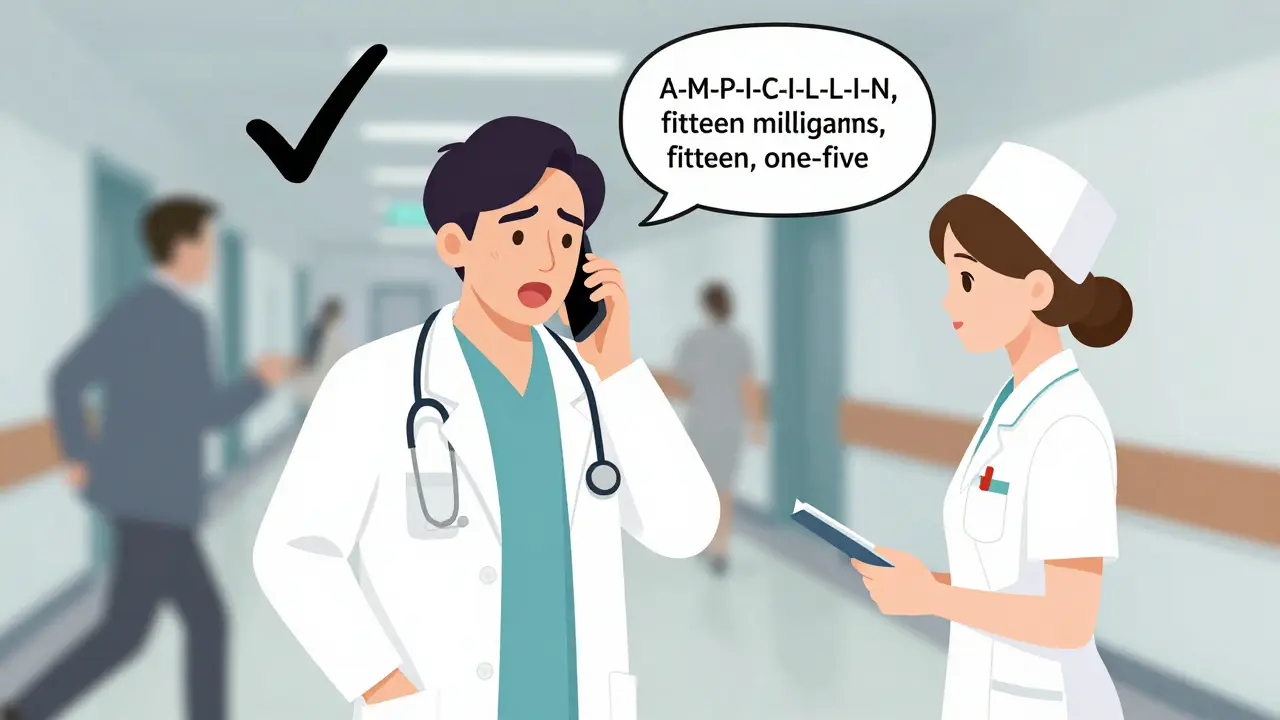
When a doctor calls in a medication order over the phone, it’s not just a quick chat-it’s a high-stakes moment. A single misheard word can mean the difference between healing and harm. Verbal prescriptions, while necessary in emergencies or during surgery, carry a risk that’s been well-documented for over two decades. The Institute for Safe Medication Practices Canada reports error rates between 30% and 50% when these orders aren’t handled with strict protocols. That’s not a small number. It’s a real threat to patient safety. But here’s the good news: with the right steps, those risks can be cut in half-or more.
Why Verbal Prescriptions Still Exist
You might wonder why we still use verbal orders when electronic systems exist. The answer is simple: sometimes, there’s no time. During a cardiac arrest, while a surgeon is scrubbed in, or when the EHR is down, writing an order isn’t an option. Verbal prescriptions fill that gap. They’re not outdated-they’re essential. But that necessity doesn’t excuse sloppy communication. The Joint Commission made this clear back in 2006: if you’re giving a verbal order, you must follow the rules. And those rules aren’t suggestions. They’re lifelines.
The Read-Back Rule: Your First Line of Defense
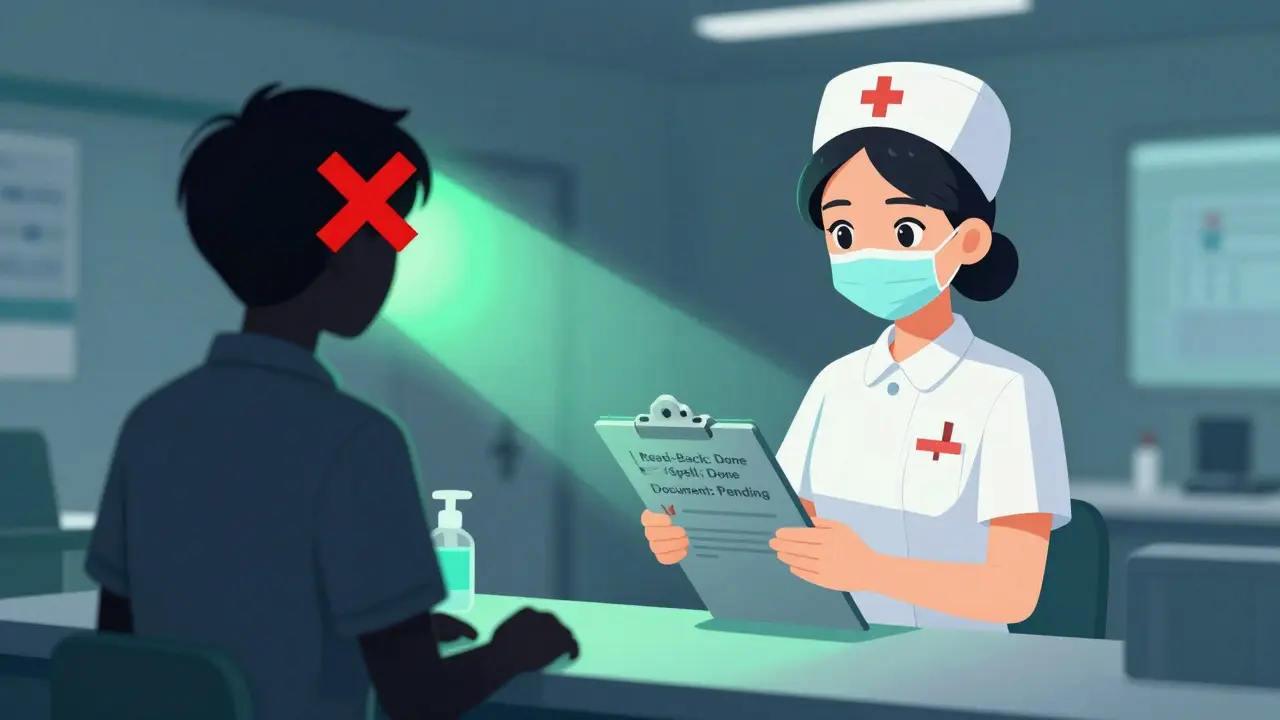
The single most effective safety step in verbal prescribing is read-back. This isn’t just repeating the order-it’s saying it back word for word, number for number, so the prescriber can confirm it’s correct. The Joint Commission required this practice in 2006, and since then, hospitals that enforce it see up to 50% fewer medication errors. But here’s the catch: read-back only works if it’s done every time, by everyone. A 2020 survey of nurses found that some prescribers skip it almost half the time. That’s not an oversight. It’s a pattern. And it’s dangerous.
Here’s how to do it right:
- The prescriber gives the full order: medication name, dose, route, frequency, and reason.
- The receiver repeats it back exactly as heard.
- The prescriber confirms: “Yes, that’s correct.”
- The order is documented immediately-no waiting.
Don’t assume the other person heard you. Don’t assume they remember. Say it. Repeat it. Confirm it. Always.
Spell It Out: No Abbreviations, No Guessing
Abbreviations are the enemy of clarity. “BID” sounds like “bid” as in “I bid you farewell.” But in a hospital, it means twice daily. And that’s not safe. The same goes for “QD” (once daily), “U” for units, or “MS” for morphine sulfate. These shortcuts have caused deadly mix-ups. The Institute for Safe Medication Practices (ISMP) says sound-alike names like Celebrex and Celexa, or Hydralazine and Hydroxyzine, are behind nearly a third of all verbal order errors.
So how do you avoid this? Spell everything out.
- Use twice daily, not BID.
- Use by mouth, not PO.
- Spell the drug name: “A-M-P-I-C-I-L-L-I-N,” not just “ampicillin.”
- State numbers two ways: “Fifteen milligrams-fifteen, one-five.”
This isn’t extra work. It’s insurance. One nurse in Auckland told me she once caught a 10-fold dosing error because the prescriber said “hydralazine” without spelling it. She asked for clarification. The prescriber corrected himself: “I meant hydralazine-H-Y-D-R-A-L-A-Z-I-N-E.” That pause saved a life.
High-Alert Drugs: When Verbal Orders Are Forbidden
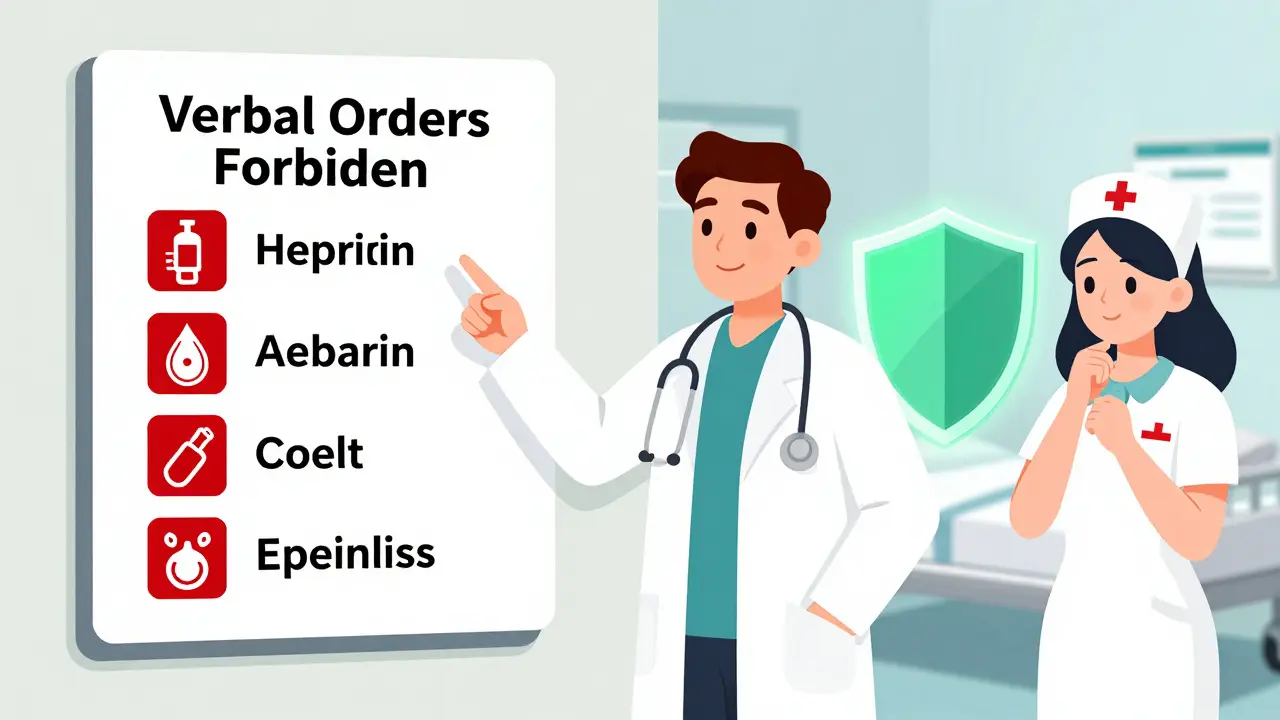
Not all medications should be ordered verbally. Some are too dangerous. The Pennsylvania Patient Safety Authority and Washington State Department of Health agree: insulin, heparin, opioids, and chemotherapy should never be ordered verbally unless it’s a true emergency. Even then, extra caution is required.
Here’s what’s off-limits for verbal orders in most hospitals:
- Insulin (especially sliding scale or IV)
- Heparin (unfractionated or low molecular weight)
- Opioids (fentanyl, morphine, hydromorphone)
- Chemotherapy agents (except to hold or discontinue)
Why? Because a small mistake here leads to a big disaster. A premature infant in a 2006 NICU incident received ampicillin and gentamicin at 10 times the correct dose because two drugs were ordered back-to-back without clear separation. The nurse didn’t catch it. The prescriber didn’t spell them out. The baby nearly died.
If you’re unsure whether a drug is high-alert, check your hospital’s list. If it’s not on the list, ask. Better to pause than to poison.
Documentation: The Only Real Record
Here’s the hard truth: the only record of a verbal order is in the memories of the people who heard it. That’s why immediate transcription isn’t optional-it’s mandatory. CMS requires authentication within 48 hours. But leading hospitals like Johns Hopkins require it before the shift ends. Why? Because memory fades. Distractions happen. A nurse might be called away to a code blue. A doctor might get interrupted by a family member. By the time they get back, they’ve forgotten half the order.
Every verbal order must include:
- Patient’s full name and date of birth
- Medication name spelled phonetically
- Dose with units (mg, mL, units-not just “10”)
- Route (IV, IM, PO, SC)
- Frequency (twice daily, every 6 hours)
- Indication (why it’s being given)
- Prescriber’s full name and title
- Time and date the order was given
- Time and date the order was authenticated
Missing any one of these? That’s not a paperwork issue. That’s a safety gap.
Who’s at Risk? The Hidden Danger Zones
Most verbal order errors happen during shift changes. That’s when fatigue, distractions, and rushed handoffs collide. The Pennsylvania Patient Safety Authority found 42% of errors occur during these transitions. Nurses report that some prescribers never use read-back. Others speak too fast. Some use unclear accents or mumble. A 2021 Medscape survey showed 68% of nurses had at least one near-miss every month because of unclear speech.
Non-native English speakers are especially vulnerable-not because they’re less competent, but because communication systems weren’t built for them. A doctor saying “fifteen milligrams” might sound like “fifty” to someone unfamiliar with the accent. That’s why stating numbers two ways (“fifteen-fifteen, one-five”) is so critical. It’s not about politics. It’s about precision.
And don’t forget: the person receiving the order has as much responsibility as the one giving it. If something sounds off, ask. If you’re unsure, say: “Can you repeat that?” No one will think less of you. In fact, they’ll respect you more.
What’s Changing? The Future of Verbal Orders
Electronic prescribing has cut verbal order rates from 22% to under 10% in hospitals since CPOE systems were adopted. KLAS Research predicts that by 2025, verbal orders will drop to just 5-8%. Voice recognition software and AI-assisted order entry are making it easier than ever to skip the phone call.
But here’s the reality: some situations will always need verbal orders. Surgeons in the OR. Paramedics in the field. A code blue in the middle of the night. That’s why safety protocols aren’t going away. They’re evolving. In 2024, the FDA is launching a national initiative to standardize how high-risk drug names are pronounced. That means “Hydralazine” will have one official way to say it-no more guessing.
And more states are making read-back mandatory. By 2023, 42 states had adopted The Joint Commission’s standards into their licensing rules. That’s not just policy. It’s law.
Final Rule: When in Doubt, Stop and Confirm
There’s no shortcut to safety. No clever trick. No app that replaces common sense. The best practice is simple: slow down. Spell it. Read it back. Write it down. Double-check. If you’re tired, distracted, or rushed, say so. Ask for help. Ask for clarification. You’re not being difficult-you’re being responsible.
One nurse summed it up perfectly: “I’d rather be called slow than be the one who gave the wrong drug.”
Are verbal prescriptions legal?
Yes, verbal prescriptions are legal under CMS and The Joint Commission regulations, but only if strict safety protocols are followed. They must be authenticated within 48 hours, and read-back verification is required. State laws may impose additional restrictions, especially for high-alert medications.
What medications should never be ordered verbally?
Insulin, heparin, opioids, and chemotherapy agents should not be ordered verbally unless it’s a life-threatening emergency. Even then, extra verification steps are required. Most hospitals prohibit verbal orders for these drugs in non-emergency situations due to the high risk of fatal dosing errors.
Why is read-back so important?
Read-back is the most effective way to catch errors before they reach the patient. Studies show it reduces medication errors by up to 50%. It forces both parties to confirm the order, eliminating assumptions and memory lapses. Skipping read-back is one of the top causes of preventable harm in hospitals.
Can I use abbreviations like BID or QD in verbal orders?
No. Abbreviations like BID, QD, U, and MS are banned in verbal orders because they’re easily misheard. Always say “twice daily,” “once daily,” “units,” or “morphine sulfate.” Clear language saves lives.
What should I do if I’m unsure about a verbal order?
Stop. Don’t guess. Ask the prescriber to repeat the order. Spell out the drug name. Confirm the dose and route. If it still doesn’t sound right, say so. It’s better to delay the order than to risk giving the wrong medication. Your hesitation could be the difference between safety and tragedy.
Gigi Valdez
February 28, 2026 AT 03:02Verbal prescriptions are a necessary evil in healthcare, and this post lays out the protocols with remarkable clarity. Read-back isn't just procedure-it's a cultural shift that needs to be embedded in every shift change. I've seen nurses get flak for insisting on it, but I've also seen the aftermath when someone didn't. The difference is life or death. No shortcuts.
Sophia Rafiq
March 1, 2026 AT 00:09Spell it out. Fifteen one-five. That’s the mantra. I work in a busy ER and half the time docs just mumble. Once heard ‘hydralazine’ as ‘hydroxyzine’-caught it because I asked for the spelling. No shame in asking. Zero. Just say it twice.
Noah Cline
March 1, 2026 AT 21:52Read-back is performative. You think it prevents errors? It just creates a checkbox culture. The real issue is understaffing and burnout. Nurses are so overloaded they’re not listening properly, and doctors are rushing because they’re on their 12th call. No protocol fixes systemic failure. You’re treating symptoms, not the disease.
Justin Ransburg
March 3, 2026 AT 19:41This is exactly the kind of clarity we need in medicine. I’ve trained new residents on verbal order protocols, and the moment they see the data-50% fewer errors when read-back is enforced-they get it. It’s not about bureaucracy. It’s about respect. Respect for the patient, the nurse, and the fact that we’re all human and we all make mistakes. Slow down. Confirm. Document. Repeat.
Sumit Mohan Saxena
March 5, 2026 AT 00:47As a clinician from India working in a U.S. hospital, I can attest that accent and linguistic nuance play a significant role in verbal order miscommunication. I have been on both sides-misunderstanding a dose because of intonation, and having my pronunciation questioned. The solution is not to judge, but to standardize phonetic spelling and insist on double-stating numbers. This post captures the essence perfectly. Thank you.
bill cook
March 6, 2026 AT 14:31Who’s really behind these rules? Pharma companies. They want you to spell everything out so you can’t accidentally order a generic and they can push their $1,200 brand-name drug instead. Read-back? It’s a revenue stream disguised as safety.
Lisa Fremder
March 7, 2026 AT 13:15Why are we still using English for medical orders? Half the staff here are non-native speakers. We should switch to a universal medical code language. No more ‘twice daily’-just ‘B2’. Clean. Simple. No room for mispronunciation. America’s outdated.
Byron Duvall
March 7, 2026 AT 21:18They say read-back saves lives. But what about the 30% of times the prescriber just says ‘yeah’ without really listening? It’s a ritual. A theater. I’ve worked in three hospitals-all of them fake it. The real solution? Ban verbal orders entirely. If the EHR’s down, too bad. Stop the madness.