
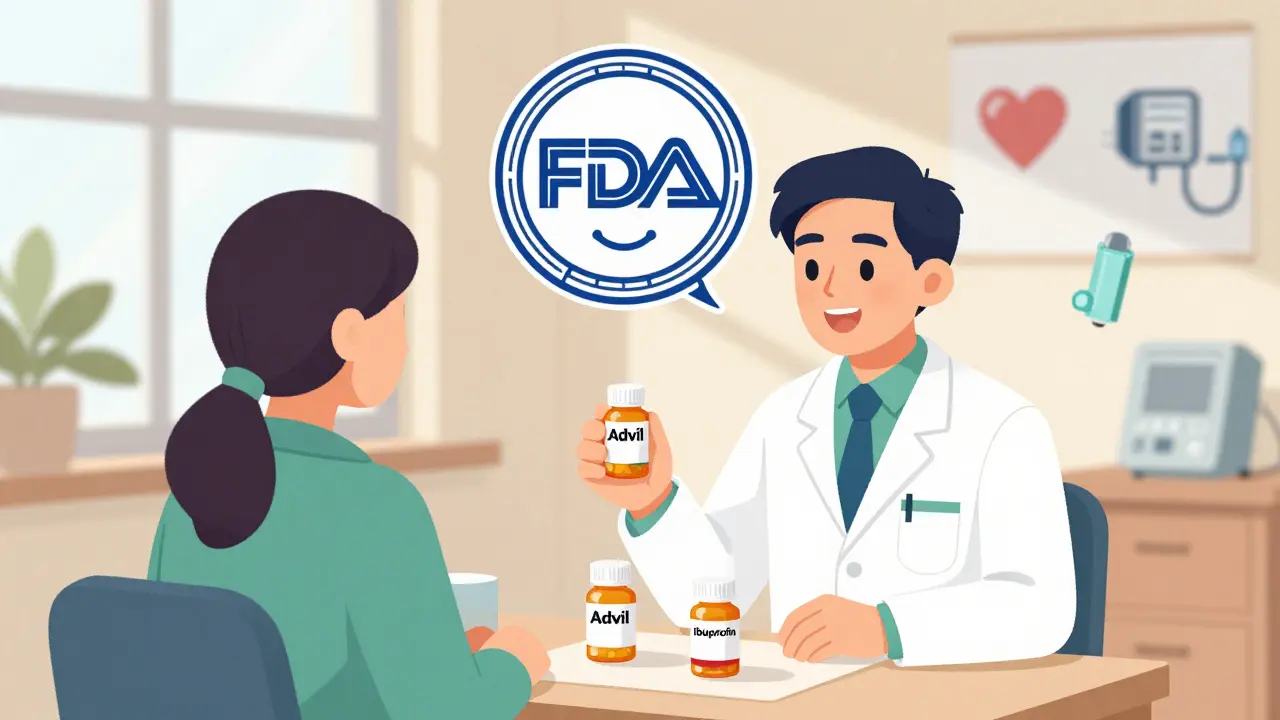
Every year, employers spend billions on healthcare - and a huge chunk of that goes to brand-name drugs that do the exact same thing as their generic versions. But here’s the thing: most employees don’t know that. They see the name on the bottle, think it’s better, and pay more - even when it’s not necessary. That’s where pharmacists come in.
Pharmacists aren’t just the people who hand out pills. In modern workplace wellness programs, they’re the quiet force behind better health and lower costs. And one of their most powerful tools? Promoting generic medications.
Why Generics Matter More Than You Think
Generics aren’t cheap knockoffs. They’re exact copies - same active ingredient, same dosage, same effectiveness. The FDA requires them to meet the same strict standards as brand-name drugs. In fact, 90% of all prescriptions filled in the U.S. are for generics. But they only make up 22% of total drug spending. That gap? That’s where money is being wasted.
Take ibuprofen. It’s the generic version of Advil. Same pill. Same effect. But if you’re paying $15 for a bottle of Advil instead of $3 for ibuprofen, you’re spending five times more for zero extra benefit. Multiply that across hundreds of employees with chronic conditions like high blood pressure, diabetes, or asthma - and you’re looking at tens of thousands of dollars saved every year.
And it’s not just about saving money. Poor adherence to medication is a silent crisis. The CDC says nearly half of all patients don’t take their meds as prescribed. Why? Cost is the #1 reason. When a person has to choose between paying for their blood pressure pill or their rent, they skip the pill. Generics remove that choice.
The Pharmacist’s Unique Edge
Employers can set up three-tier formularies. They can mandate generics. They can offer discounts. But none of that works if the employee doesn’t trust the drug.
That’s where pharmacists break through.
Unlike a benefits manager sending out an email or a HR brochure, pharmacists talk to people - face to face, on the phone, during a wellness check-in. They answer questions. They listen. They share real stories.
One pharmacist in Auckland told me she tells patients: "I take generic metformin for my prediabetes. It’s the same drug my doctor prescribed to me - just cheaper. I’ve been on it for five years. No issues." That kind of personal testimony changes minds.
They also use tools most people don’t know about. The FDA’s Orange Book tells them which generics are therapeutically equivalent to brand drugs. They check MAC (Maximum Allowable Cost) lists to make sure the cheapest option is being used. They use systems like McKesson’s OneStop Generics to automate substitutions where allowed.
And they don’t just swap pills. They do Medication Therapy Management (MTM) - a full review of everything a person is taking. Maybe someone’s on three brand-name drugs that could be replaced with two generics. Maybe there’s a dangerous interaction. Maybe they’re taking duplicate meds. Pharmacists catch it. They fix it. And in the process, they cut costs by 20-30% per patient.
How Workplace Programs Are Changing
Five years ago, most workplace wellness programs focused on gym memberships and fruit bowls. Now? They’re adding pharmacists.
Large employers - those with 5,000+ employees - are already including pharmacist consultations in 68% of their wellness plans. That number is rising fast. Since 2020, adoption has jumped 37%. Why? Because the math is undeniable.
A 2024 study by the American Pharmacists Association found that for every $1 spent on pharmacist-led medication management, employers saved $7.20 in medical costs. That’s not a guess. That’s from real data - claims analysis from thousands of employees.
Companies like Walmart are leading the way. Their Health Centers now embed pharmacists directly into employer wellness teams. Early results? A 23% drop in prescription costs among participating employees. That’s not a fluke. It’s because pharmacists are there - not just filling scripts, but having conversations.
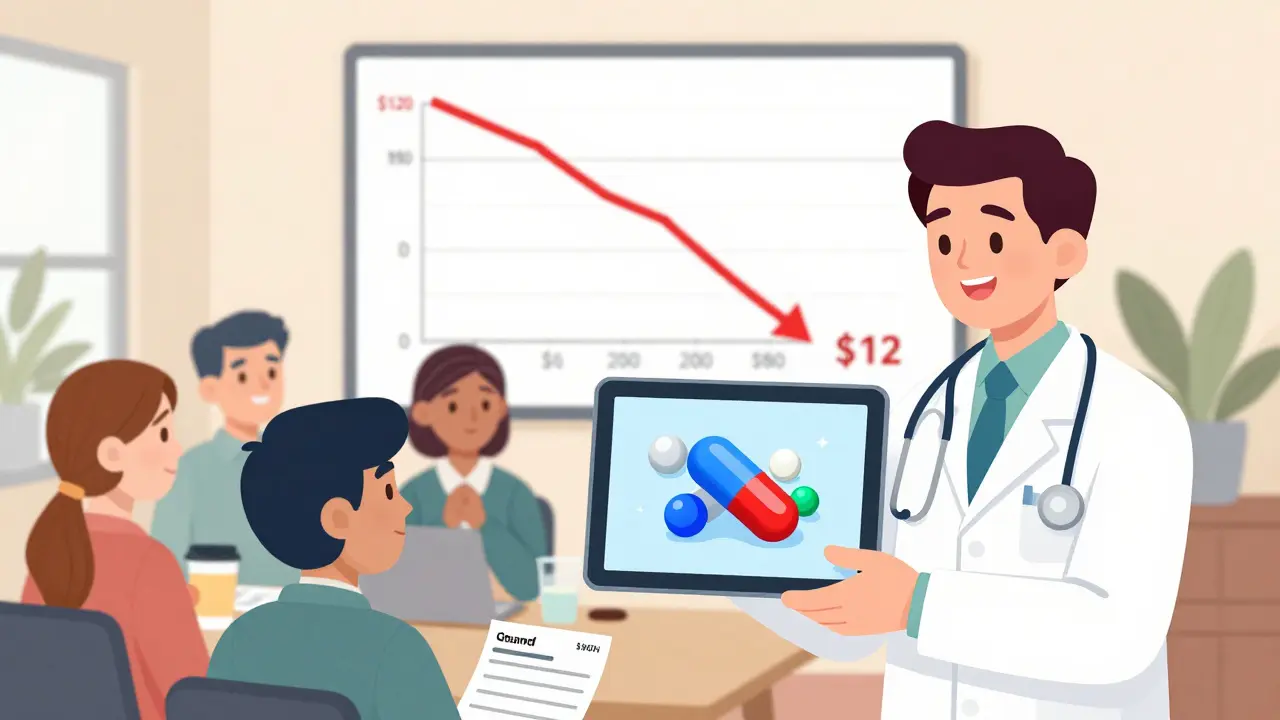
Telehealth is helping too. Employees can now hop on a 15-minute video call with a pharmacist during lunch. No waiting. No pharmacy line. Just a quick chat about why their new diabetes med is now $12 instead of $120.
Breaking Down Barriers
It’s not all smooth sailing.
Some pharmacists are stuck behind restrictive state laws. In some places, they can substitute a generic - but only if the doctor approves it first. That defeats the whole point. If a patient has to wait days for a doctor’s note just to save $50, they’ll just pay the extra.
And then there’s the trust gap. Many people still believe generics are inferior. "My cousin took a generic and it didn’t work." "The brand has better quality control." These myths are everywhere.
That’s why education matters. Pharmacists explain the ANDA process - how the FDA requires generics to prove they’re absorbed in the body within 80-125% of the brand drug. They show patients the same factory that makes Advil also makes the generic ibuprofen. They hand out one-pagers that say: "Same drug. Same FDA approval. Same results. Just cheaper."
And it works. Surveys show 78% of employees feel more confident about generics after talking to a pharmacist. That’s huge. Because confidence leads to adherence. And adherence leads to fewer hospital visits, fewer missed workdays, and better health.
What This Means for Employers
If you’re an employer looking to cut healthcare costs, don’t just look at insurance premiums. Look at prescriptions.
Here’s what you can do:
- Partner with your Pharmacy Benefit Manager (PBM) to include clinical pharmacists in your wellness program.
- Require pharmacists to offer MTM consultations to employees with chronic conditions.
- Use data from your PBM to track how many generics are being prescribed - and how many patients are switching.
- Train HR staff to talk about generics the same way they talk about gym memberships: as a smart, proven health tool.
- Share success stories. "Sarah from accounting saved $800 last year on her asthma meds by switching to generics - and her lung function improved." Real names. Real results.
And if you’re worried about liability? Don’t be. Pharmacists are trained to follow strict protocols. Studies show they correctly identify appropriate substitutions in 98.7% of cases. That’s better than most doctors.
The Future Is Here
By 2027, the American Pharmacists Association predicts 85% of large employer wellness programs will include pharmacist-led medication optimization. That’s not a forecast. That’s inevitable.
Why? Because the system is broken - and pharmacists are the only ones who can fix it.
Doctors diagnose. Nurses care. Pharmacists understand the whole system - the cost, the science, the access, the barriers. They’re the bridge between clinical need and real-world affordability.
And in a world where healthcare costs keep climbing, that bridge is worth its weight in gold.
Are generic drugs really as effective as brand-name drugs?
Yes. The FDA requires generics to have the same active ingredient, strength, dosage form, and route of administration as the brand-name drug. They must also be bioequivalent - meaning they deliver the same amount of medicine into the bloodstream at the same speed. In fact, generics must meet the same quality, purity, and stability standards. The only differences are in inactive ingredients (like color or filler) and cost. Millions of people take generics every day - with no loss in effectiveness.
Can pharmacists switch my prescription to a generic without my doctor’s permission?
It depends on your state’s laws. In 49 U.S. states, pharmacists can substitute a generic for a brand-name drug if it’s listed as therapeutically equivalent in the FDA’s Orange Book - as long as the prescriber hasn’t written "dispense as written" or "no substitution." However, some states require pharmacists to notify the prescriber or get approval before making certain changes. In workplace settings, pharmacists often work with PBM systems that automate this process to ensure compliance.
Why do some people say generics don’t work for them?
Sometimes it’s not the drug - it’s the change. Switching from one brand to another - even if both are generics - can cause slight differences in how the body responds due to inactive ingredients. This is rare, but real. Pharmacists help by monitoring for changes in symptoms after a switch and working with prescribers if needed. More often, though, people think generics don’t work because they’re cheaper. That’s a perception issue - not a medical one. Pharmacists clear this up with clear, evidence-based explanations.
How do pharmacists know which generics are safe to substitute?
Pharmacists use the FDA’s Orange Book, which lists all approved generic drugs and their therapeutic equivalence ratings. They also rely on systems like the Maximum Allowable Cost (MAC) list from their Pharmacy Benefit Manager (PBM), which tells them which generics are the most cost-effective and clinically appropriate. These tools are built into pharmacy software, so substitutions are automated where allowed - and flagged for review when needed.
Do employers really save money by having pharmacists promote generics?
Yes - and the numbers prove it. Studies show pharmacist-led generic promotion reduces prescription drug costs by 20-30%. When combined with Medication Therapy Management (MTM), adherence improves by 15-20%, which cuts down on hospitalizations and emergency visits. The American Pharmacists Association found a $7.20 return for every $1 spent on pharmacist services. That’s not theoretical - it’s based on claims data from large employers.
Jonathan Rutter
February 19, 2026 AT 15:00Look, I get it - generics are cheaper, but let’s be real: I’ve had three different generic versions of my blood pressure med, and each time I switched, I felt like I got hit by a bus. One made me dizzy, another gave me nausea, and the third? I swear my heart started beating like a drum machine. Yeah, the FDA says they’re ‘bioequivalent,’ but bioequivalent doesn’t mean my body agrees. And don’t even get me started on the fillers - some generics have dyes that make me break out. I’ve lost count of how many times I had to call my doc to switch back. So yeah, pharmacists can push generics all day, but if they’re not listening to the patient’s actual experience, they’re just another cog in the corporate cost-cutting machine. I’m not anti-generic. I’m pro-not-getting-sick-from-a-pill-that-should’ve-been-tested-on-humans-first.
Jana Eiffel
February 21, 2026 AT 05:21The philosophical underpinnings of this discourse reveal a profound tension between utilitarian efficiency and individual bodily autonomy. The commodification of health, wherein pharmaceutical efficacy is reduced to a cost-benefit calculus, fundamentally misapprehends the phenomenology of illness. To equate therapeutic equivalence with therapeutic identity is to commit a category error - one’s physiological response is not merely a function of molecular structure, but of lived context, psychological expectation, and biographical continuity with prior medication. The pharmacist, in this schema, becomes not a healer but a technician of neoliberal healthcare optimization. One cannot reduce the dignity of adherence to a spreadsheet. The human body is not a variable in an algorithm. It is a narrative - and narratives resist substitution.
aine power
February 22, 2026 AT 14:47Generics work. Stop whining.
Robin bremer
February 24, 2026 AT 12:13bro i switched to generic adderall and i swear i felt like i was on a 300mg nap taken by a sloth 😴💀 i get it’s the same chem but like… why does it feel like my brain is running windows 95? also why do they make the pills look like they were painted by a toddler? 🤡💊
Ashley Paashuis
February 25, 2026 AT 04:48While the data supporting pharmacist-led generic substitution is compelling, it is equally important to acknowledge the variability in individual patient experiences. A one-size-fits-all approach, even when backed by clinical evidence, may inadvertently undermine patient trust if it does not account for personal history, psychological factors, or subtle physiological differences. A compassionate model of care would integrate evidence-based guidelines with personalized assessment - allowing pharmacists not only to recommend, but to listen, adapt, and collaborate with prescribers when needed. The goal is not merely cost reduction, but sustainable, dignified health outcomes. This is not a contradiction - it is the essence of patient-centered care.
Arshdeep Singh
February 26, 2026 AT 17:53yo u guys are overthinking this. in india we use generics since 1980s. no one dies. no one even notices. u americanians think every pill is a magic wand. my cousin took generic metformin for 12 years. he lost 60lbs. his sugar is normal. he never even knew what brand was. u think u r special because u pay 15$ for ibuprofen? lol. ur system is broken. not the pills.
Jeremy Williams
February 28, 2026 AT 02:23The notion that pharmacists are merely cost-reduction agents overlooks their role as clinical gatekeepers. The integration of pharmacists into workplace wellness programs represents a subtle but significant shift from transactional healthcare to relational care. Their ability to contextualize medication use - to recognize when a patient’s non-adherence stems from financial distress, cognitive overload, or cultural mistrust - transforms a mechanical substitution into an act of therapeutic stewardship. This is not about efficiency. It is about recalibrating the healthcare hierarchy, placing the pharmacist not at the periphery, but at the center of the patient’s journey. The data supports it. The ethics demand it.
Maddi Barnes
February 28, 2026 AT 09:29So let me get this straight - we’re celebrating pharmacists for doing their actual job, while simultaneously acting like this is some revolutionary breakthrough? 🤦♀️ Meanwhile, in 2024, people still think generics are ‘fake’ medicine because they’re not purple and have no logo? And we’re surprised employers are saving money? Honey, the real miracle is that we haven’t collectively collapsed from cognitive dissonance yet. 🤡💊 Also, I’m pretty sure my pharmacist once told me, ‘If your doctor didn’t say no substitution, then yes, I’m swapping your $120 pill for $4.’ I cried. Then I saved $800. And I didn’t die. So… congrats? I guess? 🙃