

Clopidogrel & PPI Compatibility Checker
Select your current medication and personal health factors to see if your combination is safe or requires a doctor's review.
Which PPI are you taking?
Do you have any high-risk factors for GI bleeding?
Analyzing...
--
Recommendation
Imagine you just had a heart stent placed. Your cardiologist prescribes Clopidogrel is a blood thinner that prevents dangerous clots from forming in your arteries. It keeps the stent open and saves lives. But then, because of acid reflux or a history of stomach ulcers, your doctor adds a proton pump inhibitor (PPI) to protect your gut. Suddenly, you’re caught in a medical tug-of-war. One drug stops your blood from clotting; the other might accidentally stop the first drug from working.
This isn’t just theoretical anxiety. For years, doctors have debated whether taking these two common medications together reduces the protective power of clopidogrel. The short answer? It depends entirely on which PPI you take. Some are risky partners, while others are practically invisible to your liver’s processing systems. Understanding this difference could be the gap between safety and risk.
The Biological Clash: Why These Drugs Don't Always Get Along
To understand the problem, we have to look at what happens inside your liver. Clopidogrel is what pharmacologists call a "prodrug." This means it doesn’t work the moment you swallow the pill. It needs to be activated. Specifically, an enzyme called CYP2C19 is a liver enzyme responsible for converting inactive drugs into their active forms must chop up the clopidogrel molecule to release its active metabolite. Only then can it block the P2Y12 receptors on your platelets, stopping them from sticking together.
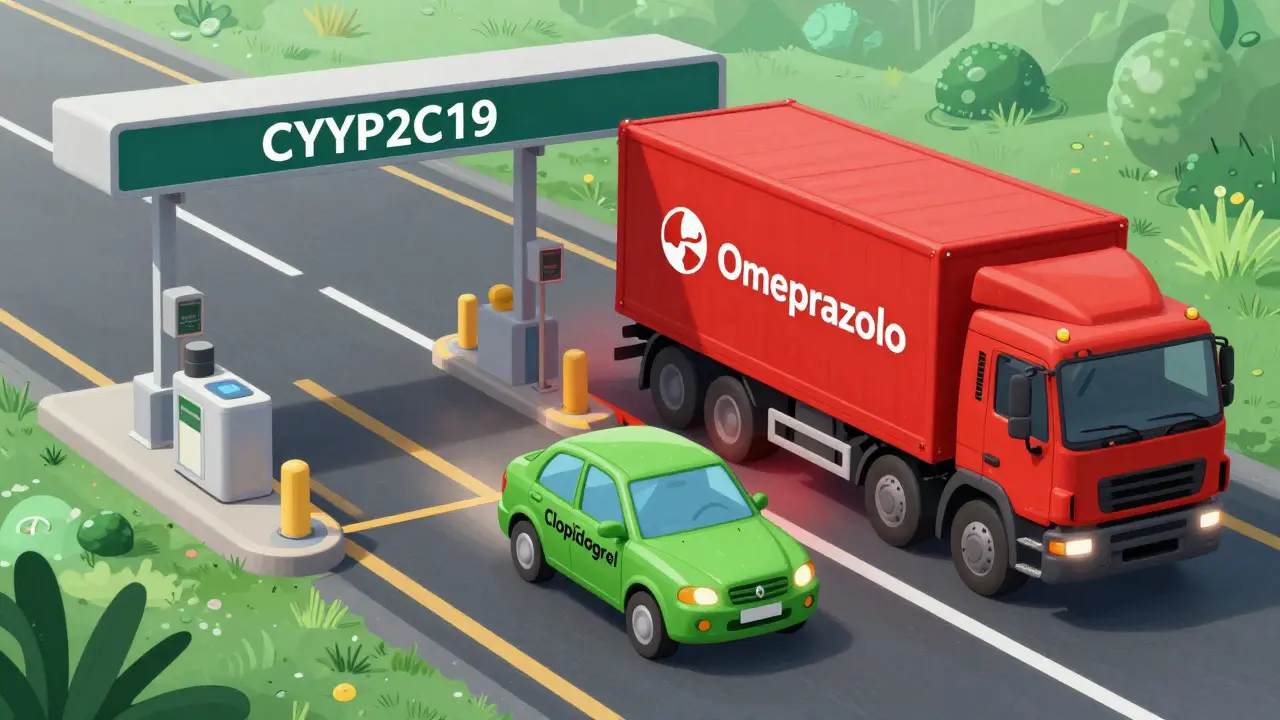
Here is where the conflict arises. Many proton pump inhibitors, particularly omeprazole and esomeprazole, also rely on CYP2C19 for their own metabolism. More importantly, they inhibit this enzyme. Think of CYP2C19 as a busy toll booth on a highway. Clopidogrel needs to pass through to become effective. If omeprazole shows up and blocks the lane, clopidogrel gets stuck in traffic. It never becomes active, and your platelets remain sticky, increasing the risk of a clot.
Research published in Circulation: Cardiovascular Interventions highlights this mechanism clearly. Studies have shown that when patients take omeprazole with clopidogrel, their platelet reactivity increases by approximately 25%. In plain English, your blood is more likely to clot than it should be. However, not all PPIs block this toll booth equally. This variation is the key to solving the dilemma.
Not All PPIs Are Created Equal
If you assume all acid reducers act the same way, you might make a mistake. The interaction strength varies wildly across different PPI brands. We can categorize them into "avoid" and "safe" groups based on how much they interfere with CYP2C19.
| PPI Medication | CYP2C19 Inhibition Strength | Clinical Recommendation |
|---|---|---|
| Omeprazole | Strong (Ki = 2-6 μM) | Avoid if possible |
| Esomeprazole | Moderate to Strong | Avoid if possible |
| Lansoprazole | Weak (Ki > 20 μM) | Generally Safe |
| Pantoprazole | Minimal | Preferred Option |
| Rabeprazole | Minimal | Preferred Option |
Omeprazole is the notorious offender here. A study documented in NIH archives showed that omeprazole reduced clopidogrel's antiplatelet effect by roughly 32.5%. In some individual cases, the inhibition was nearly complete, even when the doses were separated by 12 hours. This suggests the interference is metabolic and persistent, not just a matter of timing.
In contrast, pantoprazole and rabeprazole barely touch the CYP2C19 pathway. They use different routes for metabolism or bind so weakly to the enzyme that clopidogrel passes through unaffected. Meta-analyses show no increased cardiovascular risk when pantoprazole is paired with clopidogrel, making it the gold standard for patients who need both drugs.
The Clinical Debate: Lab Results vs. Real-World Outcomes
You might wonder why this issue hasn’t caused a massive crisis in hospitals worldwide. The reason lies in a major disagreement among experts regarding what actually matters: lab numbers or patient survival?
On one side, you have data showing clear pharmacodynamic changes. Dr. Deepak Bhatt’s analysis of the TRITON-TIMI 38 trial suggested that PPI use was associated with a 50% increased risk of major adverse cardiac events. This sounds alarming. It implies that blocking the enzyme leads directly to heart attacks.
On the other side, large-scale clinical trials tell a different story. The COGENT trial, often cited by the European Society of Cardiology, compared omeprazole against placebo in patients taking clopidogrel. Despite seeing higher platelet reactivity in the lab, there was no significant difference in actual cardiovascular events like heart attacks or strokes between the two groups. The hazard ratio was essentially neutral (HR 1.01).
Why the disconnect? Experts suggest redundancy. While CYP2C19 is the main activator of clopidogrel, other enzymes like CYP3A4 can do some of the heavy lifting too. If CYP2C19 is partially blocked, the body might compensate slightly, preventing total failure of the drug’s effect. Furthermore, clopidogrel has a relatively wide therapeutic window. You don’t need 100% activation to get benefit, whereas you do need significant acid suppression to prevent bleeding.
Who Really Needs a PPI with Clopidogrel?
Not everyone on clopidogrel needs a proton pump inhibitor. In fact, unnecessary PPI use carries its own risks, including potential links to kidney issues, bone fractures, and magnesium deficiency. So, how do you decide if the stomach protection is worth the potential drug interaction?
Guidelines from the National Institute for Health and Care Excellence (NICE) provide a clear checklist. You likely need a PPI if you have any of the following high-risk factors:
- Age over 75: Older adults have a significantly higher baseline risk of GI bleeding (Odds Ratio 3.12).
- History of ulcers: If you’ve had a gastroduodenal ulcer before, your risk skyrockets (OR 13.3).
- Concurrent NSAID use: Taking ibuprofen, naproxen, or aspirin alongside clopidogrel dramatically increases gastric irritation (OR 4.3).
- H. pylori infection: This bacteria damages the stomach lining and requires eradication therapy, often involving acid suppression.
If none of these apply to you, ask your doctor if you can skip the PPI altogether. If you do need one, the goal is to minimize GI bleeding-which PPIs reduce by about 69% in dual antiplatelet therapy patients-without compromising your heart health.

Practical Steps for Patients and Prescribers
So, what should you do if you are currently prescribed both? First, don’t panic. Millions of people take these combinations safely every day. But proactive management is smarter than reactive worry.
- Check your specific PPI. Look at your prescription bottle. Is it omeprazole or esomeprazole? If yes, schedule a chat with your pharmacist or doctor. Ask if switching to pantoprazole or rabeprazole is appropriate for you.
- Don’t adjust timing yourself. You might read online that taking the drugs 12 hours apart helps. As noted in NIH studies, this does not fully resolve the interaction with omeprazole because of the enzyme's irreversible binding nature. Switching the drug is more effective than splitting the dose.
- Consider alternative antiplatelets. Newer guidelines from the European Society of Cardiology now recommend ticagrelor as a first-line option for many acute coronary syndrome cases. Ticagrelor does not require CYP2C19 activation, meaning it has zero interaction with PPIs. If you are starting new therapy, ask if this is an option for you.
- Monitor for symptoms. Watch for signs of either extreme. Black, tarry stools indicate GI bleeding. Chest pain or unexplained shortness of breath could signal a clot. Report these immediately.
The landscape is shifting. Emerging alternatives like vonoprazan, a potassium-competitive acid blocker, are entering phase III trials. Vonoprazan works differently and has minimal impact on CYP2C19, potentially offering a future solution that combines strong acid suppression with perfect compatibility for antiplatelet users.
Frequently Asked Questions
Can I take Pantoprazole with Clopidogrel?
Yes, Pantoprazole is widely considered the safest PPI to take with Clopidogrel. It has minimal inhibition of the CYP2C19 enzyme, meaning it does not significantly reduce the antiplatelet effects of Clopidogrel. Major health organizations, including the NHS and FDA, recognize this combination as safe for patients requiring gastrointestinal protection.
Why is Omeprazole bad with Clopidogrel?
Omeprazole strongly inhibits the CYP2C19 enzyme in the liver. Since Clopidogrel needs this enzyme to convert into its active form, Omeprazole effectively blocks the activation process. This can lead to higher platelet reactivity, meaning your blood may clot more easily than intended, potentially reducing the protective benefits of the heart medication.
Does separating the doses by 12 hours fix the interaction?
For Omeprazole, separating doses by 12 hours provides little to no benefit. Studies show that the inhibition of CYP2C19 by Omeprazole is potent and persistent, often lasting longer than the time gap between doses. Switching to a non-interacting PPI like Pantoprazole or Rabeprazole is a more reliable strategy than adjusting timing.
Is Esomeprazole safer than Omeprazole?
Esomeprazole is the S-isomer of Omeprazole and shares similar metabolic pathways. It also inhibits CYP2C19 significantly. Therefore, it is generally grouped with Omeprazole as a PPI to avoid or use with caution when taking Clopidogrel. Pantoprazole remains the preferred alternative.
What are the symptoms of reduced Clopidogrel effectiveness?
Reduced effectiveness might not cause immediate obvious symptoms but increases the long-term risk of thrombotic events. Warning signs include chest pain, pressure, shortness of breath, or sudden neurological changes like slurred speech or weakness, which could indicate a heart attack or stroke due to a new clot forming.
Are there non-PPI alternatives for stomach protection?
H2 blockers like Famotidine are an alternative. They raise stomach pH less aggressively than PPIs but have negligible interaction with CYP2C19. However, for high-risk patients (e.g., those with prior ulcers), PPIs are still more effective at preventing bleeding. Vonoprazan is another emerging non-PPI option currently in advanced clinical trials.