
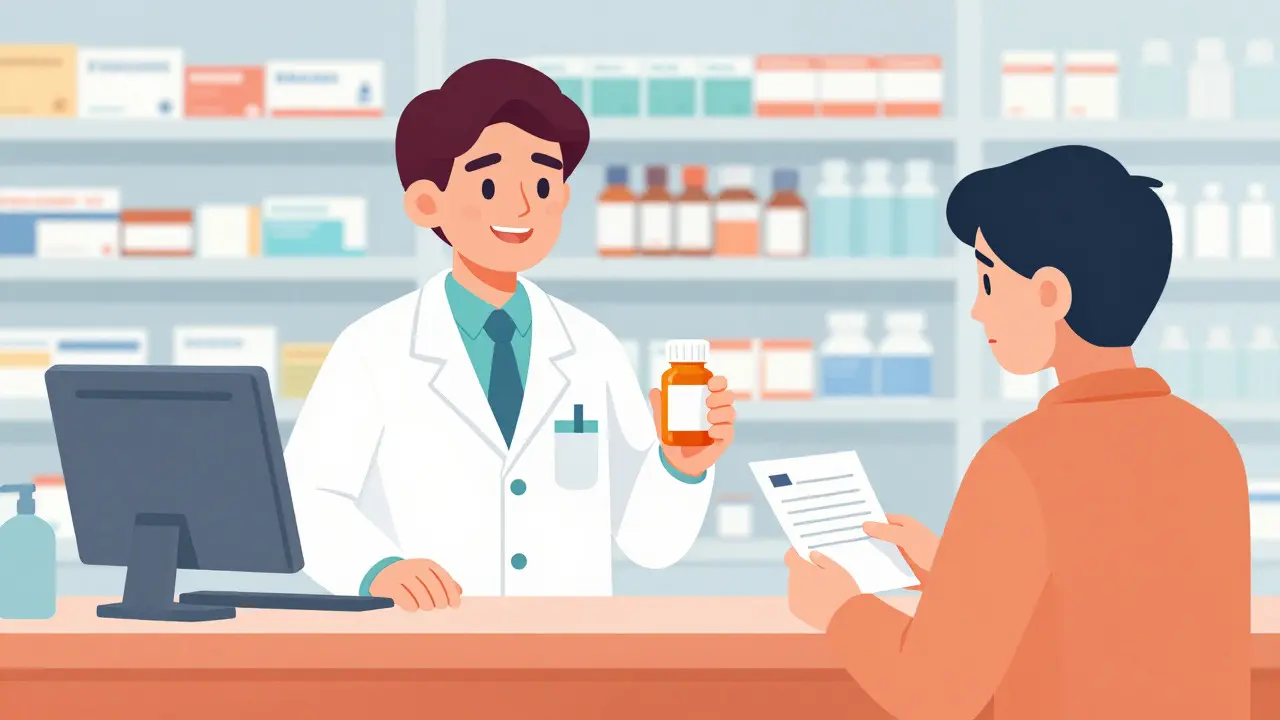
Picture this: A patient walks up to the counter with a prescription for a brand-name drug they’ve been taking for years. You pull out the generic equivalent. It costs significantly less, meets all federal standards, and contains the same active ingredient. But instead of relief, you get hesitation. The patient looks worried. They ask if it’s really the same. They mention hearing stories about side effects or different results. This is the daily reality for many pharmacists navigating generic substitution.
Generic substitution isn’t just a billing code change; it’s a complex interaction involving clinical judgment, regulatory knowledge, and delicate patient communication. While the goal is clear-reduce costs without compromising care-the path there is rarely smooth. Pharmacists sit at the intersection of these pressures, tasked with ensuring safety while managing skepticism from patients who often equate lower price with lower quality.
The Foundation of Generic Substitution
To understand why concerns arise, we first need to look at what generic substitution actually is. At its core, it is the practice of dispensing a medication that is therapeutically equivalent to the prescribed brand-name product. This system was formalized in the United States by the Drug Price Competition and Patent Term Restoration Act of 1984, commonly known as the Hatch-Waxman Act. This legislation created the Abbreviated New Drug Application (ANDA) pathway, allowing manufacturers to prove their drugs are bioequivalent to existing brand names without repeating massive, costly clinical trials.
The Food and Drug Administration (FDA) requires that generic drugs demonstrate bioequivalence within a specific range. Specifically, the generic must show that its pharmacokinetic parameters fall between 80% and 125% of the reference brand product. In practical terms, this means the body absorbs the generic drug at a rate and extent that is statistically indistinguishable from the brand name for the vast majority of medications. Studies evaluated by the FDA have shown an average difference in in vivo absorption of only about 3.5%. For most drugs, this margin is clinically irrelevant.
| Attribute | Brand-Name Drug | Generic Drug |
|---|---|---|
| Active Ingredient | Unique formulation developed by innovator | Identical chemical structure |
| Dosage Form & Strength | Specific to product | Must match brand exactly |
| Bioavailability | Reference standard | 80-125% of brand (bioequivalent) |
| Inactive Ingredients | Proprietary fillers/dyes | May differ (color, shape, size) |
| Cost | Higher (R&D recovery) | Lower (competition-driven) |
Despite these strict scientific standards, the perception gap remains wide. Patients see different packaging, different pill colors, and sometimes different shapes. These visual cues trigger psychological responses that override statistical data. As a pharmacist, your job is to bridge that gap between the hard science of bioequivalence and the human experience of taking medication.
Clinical Concerns: When Equivalence Isn't Enough
Not all medications are created equal when it comes to substitution flexibility. The biggest source of professional anxiety for pharmacists involves Narrow Therapeutic Index (NTI) drugs. NTI medications have a very small window between the dose that provides therapeutic benefit and the dose that causes toxicity. Examples include warfarin, levothyroxine, phenytoin, and lithium.
For these drugs, even the small variations allowed within the 80-125% bioequivalence range can lead to significant clinical consequences. Switching a stable patient on an anti-epileptic drug like phenytoin to a different generic manufacturer might alter blood levels enough to trigger seizures or increase side effects. This creates a legitimate clinical dilemma. While the FDA considers these generics interchangeable, many pharmacists hesitate. They worry that the potential harm to a vulnerable patient outweighs the cost savings for the insurance provider or the healthcare system.
This concern extends to biosimilars as well. Unlike traditional small-molecule generics, biosimilars are large, complex proteins derived from living cells. Minor structural variations can occur during manufacturing. Because of this complexity, the regulatory pathway for biosimilars is more rigorous, requiring clinical studies to demonstrate similarity rather than just bioequivalence. Pharmacists often feel less confident substituting biosimilars compared to traditional generics because the long-term data is still accumulating, and switching between different biosimilar products or back to the originator biologic can be complicated.

The Patient Factor: Trust and Perception
If clinical risks are the technical hurdle, patient perception is the emotional one. Research consistently shows that patient acceptance of generic substitution varies wildly based on demographics, condition type, and prior experiences. A systematic review published in the National Center for Biotechnology Information (PMC4519583) highlighted that while 96% of eligible items were recommended for substitution by pharmacists, actual patient acceptance lagged behind.
Why do patients resist? Several factors come into play:
- Visual Discrepancies: When a round blue pill becomes an oval white tablet, patients assume the medicine has changed. This confusion can lead to suboptimal drug use, missed doses, or accidental double-dosing if patients don’t recognize the new generic as their medication.
- Mistrust of Industry: Many patients believe that pharmaceutical companies hide negative information. They view generics as “cheap knockoffs” produced by foreign manufacturers with lower quality control standards. This mistrust is exacerbated by a lack of transparency in how generic approvals work.
- Prior Negative Experiences: Approximately one-third of patients report having had a negative experience with a generic substitution. Even if the issue was unrelated to the drug itself (e.g., timing of meals, stress), the brain links the adverse event to the generic switch. This anecdotal evidence carries more weight than statistical averages in the patient’s mind.
- Lack of Physician Communication: Surveys indicate that 64.4% of patients have not received information about substitution possibilities from their physicians. When the doctor doesn’t mention it, the patient assumes the pharmacist is doing it solely to save money, not to help them.
The impact of this resistance is real. In Australia, pharmacists reported spending substantial time instructing “resistant customers,” particularly those with polypharmacy, mental illness, or dementia. Half of these patients requested to speak with their physician before accepting the substitution, creating workflow bottlenecks and delaying care. For chronic conditions, acceptance rates drop to around 72%, compared to 82% for acute issues. This suggests that patients are more willing to take risks with short-term treatments but demand consistency for long-term health management.
Educational Burdens on Pharmacists
One of the most underappreciated aspects of generic substitution is the educational labor it demands from pharmacists. You are expected to be a scientist, a counselor, and a negotiator simultaneously. A survey in the Journal of Managed Care & Specialty Pharmacy (JMCP) revealed a stark disconnect: while 79.5% of pharmacy customers were told about substitution, only 52.0% received information about price differences, and a mere 38.5% were informed about their option to decline.
This leaves pharmacists filling a massive information void. You must explain bioequivalence in plain language, address fears about inactive ingredients, and reassure patients about efficacy-all while standing in line behind five other people waiting for their prescriptions. The cognitive load is high. If you spend too much time explaining, throughput drops. If you spend too little, adherence suffers.
Furthermore, pharmacists often face frustration when their expertise is questioned. Both patients and some physicians remain skeptical about therapeutic equivalence despite overwhelming scientific evidence. An Italian study noted similar frustrations among pharmacists regarding patient disbelief. This erosion of professional authority can be demoralizing. You know the data supports the switch, but you have to manage emotions that defy logic.

Strategies for Effective Substitution Management
So, how do you navigate these challenges effectively? Successful pharmacists develop specific strategies to streamline the process while maintaining trust.
- Proactive Communication: Don’t wait for the patient to ask. Briefly mention the substitution at the point of sale. “I’m dispensing the generic version today. It works the same way but saves you $X.” Simple, direct, and value-focused.
- Address Visual Changes: Acknowledge that the pill looks different. “The color and shape may vary, but the active ingredient is identical. Here’s a photo of both so you can recognize them.” Providing a visual aid reduces anxiety significantly.
- Leverage Physician Authority: If a patient is resistant, suggest they call their doctor. Often, a quick note from the prescriber confirming the switch is safe resolves the issue. Encourage physicians to discuss generics during consultations to build buy-in early.
- Know Your Exceptions: Be vigilant with NTI drugs. Have a clear protocol for when to keep patients on a specific manufacturer. Document any reasons for non-substitution clearly in the patient record to ensure continuity of care across shifts.
- Educate on Inactive Ingredients: Most concerns about allergies or sensitivities relate to fillers, dyes, or binders. Check the package insert for inactive ingredients if a patient reports issues. Sometimes, switching to a different generic manufacturer solves the problem without reverting to the expensive brand name.
State laws also play a role. In the U.S., regulations vary by state regarding mandatory substitution and patient consent requirements. Familiarize yourself with local statutes. Some states require explicit patient opt-out mechanisms, while others presume consent unless marked otherwise on the prescription. Understanding these legal boundaries protects you from liability and empowers you to advocate for your patients’ rights.
The Future of Generic Substitution
As healthcare systems continue to grapple with rising costs, generic substitution will remain a cornerstone of economic efficiency. However, the landscape is evolving. The rise of biosimilars introduces new complexities that require updated guidelines and greater pharmacist involvement. Additionally, digital health tools offer new opportunities. Apps that allow patients to track their medications and receive automated alerts about substitutions could reduce confusion and improve adherence.
Ultimately, the success of generic substitution depends on collaboration. Physicians need to initiate the conversation. Pharmacists need to execute it with empathy and expertise. And patients need to be educated partners in their own care. By addressing concerns head-on, acknowledging valid clinical exceptions, and fostering open dialogue, pharmacists can transform a source of friction into a demonstration of professional value.
What is the FDA's stance on generic drug equivalence?
The FDA requires generic drugs to be bioequivalent to brand-name drugs, meaning they must deliver the same amount of active ingredient into a patient's bloodstream in the same amount of time. The acceptable range for pharmacokinetic parameters is 80% to 125% of the reference product. The FDA has reviewed thousands of studies showing an average difference in absorption of only 3.5%, which is considered clinically insignificant for most medications.
When should pharmacists avoid generic substitution?
Pharmacists should exercise caution or avoid substitution for Narrow Therapeutic Index (NTI) drugs such as warfarin, levothyroxine, phenytoin, and lithium. These medications have a small margin between effective and toxic doses, so even minor variations in bioavailability can lead to adverse outcomes. Additionally, if a patient has a documented allergy to an inactive ingredient in the generic formulation, substitution should be avoided.
Why do patients often distrust generic medications?
Patient distrust often stems from visual differences in pill appearance (color, shape, size), misconceptions that lower price equals lower quality, and previous negative experiences that may have been coincidental. Lack of communication from physicians about the substitution process also contributes to anxiety, leading patients to believe the decision is purely financial rather than clinical.
How does generic substitution impact patient adherence?
Poorly managed substitution can negatively impact adherence. Confusion over different-looking pills can lead to missed doses or double-dosing. However, when patients are properly educated and reassured about equivalence, adherence typically improves due to reduced out-of-pocket costs. Studies show acceptance rates are higher for acute conditions (82%) than chronic diseases (72%), indicating that long-term consistency is crucial for patient compliance.
What is the difference between generics and biosimilars?
Generics are small-molecule copies of brand-name drugs with identical active ingredients. Biosimilars are biological products highly similar to an approved reference biologic. Because biologics are large, complex molecules made from living cells, minor structural variations can occur. Therefore, biosimilars require more extensive clinical testing to demonstrate similarity, and switching between different biosimilar manufacturers may carry slightly higher risks than switching small-molecule generics.