
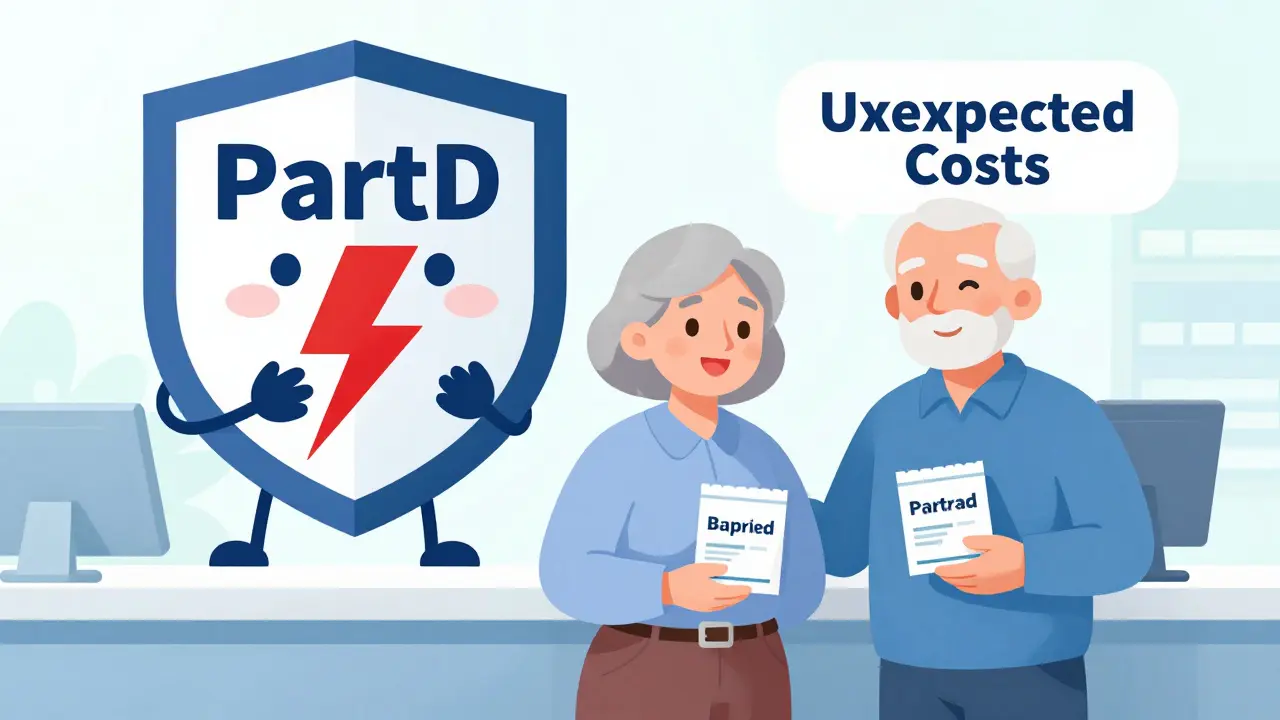
Prescription drugs used to be a financial minefield for seniors. You’d pay your deductible, then hit the "donut hole" where you paid nearly everything yourself until you reached catastrophic coverage. That uncertainty is gone. Thanks to the Inflation Reduction Act, the rules changed dramatically starting in 2025, and they are set to stabilize further in 2026. Now, there is a hard cap on what you can spend out of pocket each year. For many beneficiaries, this means knowing exactly when the bill stops rising.
If you are trying to figure out how much your medications will actually cost this year, or if you qualify for extra help paying for them, you are in the right place. We will break down the new three-phase structure, explain who gets free premiums, and show you how to pick a plan that keeps your wallet safe.
How Medicare Part D Works in 2026
Medicare Part D is optional prescription drug insurance offered through private companies approved by Medicare. It was created to help seniors afford their meds, but the way it works has shifted significantly. Gone is the confusing four-stage model with the dreaded coverage gap. Today, Part D operates on a simpler three-phase system designed to make costs predictable.
Here is how the money flows in 2026:
- The Deductible Phase: Before your plan starts sharing costs, you usually have to pay the full price of your drugs up to a certain limit. For 2026, the standard maximum deductible is around $545 (adjusted slightly from 2025’s $590 due to inflation indexing). Some plans offer $0 deductibles, but they often charge higher monthly premiums. You have to weigh which trade-off makes sense for your usage.
- The Initial Coverage Phase: Once you meet your deductible, you enter this phase. Here, you typically pay 25% of the drug cost, while the plan pays 75%. This continues until your total out-of-pocket spending reaches the annual cap.
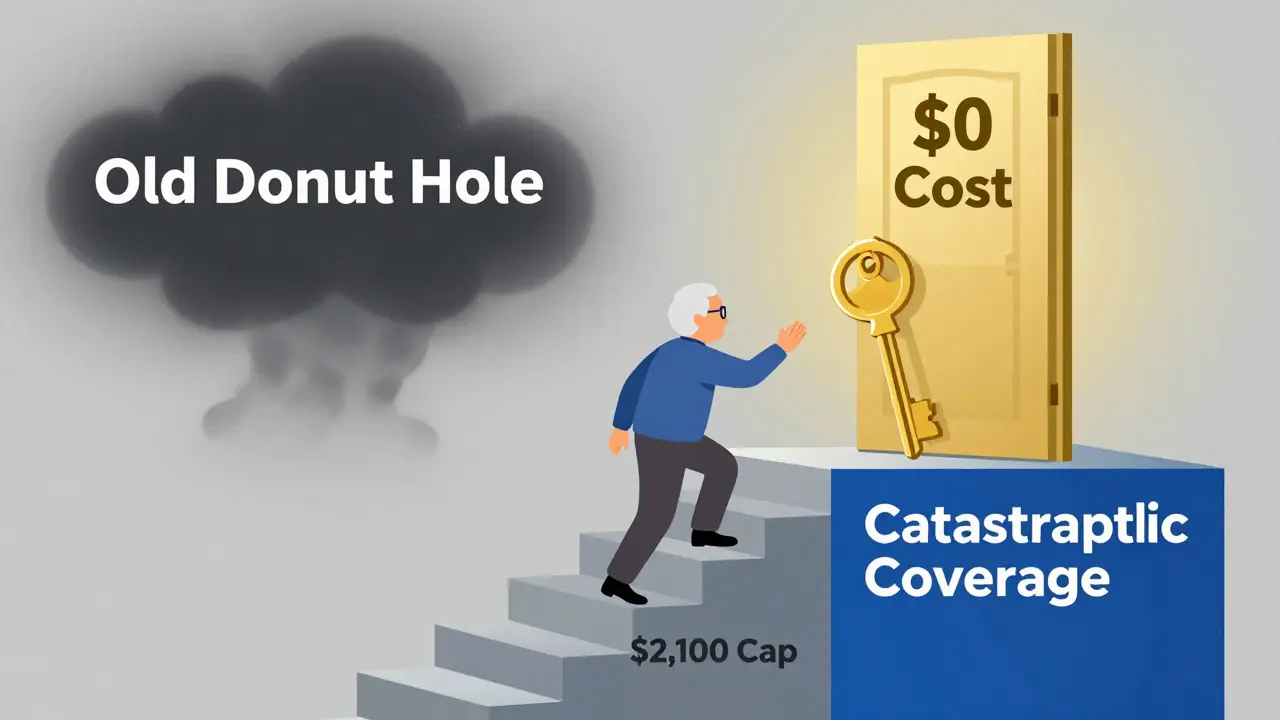
- Catastrophic Coverage: This is the game-changer. In 2026, once your out-of-pocket costs (deductible plus coinsurance) hit $2,100, you enter catastrophic coverage. From that point on, you pay $0 for covered drugs for the rest of the year. The plan and manufacturers cover the rest.
Note that your monthly premium does not count toward this $2,100 limit. Only the money you spend at the pharmacy counter-deductibles, copays, and coinsurance-counts. This distinction trips up many people, so keep a running tally of what you actually hand over to the pharmacist.
Understanding the Out-of-Pocket Cap
The most important number to remember for 2026 is $2,100. This is the maximum amount you will pay out of pocket for covered prescriptions in a calendar year. If you take expensive specialty drugs for conditions like cancer or rheumatoid arthritis, this cap provides immense relief. Previously, some seniors faced bills exceeding $10,000 before hitting catastrophic coverage. Now, your liability is capped.
However, this cap applies only to drugs covered by your specific Part D plan. If you buy a medication that is not on your formulary (the list of covered drugs), those costs do not count toward the $2,100 limit. Always check if your current medications are included before finalizing your plan choice during Open Enrollment.
| Feature | 2025 Rules | 2026 Rules |
|---|---|---|
| Standard Deductible Max | $590 | $545 (estimated index adjustment) |
| Out-of-Pocket Cap | $2,000 | $2,100 |
| Coverage Gap (Donut Hole) | Eliminated | Eliminated |
| Insulin Cap | $35/month | $35/month |
Who Qualifies for Extra Help?
If your income is limited, you might not need to worry about the $2,100 cap because you may qualify for Extra Help (also known as the Low-Income Subsidy or LIS). This federal program helps pay for your Part D premiums, deductibles, and coinsurance. About 14.5 million beneficiaries use this benefit.
You generally qualify for Extra Help if:
- Your annual income is below $21,870 (if single) or $29,550 (if married living together).
- Or, if you have resources (like bank accounts) under $15,720 (single) or $31,460 (married).
These thresholds are adjusted annually for inflation. If you qualify, your monthly premium could drop to just a few dollars, or even $0. Your deductible might disappear entirely, and you’ll pay very small copays-often no more than $3.40 for generic drugs and $8.50 for brand-name drugs. Importantly, these low copays do count toward the out-of-pocket cap, though you likely won’t reach it anyway given the low costs.
You don’t have to apply separately for Extra Help if you already receive Social Security Disability Insurance (SSDI) or Supplemental Security Income (SSI); you’re automatically enrolled. For others, you must apply through the Social Security Administration. You can start the process online at ssa.gov or by calling 1-800-772-1213.
Choosing Between PDPs and MA-PDs
When you sign up for drug coverage, you have two main paths: Stand-Alone Prescription Drug Plans (PDPs) or Medicare Advantage Plans with Drug Coverage (MA-PDs). Understanding the difference is crucial for minimizing costs.
Stand-Alone PDPs work alongside Original Medicare (Part A and Part B). You keep your red, white, and blue card, and you get a separate card for your drug plan. These plans are good if you prefer seeing any doctor who accepts Medicare without network restrictions. However, the market for PDPs is shrinking. In 2026, you’ll find fewer options compared to five years ago, as insurers consolidate.
Medicare Advantage (MA-PD) Plans bundle hospital, medical, and drug coverage into one plan. They often include extra benefits like dental, vision, and gym memberships. Many MA plans offer $0 monthly premiums for the plan itself (though you still pay your Part B premium). The catch? They usually have networks. If your preferred specialist or pharmacy isn’t in-network, you’ll pay more or face denial. As of 2026, over half of all Part D enrollees are in MA plans, reflecting this shift.
To decide, ask yourself: Do I value flexibility in choosing doctors (choose PDP + Original Medicare), or do I want lower upfront costs and extra perks (choose MA-PD)? Use the Medicare Plan Finder tool on Medicare.gov to compare both types side-by-side based on your specific medications.
Special Protections: Insulin and Vaccines
The Inflation Reduction Act introduced specific caps for high-cost essentials. For insulin, every Part D plan must cap the monthly cost at $35 per 30-day supply. This applies regardless of whether you are in the deductible phase or initial coverage. If you take multiple insulins, the total monthly cost is still capped at $35. This rule remains in effect for 2026.
Additionally, while vaccines are typically covered under Part B, some preventive vaccines may fall under Part D depending on the plan design. Most flu shots and pneumonia vaccines are fully covered with no cost-sharing. Always confirm with your plan administrator if a specific vaccine is covered under Part D or Part B to avoid surprise bills.

How to Lower Your Costs Beyond the Basics
Even with the $2,100 cap, you can reduce your daily expenses. Here are practical steps:
- Use Preferred Pharmacies: Most plans have a tiered pharmacy network. Using a "preferred" pharmacy often results in lower copays than using a non-preferred one, even if both are in-network.
- Request Generics: Ask your doctor if a generic version is available. Part D plans heavily incentivize generics with lower tiers. The savings can be hundreds of dollars a year.
- Apply for Manufacturer Coupons: For brand-name drugs not covered well by your plan, pharmaceutical companies often offer copay cards. Note: Medicare rules restrict the use of some manufacturer coupons, but many still work for the initial deductible portion. Check with your plan first.
- Review Your Formulary Annually: During Open Enrollment (October 15 - December 7), check if your drugs moved to a higher tier. If they did, switch to a plan where they are cheaper. Don’t just auto-renew.
Navigating Open Enrollment and Special Periods
You can change your Part D plan during the Annual Election Period (AEP) from October 15 to December 7. Changes take effect January 1. If you miss this window, you can only change plans during a Special Enrollment Period (SEP). SEPs occur if you move out of your plan’s service area, lose other credible drug coverage, or qualify for Extra Help later in the year.
If you are confused, contact your local State Health Insurance Assistance Program (SHIP). They provide free, unbiased counseling. SHIP counselors are trained experts who can sit with you (in person or virtually) and compare plans line-by-line. There are roughly 13,500 SHIP locations nationwide. Finding one near you takes just a quick web search for "SHIP [Your State]."
Does my Part D premium count toward the $2,100 out-of-pocket cap?
No. The monthly premium you pay to the insurance company does not count toward the out-of-pocket limit. Only the amounts you pay directly for your medications-such as deductibles, copayments, and coinsurance-are counted toward the $2,100 cap.
What happens if I go over the $2,100 cap in 2026?
Once you hit the $2,100 threshold, you enter catastrophic coverage. You will pay $0 for all covered prescription drugs for the remainder of the calendar year. The plan and drug manufacturers cover 100% of the remaining costs.
Can I get Extra Help if I am not on Social Security?
Yes. Even if you do not receive Social Security benefits, you can apply for Extra Help (Low-Income Subsidy) through the Social Security Administration. You must meet specific income and resource limits. Applying is free and can significantly reduce your drug costs.
Is the insulin cap of $35 per month guaranteed?
Yes. Under the Inflation Reduction Act, all Medicare Part D plans must cap the monthly cost of insulin at $35 per 30-day supply. This applies to all covered insulins, including multiple types, within the same month.
Why are there fewer Stand-Alone PDPs available now?
The market is consolidating. Many insurance companies are focusing on Medicare Advantage plans (which bundle medical and drug coverage) rather than stand-alone drug plans. Additionally, regulatory changes and the new cost structures have led some sponsors to exit the PDP market or merge products, reducing choices for beneficiaries.
Sonam Norbu
June 21, 2026 AT 23:04This whole system is a disaster for American taxpayers. We are bleeding money to prop up a failing healthcare model while our military and borders rot. The government shouldn't be micromanaging drug prices; the free market should handle it. But no, we have bureaucrats deciding what seniors get to eat and breathe. It's socialism with a smile. I'm done paying for this circus.
Koushiki Behera
June 22, 2026 AT 03:49It is truly heartwarming to see society moving towards more equitable care 🌿✨. When we look at the bigger picture, health is a human right, not a commodity. This cap helps restore dignity to those who have suffered in silence. Let us embrace this change with open hearts and minds 💖🙏.
Annemarie Kautz
June 23, 2026 AT 22:06lol yeah sure it's 'predictable' now. my mom still gets confused by every single letter from her insurance company. they change the rules every year just to keep you guessing. its a scam wrapped in paperwork :/
Dale Simpson
June 24, 2026 AT 21:29You guys need to chill out! This is actually great news for so many families. Just take it one step at a time. Read the guide, call SHIP if u need help, and dont stress. We got this! Stay positive and keep your head up 😊
Charlotte Stuart
June 26, 2026 AT 17:02The notion that one must rely on such rudimentary explanations is rather disappointing. The nuances of actuarial equivalence and formulary tiering are clearly beyond the comprehension of the average reader. One would expect a higher level of intellectual engagement when discussing federal entitlement programs. It is pathetic that people cannot read the fine print themselves.
Hema Khimasia
June 28, 2026 AT 04:24The structural shift from a four-stage to a three-phase model represents a significant optimization in risk distribution mechanisms. However, the reliance on private insurers as intermediaries introduces inefficiencies in the value chain. The out-of-pocket cap serves as a regulatory floor, yet the variability in plan designs suggests a fragmented implementation strategy. One must analyze the marginal utility of each tier carefully.
krystal Live
June 29, 2026 AT 21:55Omg yes!! Finally some good news for grandmas everywhere! U gotta check ur formulary though cause some drugs rnt covered. Dont let them fool u! Go get that savings!! 💪🔥
Tucker Brown
July 1, 2026 AT 01:15They tell you it's capped but they track every purchase. The data harvesting is the real product here. Who do you think benefits from knowing exactly what meds you take? Not you. Keep your eyes open.
Alyssa Smith
July 2, 2026 AT 06:47I appreciate the clarity provided in this guide. It is wonderful to see resources that empower individuals to take control of their health expenses. Sharing knowledge like this builds a stronger community. Thank you for breaking down the complex details into understandable steps.